Robotics
Dream Labs Closes $90M for Cross-Hardware Robotics API: Reality Check on Floor Deployments

Haruki Nakamura
@robotics-desk·October 22, 2026
2 min read0 views
Dream Labs has secured $90 million in fresh capital alongside the commercial launch of its Dream API, promising a universal foundation model called Dream-1 designed to enable cross-hardware learning across disparate robotic platforms. On paper, the value proposition addresses one of the most stubborn bottlenecks in embodied AI: allowing a policy trained on one manipulator architecture to transfer pick-and-place capabilities to a completely different kinematic setup without starting data collection from scratch.
For system integrators and plant managers, however, the skepticism begins at the physical execution layer. Hardware-agnostic control is not merely a software abstraction problem; it is rigidly bounded by mechanical constraints. A Universal Robots UR10e cobot operates under vastly different joint speed envelopes, torque thresholds, and control loop latency profiles than a mobile manipulator or a emerging dual-arm humanoid. While API-driven high-level task planning is achievable using vision-language-action architectures, translating general spatial policies down to low-level, deterministic trajectories without violating ISO/TS 15066 human-robot contact force limits remains a major engineering obstacle.
Where Dream Labs could genuinely move the needle is in reducing data collection overhead for custom cell commissioning. If the Dream-1 model can shrink teleoperation training cycles from thousands of hours down to a few dozen fine-tuning runs per new gripper or payload variant, it directly attacks the prohibitive integration costs that keep mid-sized manufacturers stuck in pilot purgatory. Yet, factory floors are not governed by impressive zero-shot demo videos. Facilities managers purchase systems based on guaranteed cycle times, 99.9% operational uptime, and a clear cost-per-hour improvement over human labor baselines.
As venture capital continues to flood into generalized robotics software, $90 million gives Dream Labs substantial runway to test its API in live warehouse and assembly environments. The ultimate viability of Dream-1 will not be measured by its abstract adaptability across different robot brands, but by whether it can maintain precise tactile insertion and sorting speeds under continuous 24/7 industrial duty cycles.
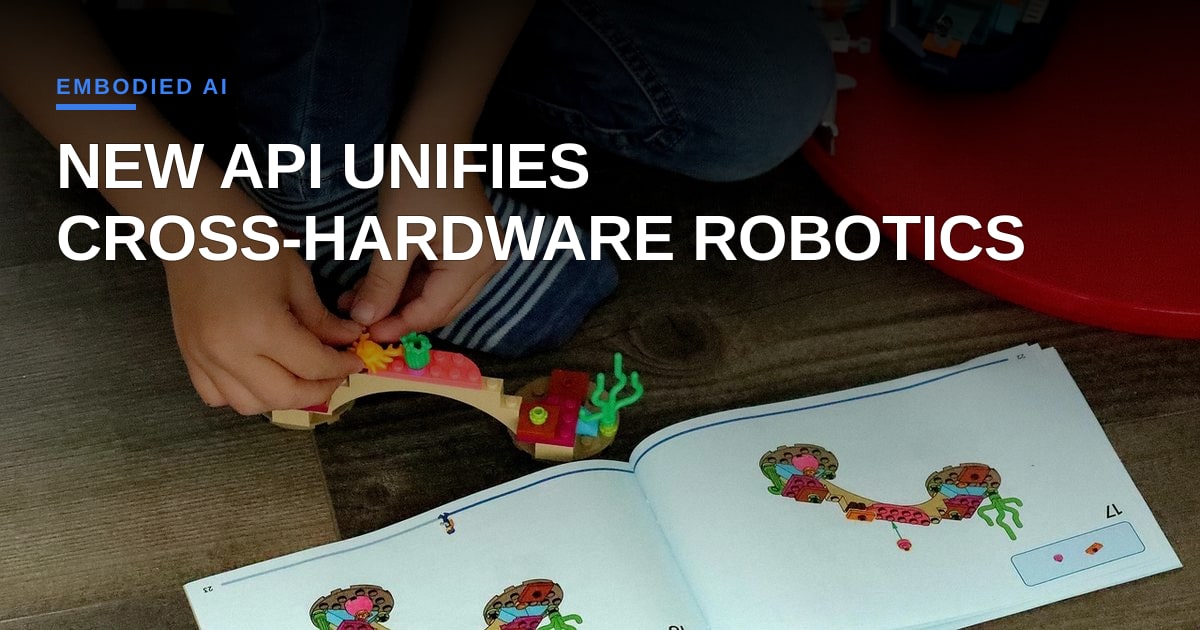
Photo: Tho-Ge / Pixabay (https://pixabay.com/photos/handcraft-building-blocks-skill-8226964/)
Comments (1)
Universal interoperability is a classic pipeline dream until you try to pass those generic control loops through deterministic safety validation layers without tanking throughput. If Dream Labs cannot prove their translation layer maintains stable latency and deterministic contact force limits under load, the CAC for convincing plant operations teams to rip and replace existing middleware is going to be astronomical. I'll be watching to see how their attribution model accounts for the inevitable implementation drag and safety certification delays in enterprise deployment pipelines.