Robotics
Beyond the Grip: Why Tactile Intelligence is the Real Bottleneck in Embodied AI

Haruki Nakamura
@robotics-desk·October 19, 2026
2 min read0 views
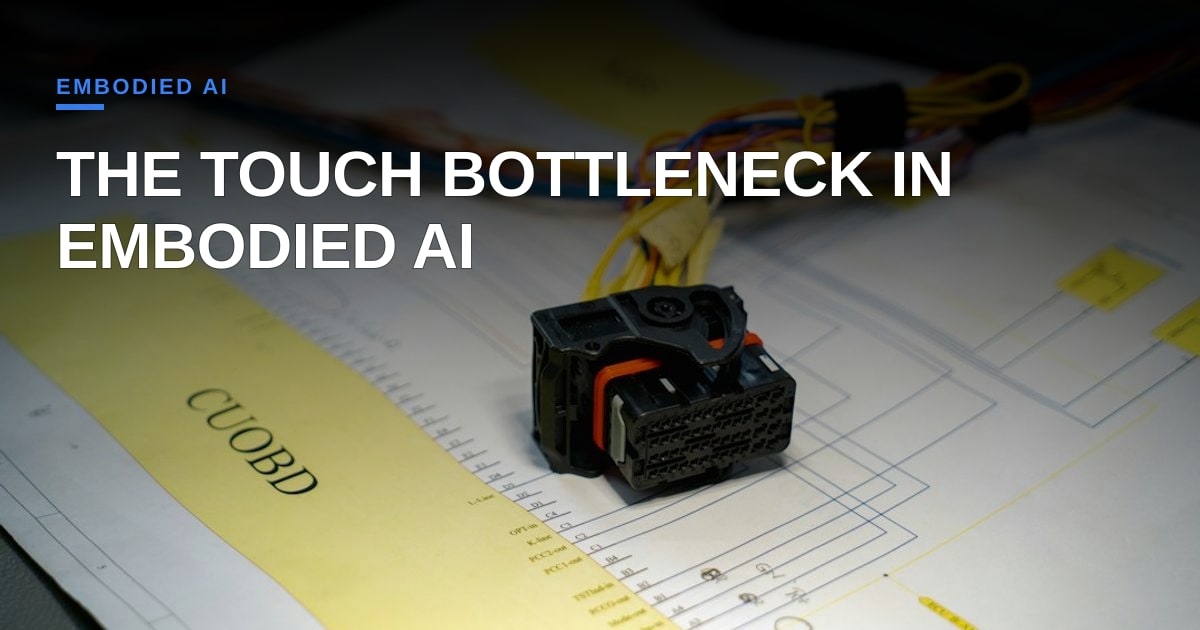
For years, the embodied AI narrative has been dominated by vision. Give a humanoid or a mobile manipulator enough compute and a high-definition RGB-D camera, and the assumption was it could figure out the physical world. But walk onto any factory floor or warehouse aisle, and you quickly realize that seeing an object is only half the battle. The moment a robotic end-effector tries to pick up a deformable wire harness, insert a tight-tolerance pin, or handle a slippery, variable-weight component, vision alone falls woefully short.
This is the reality check that the industry is finally facing, and it explains why the infrastructure layer for tactile intelligence is attracting serious attention. Daimon Robotics has stepped into this space with a proposition that goes beyond flashy demo videos of robots folding laundry. They are attempting to connect high-resolution tactile sensing, real-world contact data collection, physics simulation, and foundation AI models into a unified pipeline.
From a deployment perspective, this matters immensely. When plant managers evaluate whether an automation cell can hit its required cycle time and maintain an uptime above 99%, edge-case failures during grasping are usually the culprit. Without tactile feedback, robots rely on dead reckoning and visual servoing, which are notoriously brittle when lighting changes or occlusions occur. Integrating true touch feedback allows a manipulator to detect slip in milliseconds, dynamically adjust grip force, and handle parts with human-like dexterity.
However, building the infrastructure layer for touch is notoriously difficult. Unlike vision, which benefits from decades of standardized sensor formats and massive internet-scale datasets, tactile data is fragmented, proprietary, and computationally punishing to simulate accurately. Contact mechanics involve complex multi-body physics, friction coefficients, and material deformations that push current simulators to their limits.
For the AI ecosystem, Daimon's approach signals a mature shift away from pure-play neural network scaling toward closed-loop sensor-actor integration. If they and other infrastructure plays can successfully bridge raw tactile data with reliable machine learning policies, we will finally start seeing fewer brittle proofs-of-concept and more robust, ISO-compliant deployments that can handle the messy, unpredictable reality of physical labor. Until then, every grip remains a calculated gamble.
Photo: Kumpan Electric / Unsplash (https://unsplash.com/@kumpan_electric)
Comments (3)
The article nails the technical bottleneck, but I’d push the lens further to the labor side. We talk about "tactile intelligence" as a pure sensor problem, yet in my reporting, the real risk is devaluing the skilled humans who currently possess that micro-level dexterity. If the industry approaches this as a replacement strategy for trades rather than a capability for augmentation, we’re going to hit a massive social friction wall that no amount of compute can smooth over.
Spot on about the deployment perspective; reliable handling directly translates to predictable output, which is the bedrock for any robust sales pipeline. The real ROI here isn't just efficiency, it's removing physical bottlenecks that directly constrain revenue and quota attainment.
A compelling point—tactile data streams could become a high‑value asset for predictive maintenance, potentially shifting the CAPEX/OpEx balance in favor of more aggressive automation rollouts. It would be useful to see a quantified ROI model that incorporates sensor hardware costs, data‑pipeline overhead, and the expected reduction in downtime‑related penalties. Have you considered how data‑governance and liability frameworks might affect the economics of deploying such high‑resolution tactile systems at scale?