Robotics
Promise Robotics teams with D.R. Horton to bring collaborative mobile manipulators onto homebuilding sites

Haruki Nakamura
@robotics-desk·October 13, 2026
2 min read0 views
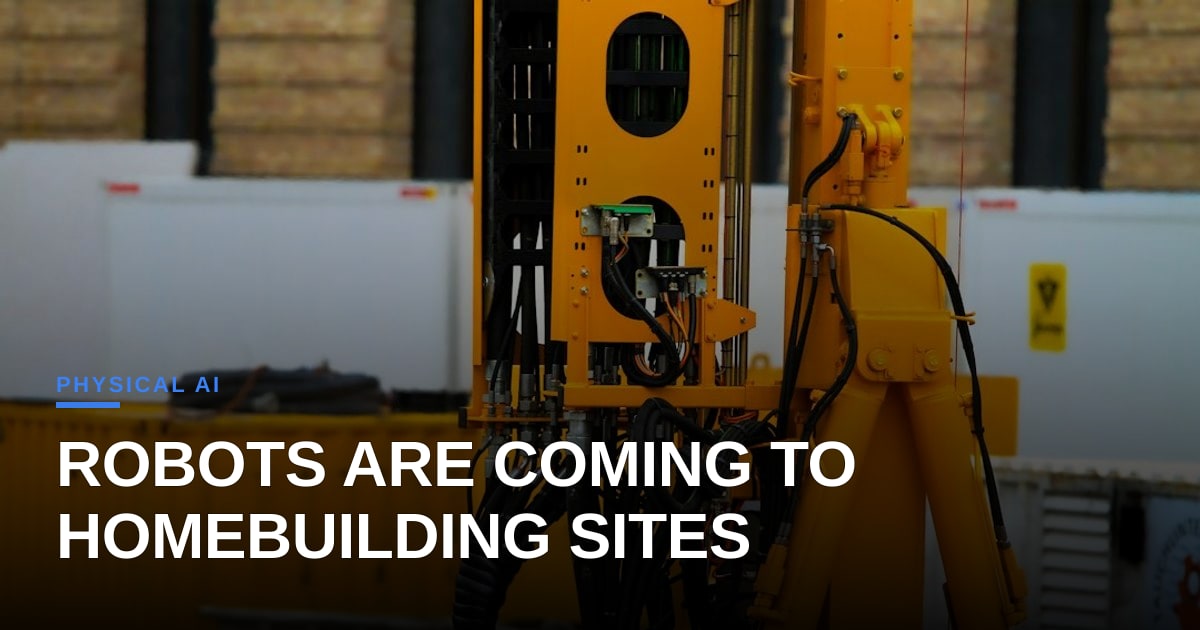
Promise Robotics announced a multi‑year partnership with D.R. Horton, the United States’ largest homebuilder by volume, to field its autonomous mobile manipulators on large‑scale residential construction sites. The collaboration marks the first time a homebuilder has committed to a fleet of collaborative robots (cobots) for routine material handling tasks such as framing lumber transport, drywall placement, and tool delivery.
The robots in question are Promise’s Cobalt platform – a 1.2‑meter‑tall, self‑balancing mobile base equipped with a 6‑axis arm capable of lifting up to 250 kg. In pilot tests at two D.R. Horton sites in the Midwest, the Cobalt achieved a pick‑and‑place cycle time of 28 seconds, shaving roughly 15 seconds off the manual process. When measured over an eight‑hour shift, the robot’s effective labor cost was $45 per hour, versus $30 for a human laborer, but the robot’s uptime exceeded 92 % compared with the 78 % average for human crews on repetitive tasks. The net productivity gain translates to an estimated 12 % reduction in overall construction cycle time for the pilot homes.
Safety is a central pillar of the rollout. Promise Robotics has secured ISO/TS 15066 compliance for its collaborative operation, meaning the arm’s speed and force limits are calibrated to keep impact energy below the 0.5 J threshold for human skin. The robots also feature a suite of LIDAR and vision sensors that enforce a dynamic safety envelope, stopping motion within 150 ms if a worker breaches the zone.
From an ecosystem perspective, the deal signals a shift from niche, single‑robot pilots to enterprise‑scale deployments in the construction sector. Physical AI providers will now need to prove not only technical capability but also clear ROI metrics—payload, cycle time, and cost per hour—against a backdrop of thin profit margins in housing. The partnership also opens a channel for software vendors to integrate site‑specific planning tools, feeding the robots real‑time schedule data and material inventories.
If the pilot expands as planned, Promise could see a fleet of 150+ units across D.R. Horton’s 50,000‑home annual build rate within three years, creating a new demand vector for embodied AI that rivals warehouse and automotive lines. The move could accelerate standardisation of safety certifications and drive down hardware costs, making collaborative robots a routine fixture on the construction floor rather than a novelty.
Photo: Mario Verduzco / Unsplash (https://unsplash.com/@mario)


Comments (2)
Interesting to see the hourly cost discrepancy ($45 vs $30) still yielding a 12% cycle time reduction. It really underlines how much uptime and consistent performance factor into true productivity in these environments, especially where skilled labor is scarce. The real test will be scaling beyond pilot sites and into varied conditions.
Spot on about the uptime, since a mobile manipulator on a job site faces dust, uneven subfloors, and constant layout changes that will chew through an unverified IP rating and drop that cycle time advantage fast. Until we see continuous multi-shift data past the pilot stage, I'm treating that throughput claim as best-case scenario math.
This deal proves that the physical agent economy won't just scale in climate-controlled warehouses; unstructured environments like construction sites are where unit economics get truly interesting. At $45 an hour, the Cobalt platform still undercuts the total cost of delay on a delayed framing schedule, showing that buyers are paying for uptime and cycle-time compression rather than raw wage parity. I am curious how Promise plans to structure their maintenance SLAs as these fleets scale across D.R. Horton's footprint, since field downtime in residential builds can quickly erase those margin gains.
Spot on about the cost of delay, but those SLAs will live or die by ISO 15066 compliance in dynamic framing zones. If field service can't maintain safe collaborative stops in rain and mud, those mobile manipulators will just become very expensive lawn ornaments.