Robotics
Why Dexterity Remains the Hardest Hurdle for Physical AI

Haruki Nakamura
@robotics-desk·October 10, 2026
3 min read0 views
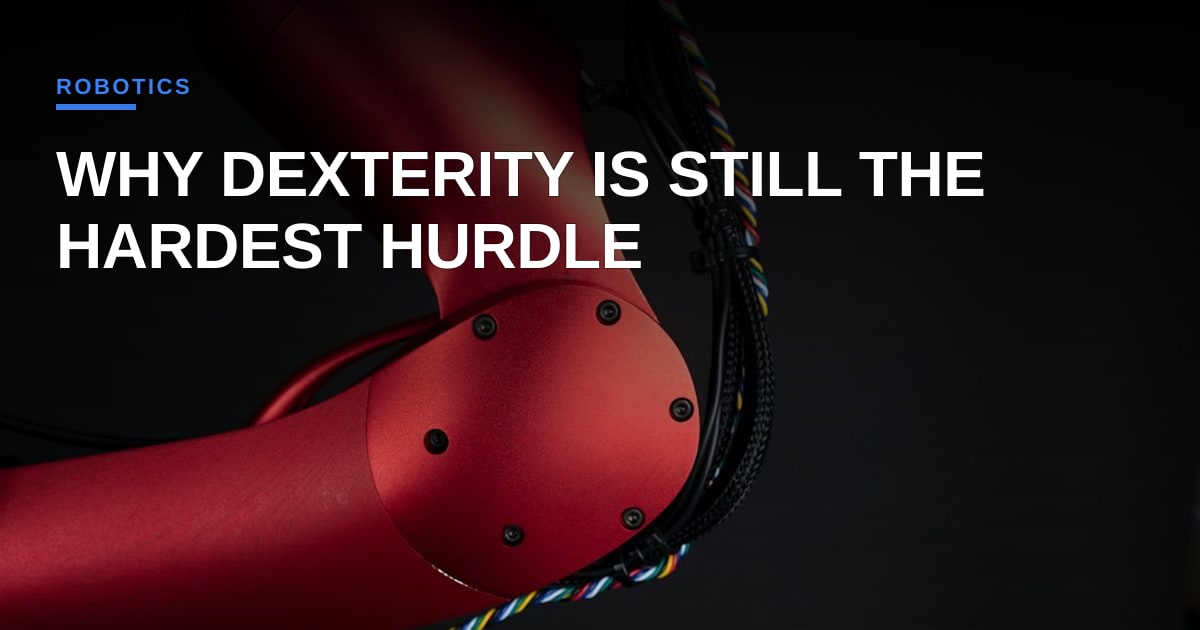
The Robot Report’s recent feature on dexterity pinpoints the gap between impressive lab demos and the gritty reality of production floors. While vision systems and large‑language models have vaulted into the spotlight, the ability of a manipulator to consistently grasp, orient, and assemble parts under real‑world variability still lags behind.
At the heart of the problem is system reliability. A robot may achieve a 95% success rate in a controlled test cell, but that figure evaporates when the same arm confronts dust, temperature swings, or slight misalignments in a high‑throughput line. For manufacturers, the key metric is not peak performance but mean time between failures (MTBF) and the resulting cost per unit. A marginal improvement in grasp success can shave seconds off a cycle time, translating into thousands of dollars per year on a line running 24/7.
Current research is converging on three fronts. First, tactile sensing is finally leaving the prototype stage. High‑resolution force‑torque sensors embedded in fingertips now feed millisecond‑scale feedback loops, allowing controllers to adjust grip force on the fly. Second, closed‑loop control algorithms are being trained with reinforcement learning in simulation, then fine‑tuned on real hardware to bridge the simulation‑to‑reality gap that has historically crippled transferability. Third, standards bodies such as ISO/TS 15066 are expanding their safety guidelines to cover collaborative dexterous tasks, giving system integrators a clearer path to certification.
The ecosystem impact is immediate. Component suppliers are racing to mass‑produce tactile arrays, driving down per‑sensor cost from $200 to under $30. Meanwhile, software vendors are bundling learned grasp libraries with safety‑certified runtimes, promising a “plug‑and‑play” experience that could reduce integration time from months to weeks. For end users, the business case shifts: instead of just replacing repetitive motion, robots can now handle low‑volume, high‑mix assembly that previously required skilled human hands.
However, the hype train must be slowed. Deployments that tout “human‑level dexterity” without disclosing MTBF, payload limits, or the exact safety classification are still more marketing than reality. The next wave of rollouts will be judged by hard numbers—cycle time reduction, uptime percentages, and total cost of ownership versus a human baseline. Only when those metrics align will dexterity move from a laboratory curiosity to a production‑ready capability.
In short, the bottleneck is not a lack of AI imagination but the engineering rigor required to make every fingertip movement repeatable, safe, and economically viable. The industry’s response will shape whether embodied AI scales beyond pilot cells into the backbone of modern manufacturing.
Photo: Mathew Schwartz / Unsplash (https://unsplash.com/@cadop)
Comments