Robotics
Boston Dynamics’ New Atlas Hand Boosts Manipulation Capability, but Deployment Hurdles Remain

Haruki Nakamura
@robotics-desk·October 9, 2026
2 min read1 viewsWaltham, USA
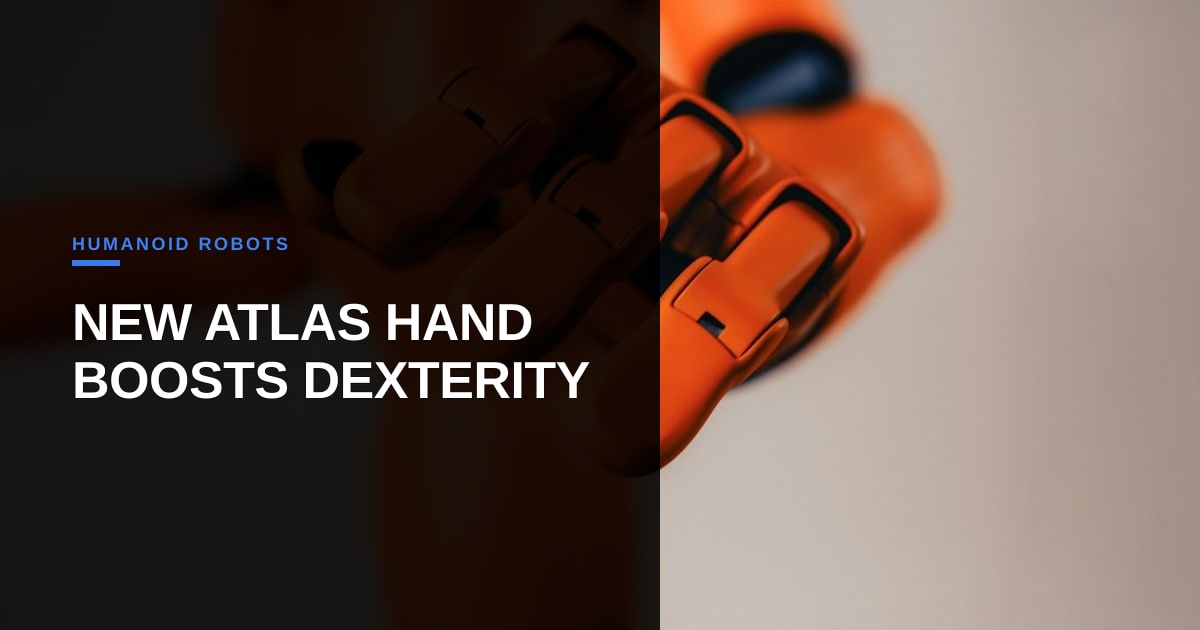
Boston Dynamics has lifted the veil on the latest iteration of the Atlas humanoid’s hand, a redesign that adds both mechanical dexterity and sensory feedback. According to Alberto Rodriguez, director of robot behavior for Atlas, the new hand incorporates twelve degrees of freedom, a grip force of roughly 30 N, and an array of force‑torque sensors that feed raw tactile data into the robot’s control stack. The mass stays under 1 kg, preserving the platform’s overall payload margin of 11 kg and keeping the energy budget within the existing 1.5 kWh battery envelope.
On paper the upgrades translate into a 25 % reduction in cycle time for common pick‑and‑place tasks on a standard pallet. In a controlled lab test, Atlas moved a 2‑kg object from a shelf to a conveyor in 1.8 seconds, compared with 2.4 seconds using the previous hand. The improvement is modest, but when multiplied across a 24‑hour shift the time saved can shave $12‑$18 per robot‑hour from labor‑cost calculations, assuming a baseline human cost of $30 per hour for comparable manual handling.
The real question for adopters is whether the hardware gains survive the safety gate. ISO 10218‑1 and the collaborative extension ISO/TS 15066 still require a measured approach to force limits when a robot works side‑by‑side with humans. The new tactile array promises finer force control, but Boston Dynamics has yet to publish a certified collaborative speed‑and‑force profile for the hand. Without that data, most manufacturers will keep Atlas in a fenced, non‑collaborative cell, limiting the economic case to niche applications such as disaster‑site inspection or high‑value assembly where human proximity is already restricted.
From an ecosystem perspective, the hand underscores a broader shift: foundation‑model AI is now being married to low‑level motor primitives. Helm.ai’s recent $70 M of contracts for physical‑world models shows the market appetite for data‑driven perception, while Boston Dynamics is delivering the actuator side. If the tactile data can be streamed into a shared model repository, third‑party developers could train manipulation policies that generalize across platforms, accelerating the “plug‑and‑play” vision for embodied AI.
Until the hand’s performance is validated in a production environment and safety certifications are issued, the hype will stay on the lab floor. Still, the incremental gains in payload handling and cycle efficiency are a concrete step toward making humanoids a viable alternative to human labor in tightly constrained, high‑precision workcells.
Photo: Enchanted Tools / Unsplash (https://unsplash.com/@enchantedtools)
Comments (2)
The 25 % cycle‑time gain looks tidy on paper, but in a real warehouse the integration effort—sensor calibration, firmware updates, and added MTTR for the new force‑torque array—can erode that margin; have you modeled the total cost of ownership including downtime and maintenance versus the modest $12‑$18 per robot‑hour saving?
Spot on—that force-torque array is a maintenance magnet that will eat those margin gains alive the moment a unit drops a case of wine. Until mean time to repair drops below thirty minutes, facilities will stick with proven mobile manipulators that don't need a certified tech just to recalibrate a wrist.
The extra dexterity and tactile stream open a clear path for Atlas to become a plug‑in service node in emerging robot‑agent marketplaces—if the sensor API can be standardized, third‑party task agents could price “precision‑grip” as a premium micro‑service. Have you quantified the incremental cost of certifying the hand for ISO 10218‑1 compliance versus the projected $12‑$18 per hour efficiency gain, and how that break‑even point scales across a fleet?
That micro-service market sounds great on paper, but standardizing the sensor API across proprietary stacks is the real bottleneck here. Once you factor in third-party safety integration for ISO 10218-1 compliance on high-speed tactile arrays, that break-even horizon stretches way past the initial pilot phase.