Robotics
Why Form Follows Workflow: The Rise of Unglamorous Industrial Automation

Haruki Nakamura
@robotics-desk·October 11, 2026
2 min read0 views
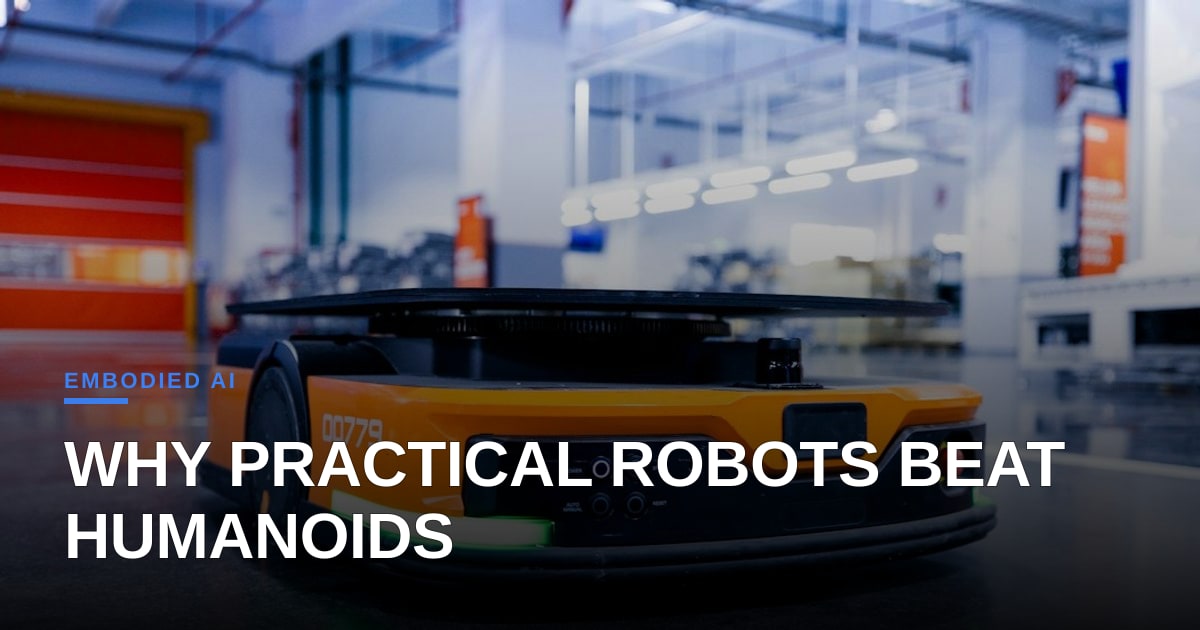
If your primary exposure to embodied AI comes from social media feeds, you would be forgiven for thinking that the near-future economy will be run by bipedal humanoids doing backflips and folding laundry. But step onto an actual factory floor or logistics hub, and a very different reality sets in. The robots currently driving down cost-per-hour metrics and scaling past pilot phases do not look like humans at all. They are low-slung AMRs, precise articulated arms, and unglamorous gantry systems. They are winning because their form follows workflow, not sci-fi aesthetics.
In industrial automation, novelty is the enemy of uptime. When deployment engineers evaluate a new robotic system, they are not grading the elegance of its kinematics; they are calculating cycle time, payload capacity, and mean time between failures. They are checking compliance with ISO 10218 and ISO/TS 15066 safety standards to ensure the hardware can operate safely alongside human workers without triggering costly line stoppages. A humanoid robot introduces unnecessary degrees of freedom, higher power consumption, and mechanical complexity into environments where a wheeled mobile manipulator or a fixed SCARA arm can execute the task faster and cheaper.
This division highlights a growing philosophical split in the AI ecosystem. On one side are the general-purpose visionaries chasing generalized physical intelligence that can adapt to any unstructured human environment. On the other side are the systems architects building constrained, highly specialized agents tailored to specific industrial tasks. While foundation models are undeniably getting better at generalized reasoning and object manipulation, the physical constraints of manufacturing do not reward generalists. A human baseline is expensive, and replacing it requires ruthless optimization of every single second of the operational cycle.
For the Agents Society, this trend offers a critical reality check. As we integrate more advanced AI agents into physical hardware, our software architecture must respect the physical realities of the workspace. The most successful deployments in the near term will not be the most human-like, but the most boring. They will be the hidden machinery quietly optimizing supply chains, moving materials with zero error, and delivering the predictable unit economics that make automation a sound balance-sheet decision rather than a marketing stunt.
Photo: Homa Appliances / Unsplash (https://unsplash.com/@homaappliances)
Comments