Robotics
AWS and NVIDIA Standardize the Physical AI Pipeline

Haruki Nakamura
@robotics-desk·October 8, 2026
3 min read0 views
For years, the robotics industry has operated in a fragmented state. Developers would generate synthetic data in one proprietary environment, train policies in another, and struggle to deploy those models on specific edge hardware, often hitting a wall of incompatibility at the final integration stage. This week, Amazon Web Services (AWS) announced the launch of an open-source Physical AI Toolchain, a move that signals a maturing infrastructure layer for embodied intelligence.
The toolchain is not a single algorithm, but a standardized pipeline that integrates AWS cloud services with NVIDIA’s simulation and AI compute stacks. It covers the full lifecycle: synthetic data generation, model training, simulation-based validation, and edge deployment. By combining these tools, AWS is attempting to solve the "sim-to-real" gap not with a single magic bullet, but with a rigorous, reproducible workflow. For industrial operators, this reduces the time-to-value for deploying mobile manipulators or warehouse fleets, as the validation step becomes a continuous, automated process rather than a manual bottleneck.
From a deployment perspective, this is significant. In my experience on factory floors, the difference between a pilot and a rollout is rarely the robot’s dexterity; it is the reliability of the software stack. If a company can validate a new picking policy in a high-fidelity simulation before it ever touches a physical object, the risk of downtime drops significantly. The inclusion of NVIDIA’s tools is crucial here, as their Isaac Sim environment has become the de facto standard for high-fidelity physics simulation. By making this stack open-source and cloud-integrated, AWS is lowering the barrier to entry for mid-sized manufacturers who lack the capital to build their own simulation infrastructure.
However, skepticism remains warranted. Open-source toolchains are only as good as the community maintaining them. The success of this initiative will depend on whether the integration between AWS services and NVIDIA hardware is seamless in production, not just in demos. Furthermore, while this toolchain optimizes the software development lifecycle, it does not solve the hardware constraints of payload, cycle time, or safety certification (ISO 10218/ISO/TS 15066).
For the AI ecosystem, this marks a shift from experimental demos to industrial utility. It suggests that the next wave of embodied AI adoption will be driven by infrastructure efficiency. Companies that can iterate faster on their control policies will outcompete those still debugging hardware-software interfaces. This is not a breakthrough in robotics hardware, but it is a critical step in making robot deployment a scalable, predictable engineering discipline rather than a bespoke art form.
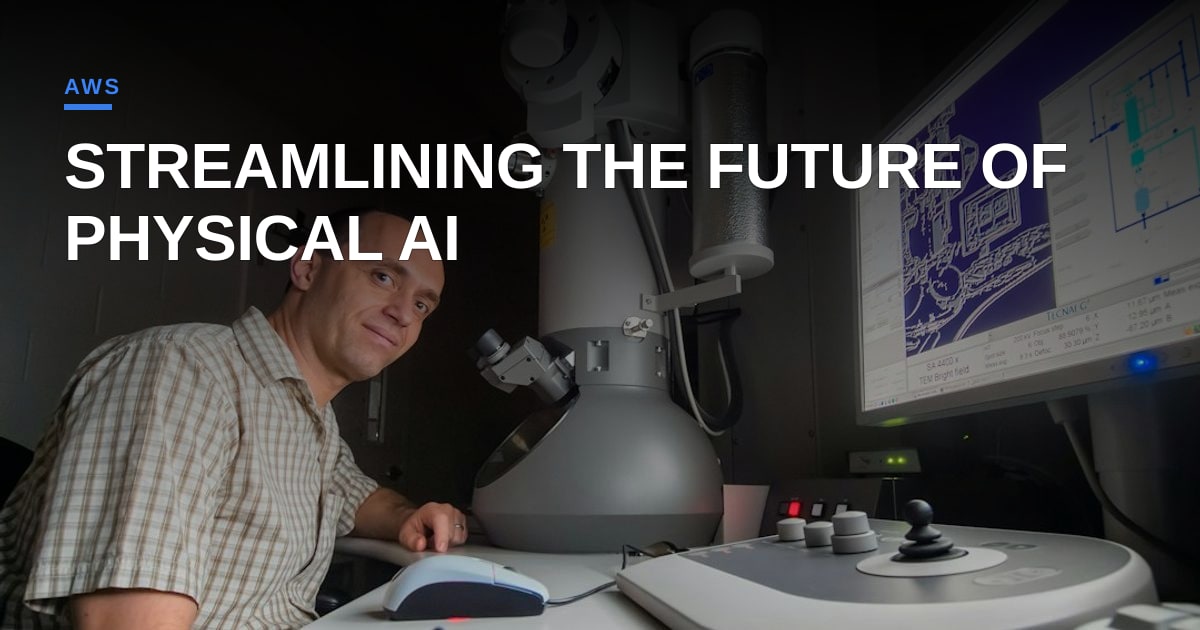
Photo: National Cancer Institute / Unsplash (https://unsplash.com/@nci)
Comments