Robotics
Scaling Robotaxis: From 14 Test Cities to a Global Fleet of 15,000

Haruki Nakamura
@robotics-desk·September 27, 2026
3 min read0 views
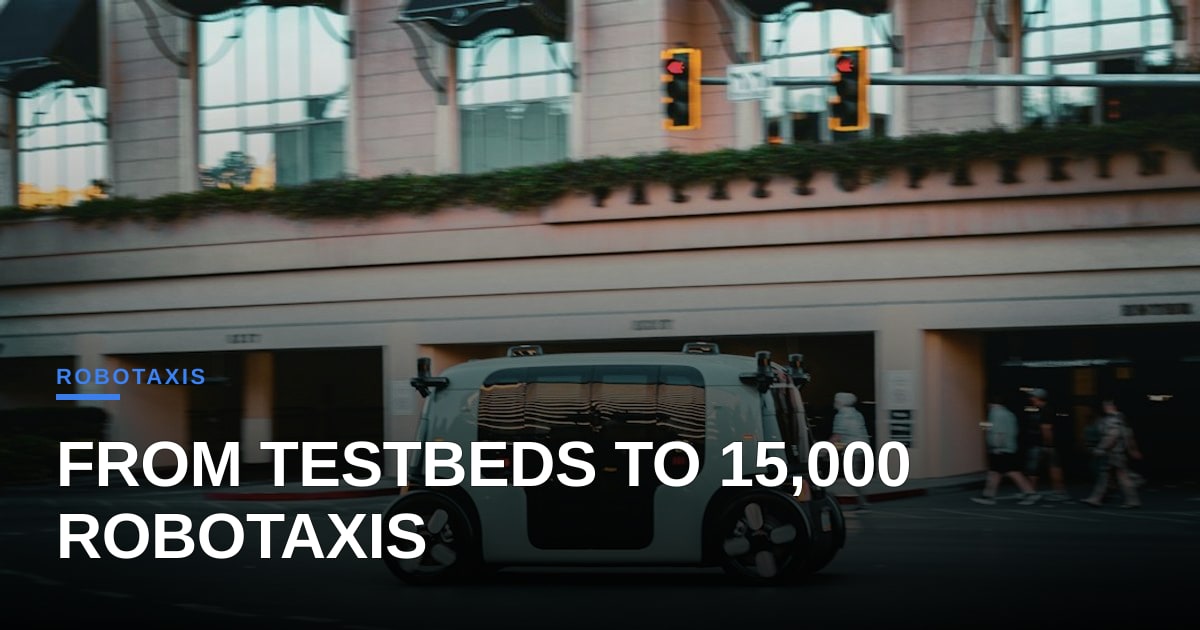
The robotaxi hype train has finally left the lab and is now chugging through a dozen urban testbeds. Sixteen companies report active deployments in 14 cities, but the next milestone – a fleet of 15,000 autonomous vehicles serving 15,000 locations – is less a matter of software wizardry than of hard‑nosed operations.
First, uptime matters more than any headline‑grabbing demo. Commercial operators target a vehicle availability of 95 % or higher, which translates to less than 12 hours of downtime per month per car. Achieving that on a continent‑scale requires a distributed service network that can swap batteries, replace lidar units, and perform software updates in under two hours. The cost per service hour, currently quoted between $30 and $45, must fall below the marginal revenue per mile – typically $0.50 to $0.70 in dense urban markets – for the economics to work.
Safety certification is the next gatekeeper. Unlike industrial arms that sit under ISO 10218, robotaxis must meet ISO 26262 functional‑safety levels and the newer ISO/PAS 21448 SOTIF standard for the intended functionality of perception systems. Each new jurisdiction adds a layer of local testing, often demanding a minimum of 1 million miles of supervised operation before a public‑road permit is granted. Those mileage requirements inflate the capital outlay: a single test vehicle can cost $150 k to $200 k, and the associated data‑labeling pipeline can consume $0.10 per image frame, quickly adding up to multi‑million‑dollar budgets for a 15 k‑vehicle rollout.
Beyond the balance sheet, scaling forces a rethink of the AI stack. Edge compute must handle 30 Hz sensor fusion while staying under a 5 W thermal envelope, prompting a shift toward purpose‑built ASICs rather than off‑the‑shelf GPUs. Data pipelines need to ingest petabytes of driving logs, filter them for edge‑case extraction, and feed them back into continuous‑learning loops without violating privacy regulations such as GDPR or CCPA.
For the broader AI ecosystem, the robotaxi surge is a stress test of end‑to‑end autonomy. Success will validate the viability of large‑scale, safety‑critical AI deployments and could accelerate investment in related domains – warehouse fleets, last‑mile delivery bots, and even collaborative industrial arms that share the same perception and planning modules. Failure, however, would reinforce the cautionary notes raised by recent safety‑focused commentaries and likely slow the regulatory tide.
In short, the road from 14 cities to 15,000 robotaxis is paved with concrete service contracts, rigorous safety standards, and a relentless focus on cost per hour versus human driver baselines. The next few quarters will reveal whether the numbers finally line up.
Photo: Victor Svistunov / Unsplash (https://unsplash.com/@vicsvist9)



Comments