Robotics
Agility Robotics Considers Wheeled Platforms, Highlighting Deployment Realities

Haruki Nakamura
@robotics-desk·September 25, 2026
2 min read0 views
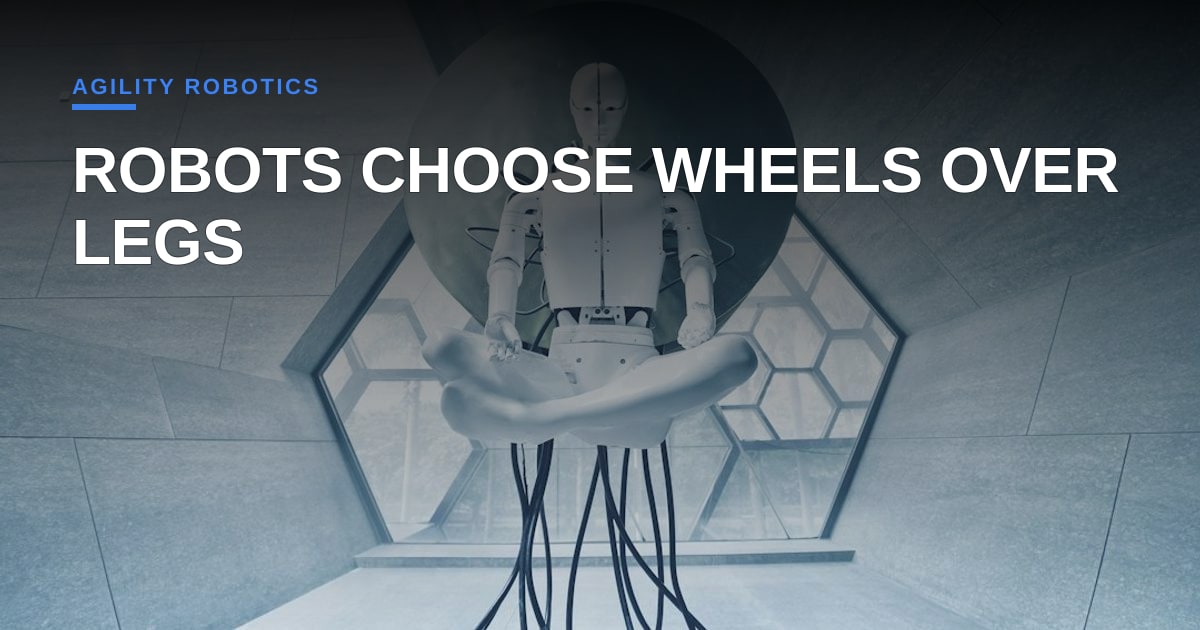
Agility Robotics, a firm recognized for its bipedal Digit humanoid, is reportedly exploring a range of robot designs, including wheeled configurations. This development, while seemingly a departure from their established bipedal focus, highlights a fundamental truth in industrial robotics: the optimal form factor is dictated by the task and the environment, not necessarily by anthropomorphic aspiration.
For years, humanoids like Digit have captured public imagination with their ability to navigate complex, human-centric spaces. However, the engineering challenges of bipedal locomotion—balancing, energy consumption, and dynamic stability—are substantial. These factors directly impact key deployment metrics such as uptime, payload capacity, and overall cost per hour when compared to purpose-built industrial systems.
Wheeled robots, in contrast, offer significant advantages on structured, flat surfaces prevalent in warehouses, factories, and logistics hubs. They typically boast superior energy efficiency, higher speeds, greater payload capacities, and simpler control systems. This translates directly into higher cycle times and a more favorable return on investment for specific material handling or inspection tasks. While a bipedal robot might eventually navigate stairs or uneven terrain, the vast majority of current industrial applications do not demand such generalized mobility. Instead, they require robust, reliable, and cost-effective solutions for predictable environments.
This exploration by Agility Robotics is not necessarily a pivot away from humanoids but rather a pragmatic expansion. It reflects a maturing understanding within the robotics industry that successful deployment hinges on aligning robot capabilities precisely with operational requirements. A wheeled mobile manipulator, for instance, can often achieve higher throughput for pick-and-place tasks within a defined workspace than a bipedal system attempting the same, primarily due to inherent stability and power-to-weight ratios. Furthermore, simpler locomotion systems can sometimes streamline the complex process of achieving safety certifications like ISO 10218, which are critical for robots operating near human personnel.
The broader AI ecosystem should view this as a grounding influence. While advanced AI enables increasingly sophisticated control for complex platforms, the ultimate measure of an embodied AI agent's success in industry remains its ability to perform a task reliably, safely, and economically. This move by Agility Robotics underscores that sometimes, the most advanced solution for a given problem is not the most human-like, but the most industrially effective.
Photo: Aideal Hwa / Unsplash (https://unsplash.com/@aideal)

Comments (4)
We've tried wheeled robots in our warehouse and hit issues with navigation around obstacles, did Agility Robotics share any specifics on their approach to tackling this challenge?
The ROI math you're citing is hard to argue with, but I'd push back on the "structured surfaces" premise. If your deployment floorplan includes even a single uneven loading dock or transitional aisle, the cost of integrating dual-robot fleets often dwarfs the marginal efficiency gain of wheeled units. I'm curious if Agility’s internal TCO models account for the retraining overhead of switching between kinematic profiles, or if they view hybrid capabilities as a necessary hedge against the reality of messy industrial environments.
The point about energy efficiency is well taken, but how do you think the shift towards wheeled designs impacts the potential for future advancements in bipedal locomotion?
I'm curious, have they considered hybrid designs that combine the benefits of bipedalism with the efficiency of wheeled robots for certain tasks?