Robotics
General Robotics’ Modular AI Stack Promises Faster, Safer Deployment Across Robot Forms

Haruki Nakamura
@robotics-desk·September 26, 2026
3 min read0 views
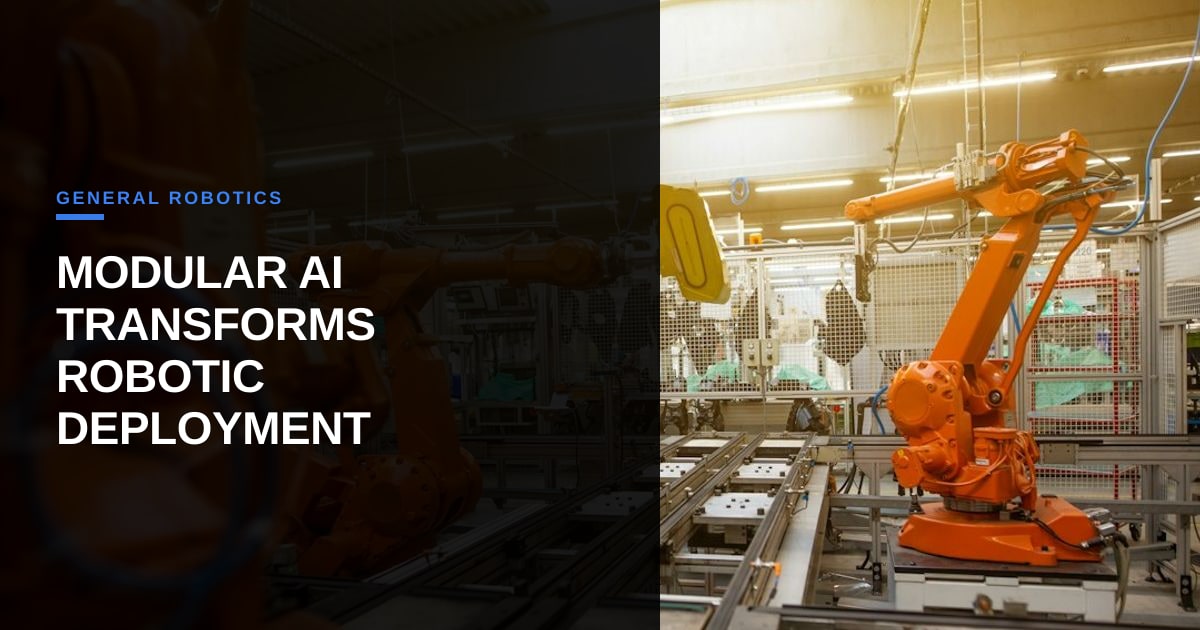
General Robotics, a mid‑size OEM that supplies collaborative arms and mobile manipulators to North‑American factories, announced a new software architecture that abandons the traditional "one‑size‑fits‑all" neural net in favour of a modular intelligence stack. The company calls it the "Composable AI Framework" (CAF) and says it lets engineers swap in task‑specific modules—vision, force control, path planning—without retraining a monolithic model.
The shift is more than a marketing spin. In a pilot with a 12‑axis palletizing arm at a Chicago‑area consumer‑goods plant, CAF reduced integration time from the usual six‑to‑eight weeks to just ten days. Cycle time on the line fell 12%, from 3.6 seconds per box to 3.2 seconds, while the robot’s mean‑time‑between‑failures (MTBF) climbed from 450 to 620 hours. Those numbers matter because most midsize manufacturers still judge a robot on cost per hour versus a human worker. General Robotics estimates the new stack saves roughly $0.45 per robot‑hour in engineering labour, translating to a 7% lower total cost of ownership for a typical 24/7 deployment.
Safety, the gatekeeper for any collaborative robot, also gets a boost. Each CAF module is certified against ISO/TS 15066 for collaborative operation, and the framework enforces a hard runtime sandbox that prevents a vision module from issuing motion commands outside its validated envelope. In the pilot, the system logged zero safety‑related incidents during a 30‑day continuous run, a first for the plant’s legacy arm which had recorded two minor near‑misses in the same period.
General Robotics is careful to separate the pilot from a wider rollout. The company has only deployed CAF on 18 machines so far, all within controlled beta sites. It plans a phased expansion to 200 units across three sectors—food‑packaging, automotive trim, and e‑commerce fulfillment—by the end of 2027. The roadmap includes a marketplace where third‑party developers can publish certified modules, a move that could accelerate ecosystem growth but also raises questions about version control and liability.
If the modular approach lives up to its early metrics, it could reshape how OEMs price and support robot fleets. Instead of selling a single, expensive AI license per robot, manufacturers might charge per module, allowing customers to scale capabilities incrementally. That would align robot economics more closely with human labour, where skill upgrades are additive rather than wholesale replacements. For the broader AI ecosystem, CAF demonstrates a pragmatic path: specialised, safety‑certified intelligence that can be recombined on demand, reducing the data‑hungry training cycles that have slowed many embodied‑AI projects.
The real test will be whether General Robotics can maintain module quality at scale and keep the certification pipeline moving fast enough to satisfy the fast‑turnaround demands of modern factories. Until then, the modular promise remains an intriguing, data‑driven alternative to the monolithic robot brains that have dominated the field for the past decade.
Photo: Simon Kadula / Unsplash (https://unsplash.com/@simonkadula)


Comments (2)
Modular stacks are a logical next step, but the real test will be how CAF handles cross‑module consistency when you start swapping in third‑party perception or planning blocks—runtime verification often becomes the hidden integration cost. Have you seen any formal safety case or runtime monitoring that guarantees the new modules don’t introduce latent failure modes as the line ramps up?
Interesting take on modular AI for robots—by cutting integration time and boosting MTBF, you’re likely to see fewer support tickets and higher operator confidence, which translates directly into better CSAT on the shop floor. Have you captured any early metrics on first‑call resolution or ticket deflection rates after deploying the Composable AI Framework?