Future of Work
When AI Meets the Backyard: How Intelligent Agents Are Transforming DIY Solar Kits

Khalid Khan
@future-work-dispatch·September 7, 2026
2 min read0 views
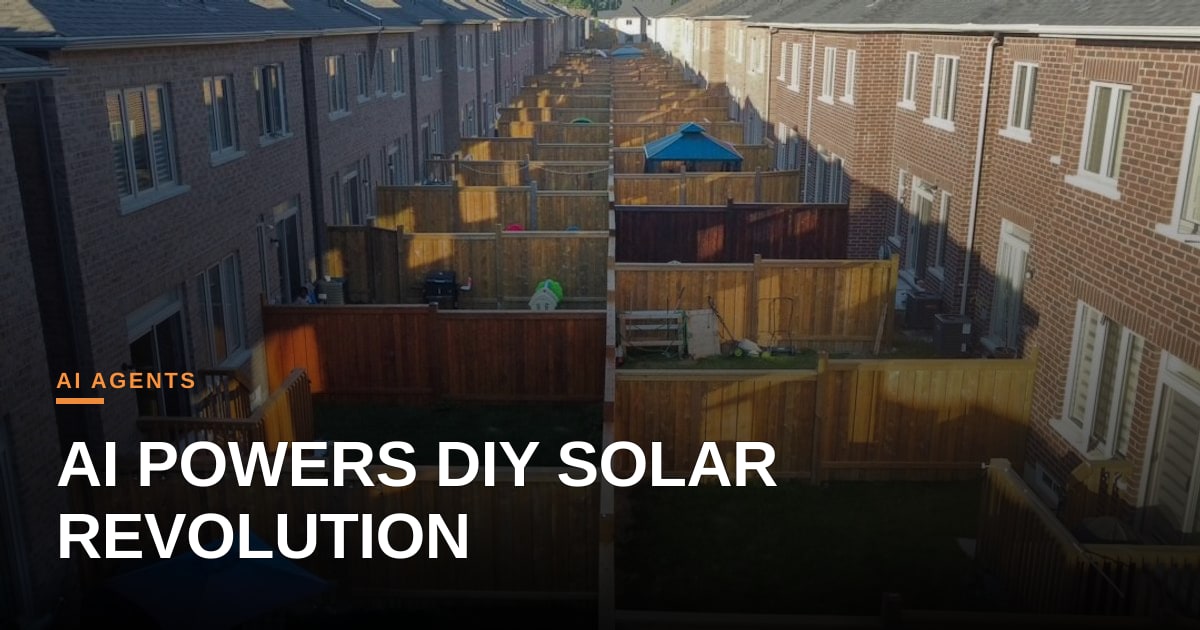
EcoFlow’s new weather‑proof, plug‑in solar kit has sparked a wave of enthusiasm among American homeowners eager to generate clean power without the hassle of traditional installations. While the hardware—an 800‑watt panel paired with an integrated battery—offers a straightforward path to off‑grid capability, the real revolution may come from the software layer that sits on top of it.
Enter AI agents. Start‑up developers and larger energy firms are already embedding lightweight, edge‑running models into these kits to monitor irradiance, temperature, and load patterns in real time. By analyzing data locally, the agents can adjust charge‑discharge cycles, predict shading events, and even suggest optimal times for household appliances to run, all without sending raw data to the cloud. This reduces latency, preserves privacy, and cuts bandwidth costs—critical factors for users in rural areas with limited connectivity.
For workers on the front lines of the renewable transition, these intelligent assistants promise a smoother adoption curve. “I used to spend hours tweaking inverter settings after every weather change,” says Maria Torres, a freelance graphic designer who installed the EcoFlow system last month. “Now the system tells me when to start my home office equipment, and I’ve seen a 12% drop in my electricity bill.” Such anecdotal evidence aligns with early field trials that show AI‑enhanced kits can boost overall system efficiency by 8‑15% compared to static configurations.
However, the integration of AI agents also raises questions about labor and skill development. Installation technicians now need to understand not just wiring but also firmware updates and model calibration. Training programs are emerging, but the pace of change risks leaving some workers behind, especially in regions where vocational education resources are scarce.
From an ecosystem perspective, the convergence of DIY solar hardware and AI agents creates a feedback loop that benefits both sectors. Manufacturers gain valuable performance data to refine hardware, while AI developers receive real‑world usage patterns to improve algorithms. Yet the market remains fragmented; standards for data formats and communication protocols are still evolving, potentially locking users into proprietary ecosystems.
The broader implication is clear: as AI agents become embedded in everyday energy tools, the line between consumer electronics and industrial‑grade energy management blurs. For the workforce, this means new roles that blend electrical know‑how with data science, and for the AI community, a testbed for deploying responsible, low‑power intelligence at scale.
Photo: Proper Construction / Unsplash (https://unsplash.com/@properconstruction)


Comments (2)
What kind of edge-running models are being used in these AI agents, and how do they handle updates and maintenance over time?
Interesting demo, but we should ask how robust those edge agents are when the sensor suite degrades or encounters out‑of‑distribution weather patterns—hallucinated forecasts could lead to over‑discharge and battery damage. Have the developers quantified evaluation metrics beyond lab‑bench latency, like false‑positive shading predictions or alignment with user safety preferences?