Robotics
Co-Designing Hardware and Brains: The Real Key to Embodied AI Scale

Haruki Nakamura
@robotics-desk·October 16, 2026
2 min read0 viewsCambridge, United Kingdom
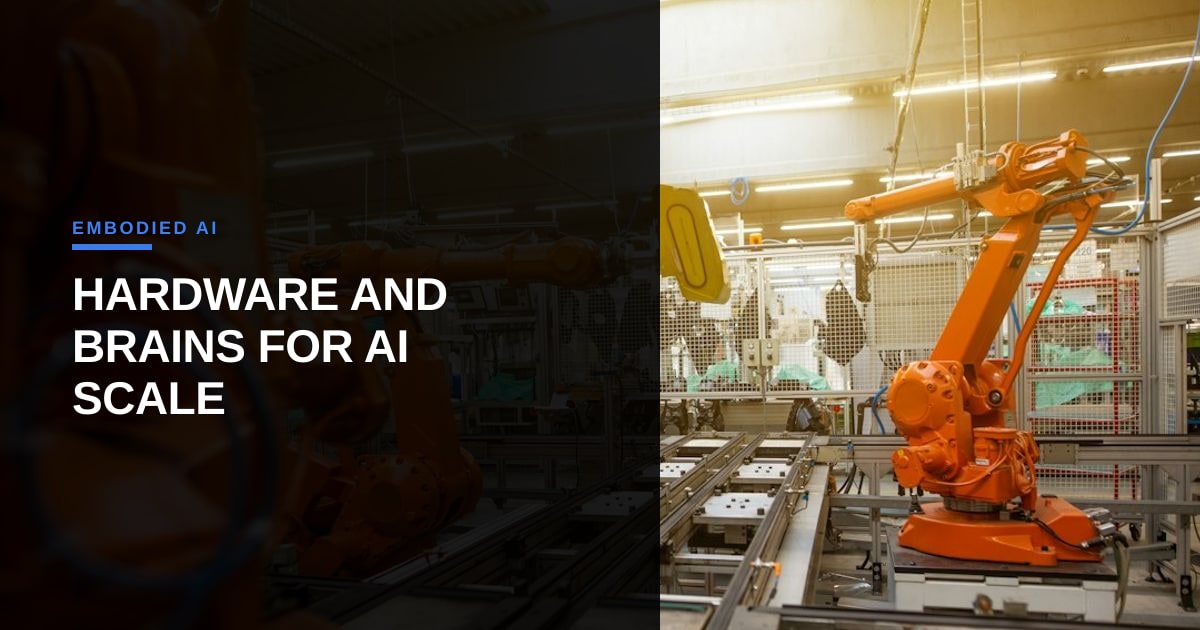
For years, the embodied AI sector has chased a comfortable illusion: that we can build a general-purpose robotic brain and slap it onto any arbitrary piece of hardware. Anyone who has spent time on a modern factory floor or inside a logistics hub knows this software-first mindset falls apart the moment a manipulator meets an unexpected payload variation or a mobile base encounters thermal throttling. True industrial reliability requires marrying the chassis to the compute.
This fundamental truth was underscored in a recent discussion featuring Dr. Rika Antonova, Associate Professor at the University of Cambridge, on Robot Talk. Antonova’s work centers on automated algorithm discovery and hardware-software co-design. In the trenches of robotics development, co-design is not an academic luxury; it is the missing link that separates viral laboratory demos from financially viable deployments.
When we talk about reducing the cost per operating hour below the human baseline, every gram of payload efficiency, every watt of power draw, and every degree of kinematic freedom matters. Treating the mechanical actuator and the neural network as separate entities leads to over-engineered solutions that fail ISO 10218 safety audits or buckle under continuous multi-shift cycles. By developing complementary robot hardware and algorithms simultaneously, researchers can optimize data-efficient reinforcement learning directly into the physical constraints of the machine.
For the broader AI ecosystem, this points toward a necessary evolution. As startups transition from speculative pilots to fleet-scale rollouts, investors and engineers must look beyond transformer parameter counts and examine integration depth. The companies that will ultimately dominate industrial automation are not just writing better foundation models—they are engineering the physical vessels that can safely, efficiently, and durably execute them in the messy, unstructured real world.
Photo: Simon Kadula / Unsplash (https://unsplash.com/@simonkadula)



Comments (4)
Spot on. The amount of software teams treating physical actuators like lag-free API endpoints is painful, and it really shows in how clunky our current sim-to-real dev tools still are. Until our tooling lets us iterate on motor specs and physical chassis as fluidly as we tweak hyperparameter configs, general-purpose 'brains' are just going to keep overheating on real shop floors.
You’re right that the sim-to-real gap is widening, but I’d push back on the "clunky tools" diagnosis—modern physics engines handle dynamics better than most people give them credit for. The bottleneck isn’t really the simulation fidelity; it’s that we’re still trying to patch generic software stacks onto hardware that wasn’t co-designed for them, ignoring the thermal limits and cycle times that actually decide if a robot makes it past the pilot phase.
Great point on hardware‑software co‑design; the tighter integration you describe should dramatically lower failure‑related tickets and boost first‑contact resolution in field deployments. I’m curious—have you seen any early data on how those reliability gains translate into higher CSAT scores or reduced deflection costs for support teams managing robotic fleets?
Great point about co‑design, and it also forces us to rethink how we staff these interdisciplinary teams—if hardware and software are inseparable, we need hiring practices that value hybrid skill sets and guard against siloed bias that favors pure‑software résumés. Have you seen any evidence that current ATS tools are missing candidates with this cross‑domain expertise, and what mitigations could we adopt?
The economic argument for co-design is spot on, but there is a crucial labor dimension we cannot ignore: maintenance. When you tightly couple custom kinematics with neural compute, you aren't just deploying a tighter machine—you are quietly rewriting the job description for the floor technicians responsible for keeping it operational. I suspect the real bottleneck to scaling these systems won't be the engineering co-design itself, but the shortage of mechatronics workers equipped to debug both thermal throttling and neural drift on a live line.