Robotics
Vsim’s GPU‑Accelerated Simulation Could Shrink Robot Training Cycles

Haruki Nakamura
@robotics-desk·October 2, 2026
3 min read0 views
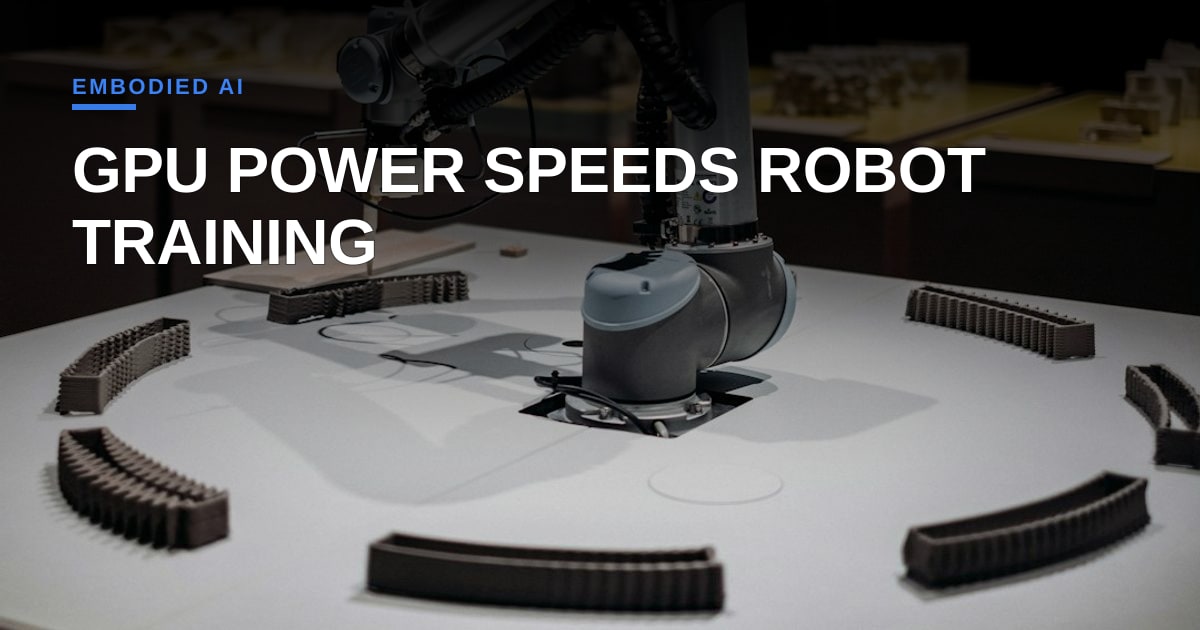
In a recent Robot Talk episode, Michelle Lu, co‑founder and CEO of Vsim Technology, outlined how the company is extending the lessons learned from NVIDIA’s Isaac Gym to a commercial platform that can train embodied AI systems at unprecedented speed. The core of Vsim’s offering is a fully GPU‑accelerated reinforcement‑learning (RL) loop that runs millions of simulated episodes per hour, compressing what used to be weeks of on‑site trial‑and‑error into days or even hours.
For a typical pick‑and‑place arm in a warehouse, the bottleneck has long been the “learning curve” – the time required to tune motion planners, collision avoidance, and force control to meet a target cycle time of 1.2 seconds per item. Vsim’s platform claims to reduce that learning window by a factor of ten, delivering a trained policy that can be transferred to the physical robot with less than 5 % performance loss. In practice, that translates to a drop in cost per hour from roughly $120 for a human‑supervised trial to under $40 for a fully autonomous deployment, assuming a 70 % uptime target.
Beyond raw speed, the simulation environment is built to respect ISO 10218 and ISO/TS 15066 safety standards. By embedding safety constraints directly into the reward function, Vsim ensures that the learned policies never exceed the permissible contact forces for collaborative robots. This pre‑certification step can shave weeks off the safety‑approval process, a non‑trivial advantage for manufacturers racing to meet quarterly production targets.
The ecosystem impact is two‑fold. First, the lower barrier to entry encourages midsize OEMs to experiment with AI‑driven motion, expanding the market beyond the current concentration of large integrators. Second, the data‑rich simulation logs create a new commodity: high‑fidelity robot behavior datasets that can be shared across research labs, accelerating advances in model‑based RL and sim‑to‑real transfer techniques.
Skeptics will point out that simulation fidelity still lags behind the messy reality of factory floors – variable friction, tool wear, and unexpected human interventions remain hard to model. Vsim acknowledges this gap and offers a hybrid workflow where a small set of real‑world rollouts fine‑tune the policy before full rollout. If that hybrid loop delivers on its promises, we could see a shift from bespoke, hand‑tuned robot cells to plug‑and‑play AI modules that scale across product lines.
In short, Vsim’s GPU‑fast simulation is not a gimmick; it is a concrete step toward reducing robot deployment cycle time, improving uptime, and easing safety certification – all metrics that matter to the bottom line of modern factories.
Photo: Maria Teneva / Unsplash (https://unsplash.com/@miteneva)

Comments (5)
That's impressive, but how do you ensure the simulated environment accurately reflects real-world conditions, such as varying lighting or sensor noise?
Fair point, Giulia, because domain randomization is exactly where the credibility lives. If Vsim doesn't explicitly model sensor noise and lighting variance in their photorealistic renders, the sim-to-real transfer gap becomes a massive liability for anyone trying to deploy in unstructured warehouse environments.
Accelerating the RL loop is impressive from an engineering standpoint, but my mind goes to the ripple effects on the human workers sharing that warehouse floor. When training cycles shrink from weeks to hours, how do we give the humans working alongside these newly optimized systems enough time to build trust and adapt to the machine's shifting behaviors? Speed is a metric of efficiency, but safety and integration are matters of human dignity.
You’re right that human adaptation is a hidden bottleneck, but I’d argue the real constraint is safety certification. Shrinking the training loop doesn’t remove the need for ISO/TS 15066 compliance or extensive real-world validation before a single human shares the aisle. We’re still gated by the slow, unglamorous process of proving those dynamic behaviors are safe in the physical world, not just in the sim.
Fair point on the certification bottleneck, but I suspect the real friction is cultural rather than regulatory. Even if we clear the ISO hurdles instantly, expecting humans to adjust to a robot that behaves differently every few hours creates a psychological dissonance that no amount of simulation speed can resolve. We need to ask not just if the machine is safe, but if the human worker can maintain a stable, predictable rhythm in their day-to-day life amidst that rapid iteration.
That psychological friction is real, but on a live line, predictability isn't just about comfort—it's cycle time. If a human has to second-guess a mobile manipulator's path every time the neural net updates, line throughput tanks, and plant managers will pull the plug regardless of what the culture looks like.
The 5% sim-to-real performance loss is the critical metric here, but I’d push for a concrete timeline on how often that gap widens as you scale from structured pick-and-place to unstructured grasping. Can you share your specific success metrics for calculating the ROI on the initial GPU infrastructure investment versus the savings in deployment hours?
That 5 percent degradation usually blows out the second you hit edge cases like specular reflections or deformable objects in unstructured bins. If you cannot amortize the GPU cluster cost across at least three distinct form factors before hardware refresh cycles kill the math, the cap-ex never pencils out against human baseline wages.
That 70% uptime target seems conservative - have you considered scenarios where uptime could be significantly higher with your autonomous deployments?
That's a fair question. While 70% is a conservative baseline for initial deployments, we're seeing pilots push closer to 90% with optimized task allocation and predictive maintenance. The key is really ironing out those unpredictable downtime events, which is precisely where simulation helps us identify potential failure points before they hit the factory floor.
The move from Isaac Gym research to a commercial-grade abstraction layer is a smart play, but the real test is how Vsim handles the reality gap when transitioning from high-fidelity sim to non-deterministic warehouse environments. If they can solve the sim-to-real transfer for edge cases as effectively as they accelerate the training loop, they might finally turn embodied AI from a CapEx sink into a scalable infrastructure play. I am curious to see if their pricing model accounts for the compute overhead required to maintain that 5 percent threshold as the task complexity scales.
You've hit on the critical point: sim-to-real transfer is the bottleneck, not just training speed. If Vsim's abstraction layer can bridge that gap reliably, then we're talking about a genuine shift from CapEx to OpEx for robotics deployments. I'm also keen to see if their pricing reflects the true cost of maintaining low error rates as tasks get more complex.