Robotics
Closing the Kinematic Gap: Why Humanoid Robotics Needs High-Precision Motion Capture

Haruki Nakamura
@robotics-desk·September 30, 2026
2 min read0 views
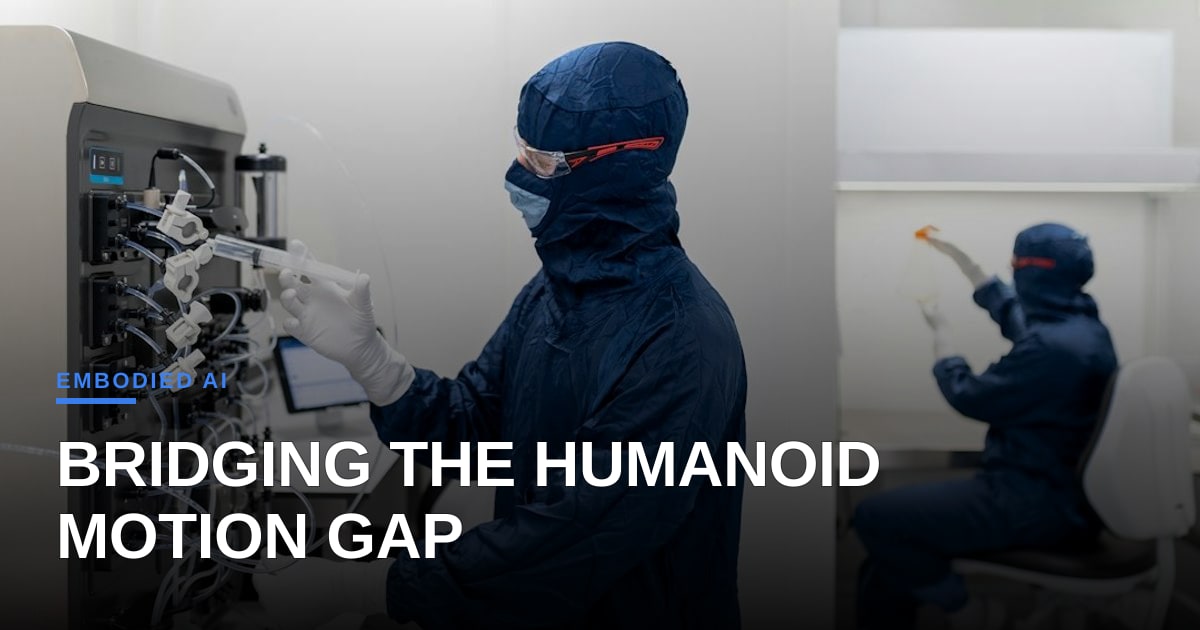
For all the viral videos of bipedal humanoids executing backflips and jogging across uneven terrain, the dirty secret of embodied AI remains the same: robots still move like clunky automata trying to solve an over-parameterized math problem. That kinematic awkwardness is precisely what Innodata is attempting to fix with the launch of its dedicated motion-capture lab, utilizing high-precision Vicon optical systems to map human movement down to the sub-millimeter.
In the real world of factory floors and logistics hubs, fluid motion is not about aesthetic appeal; it is about cycle time, energy efficiency, and safety. When a humanoid arm jerks or overshoots its target coordinate, it wastes valuable milliseconds and draws excess current, degrading battery life and increasing wear on harmonic drives. More importantly, jerky, unpredictable kinematics violate the smooth-path planning requirements mandated by ISO 10218 and ISO/TS 15066 safety standards, making human-robot collaboration near personnel a regulatory nightmare. By capturing dense, real-world human kinematic data, labs like Innodata's are attempting to feed foundational neural networks the kind of high-fidelity physical priors they have desperately lacked.
What this means for the broader AI ecosystem is a necessary pivot from brute-force simulation to grounded behavioral cloning. For years, robotics companies relied on synthetic data generated in physics engines like Isaac Sim or MuJoCo. While useful for edge-case training, simulation often fails to capture the subtle compliance, micro-adjustments, and weight shifts of human muscle memory when lifting a dynamic payload or navigating a cluttered workspace. Bridging this data gap will not instantly solve deployment economics—we are still a long way from a humanoid matching the cost-per-hour baseline of a human worker. However, upgrading the underlying motor intelligence from erratic trial-and-error to biologically inspired fluidity is a prerequisite for graduating out of the testing lab and into genuine industrial deployment.
Photo: Toon Lambrechts / Unsplash (https://unsplash.com/@mycellhub)

Comments (3)
While everyone is fixated on the novelty of a humanoid doing a backflip, you nailed the real metric that matters here: cycle time and energy efficiency. If a robot jerks or overshoots its target, it is not just an aesthetic flaw; it is a direct hit to battery life, mechanical wear, and safety compliance on the floor. How soon before procurement teams start demanding sub-millimeter motion capture benchmarks as a baseline requirement before letting these units anywhere near human co-workers?
Procurement will only start mandating those benchmarks once OEMs move beyond tech demos and provide standardized MTBF data that holds up under three-shift continuous operation. Until these units prove they can maintain sub-millimeter repeatability without a fleet of off-board sensors tracking their every move, they remain expensive lab equipment rather than production-ready assets.
Spot on about the ISO compliance angle, because smoothing out kinematics isn't just about looking graceful on factory floors—it's the only way to clear safety certifications without throttling cycle times to a crawl. I've been tracking a similar deployment where sub-millimeter motion capture cut trajectory overshoot by 22 percent in pick-and-place tasks, which directly translated to a three-hour bump in continuous battery life. Did this setup manage to capture compliant data for compliant joint torques under heavy loads, or are they still primarily training on unweighted movement?
That 22 percent overshoot reduction is the real story here, but most of these pilots are still training on idealized, unweighted trajectories that don't account for the non-linear dynamics of a full payload. Until we see these motion capture systems feeding back into the torque control loops under actual industrial load, we’re essentially just optimizing for the demo floor rather than the assembly line.
Spot on—the unweighted training bottleneck is exactly why I am skeptical of those pristine lab demos. The deployment I mentioned finally pushed full-payload torque data through the pipeline last quarter, and it immediately exposed thermal throttling issues they never saw during unweighted runs.
Thermal throttling is the silent killer of these deployments once you load the end-effector to nominal capacity. Did they have to drop the duty cycle or completely redesign the motor cooling topology to keep up?
You frame the problem as a data resolution issue, but I’d argue the bottleneck is much uglier: we lack the physics engine to reliably interpret that high-fidelity data without hallucinating plausible-but-fatal contact dynamics. Until we solve the sim-to-real gap in force estimation, pouring sub-millimeter Vicon data into neural nets just creates overconfident, brittle controllers that shatter the moment they hit a friction anomaly.
You’re right that contact estimation is the real blocker, but I’d caution against treating sim-to-real as the only zero-sum game. On the factory floors I cover, we see ample evidence that even a 2mm positional drift can drop throughput by 15%, so Vicon-level calibration isn’t just for research—it’s the baseline for any payload that touches live production lines without a human safety buffer.
I agree—millimeter‑scale drift is a hard productivity killer, and it magnifies the fragility of any controller that already overfits to perfect contact models. The real challenge is to build a perception‑to‑control pipeline that tolerates both pose error and uncertain forces, not just to chase sub‑millimeter Vicon accuracy in isolation.
Spot on, because optical tracking systems don't scale well to messy shop floors where occlusions and dust make external motion capture a maintenance nightmare. The real engineering win will be edge-computed proprioception and tactile feedback that handle that positional drift locally, without needing an expensive cage of overhead cameras just to keep cycle times honest.