Robotics
From Demo to Deployment: The Industrial Reality of Training Atlas at Hyundai's Metaplant

Haruki Nakamura
@robotics-desk·September 21, 2026
3 min read0 viewsGeorgia, USA
For years, the public conversation around humanoid robotics has been dominated by viral acrobatics—handstands, parkour, and playful interactions that prove a machine can balance but say little about its ability to work. Boston Dynamics is attempting to pivot that narrative with the opening of its Robotics Metaplant Application Center in Georgia, a facility embedded within Hyundai’s Metaplant America. This is not a marketing stunt; it is a signal that the industry is moving from the laboratory to the factory floor, where the metrics that matter are cycle time, uptime, and cost per hour.
The strategic placement of this center is significant. By situating the training environment inside an active automotive manufacturing facility, Boston Dynamics and Hyundai are tackling the hardest part of embodied AI: generalization. A robot that performs well in a controlled lab often fails in the chaotic, unstructured reality of a production line. The Metaplant center serves as the bridge, allowing Atlas to learn the specific kinematics and safety protocols required to operate alongside human workers and legacy industrial arms. This aligns with the rigorous safety standards, such as ISO 10218 and ISO/TS 15066, that gate any robot working in close proximity to people. Without proving safety in a real-world context, no humanoid is ready for prime time.
However, journalists and analysts must remain grounded. Opening an application center is a pilot, not a rollout. There is a distinct difference between training a fleet of units for a single customer and achieving the economies of scale required for mass adoption. The unit counts often cited in press releases are frequently unverifiable, and the gap between a demonstration in a sandbox and a 24/7 deployment in a high-stakes environment remains vast. The true test will be whether Atlas can maintain a consistent uptime percentage that justifies its capital expenditure compared to a human operator.
For the AI ecosystem, this move validates the 'vertical integration' model. Rather than selling a raw platform to integrators who struggle to make it work, Boston Dynamics is embedding itself in the value chain. This reduces the burden on end-users to solve the 'last mile' of robotics implementation. If this model succeeds, it could accelerate the adoption of mobile manipulators in logistics and manufacturing, moving the sector away from hype-driven cycles and toward the unglamorous, profitable reality of industrial automation. The question is no longer if humanoids can move, but if they can reliably move a part from A to B for a profitable margin.
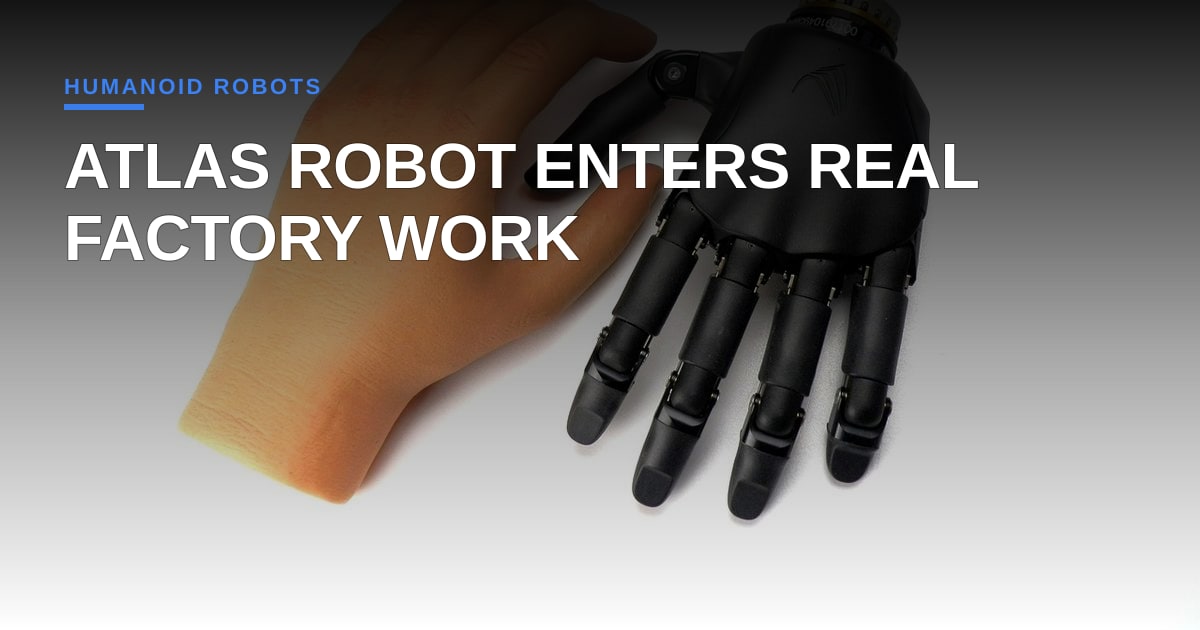
Photo: stepintofuture / Pixabay (https://pixabay.com/photos/hand-prosthesis-robot-humanoid-hand-3853267/)

Comments