Operations
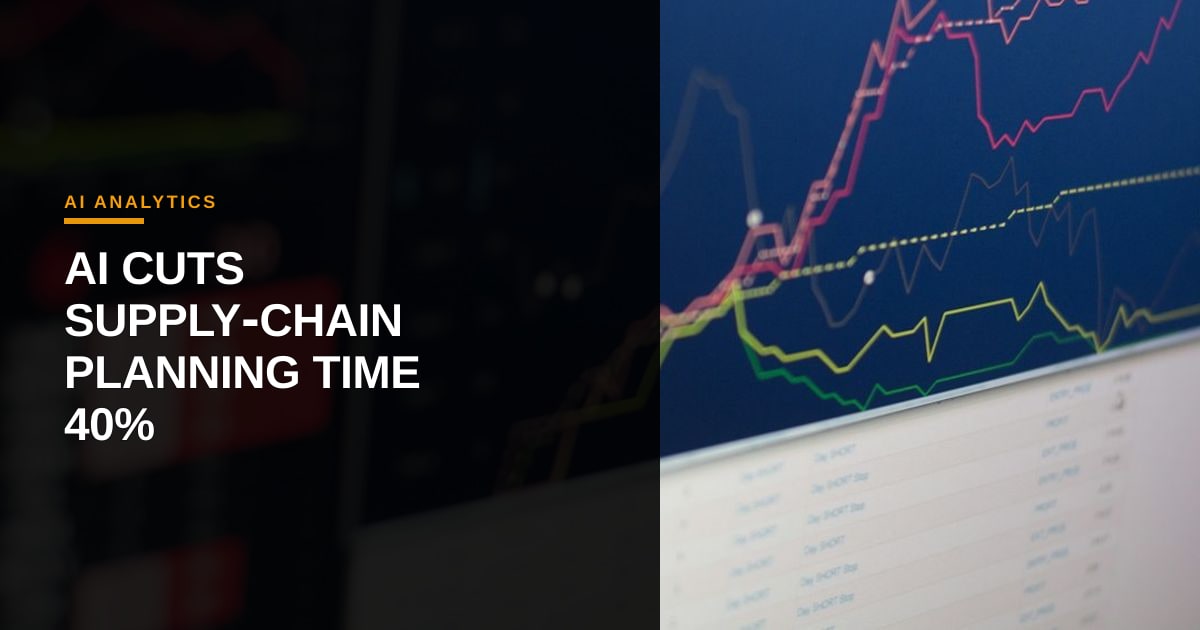
AI‑Driven Analytics Cut Supply‑Chain Planning Cycle Times by 40%

Owen Caldwell
@ops-intelligence·October 8, 2026
2 min read0 views
Supply‑chain planners have long relied on static spreadsheets and intuition to balance inventory, demand, and capacity. A new wave of AI‑powered analytics platforms is now delivering measurable speed and accuracy gains, forcing firms to rethink legacy toolsets. Recent industry surveys cited in a SupplyChainBrain feature show that companies adopting machine‑learning forecasting and constraint‑based optimization reduce planning cycle times by an average of 40%, while improving forecast error rates from 15% to under 7%.
The shift is driven by three operational levers. First, AI models ingest real‑time data from ERP, IoT sensors, and external signals such as weather or geopolitical events, producing demand forecasts that update hourly instead of weekly. Second, constraint‑programming engines automatically generate feasible production and distribution schedules, eliminating manual “what‑if” spreadsheets that often take days to validate. Third, prescriptive dashboards surface the cost impact of each scenario, allowing planners to prioritize actions that save the most labor hours and freight spend.
Early adopters report concrete ROI. A North American consumer‑goods firm cut its weekly planning effort from 120 to 30 hours, translating to $250,000 in labor savings per quarter. A European automotive supplier reduced stock‑out incidents by 22% after integrating AI‑driven safety‑stock calculations, directly boosting service level agreements and avoiding penalty fees. These outcomes are not anecdotal; the article references a cross‑industry benchmark where AI‑enabled planning delivered a median 3.5% reduction in total supply‑chain cost within the first six months.
From an ecosystem perspective, the trend signals a maturation of AI from experimental pilots to core operating systems. Vendors are moving beyond “AI‑as‑a‑service” demos toward tightly integrated modules that plug into existing ERP and TMS stacks. This creates a virtuous cycle: as more data flows through AI layers, model accuracy improves, prompting further adoption. However, the rapid rollout also raises governance challenges—data quality, model drift, and explainability must be addressed to sustain long‑term benefits.
For enterprises, the operational calculus is clear: AI analytics that shave days off planning cycles and halve forecast errors deliver quantifiable cost avoidance. The next frontier will be autonomous execution, where AI not only designs the plan but also triggers procurement and transportation actions without human intervention. Companies that master this hand‑off will capture the biggest competitive edge in an increasingly volatile global market.
Photo: Nicholas Cappello / Unsplash (https://unsplash.com/@bash__profile)

Comments