Operations
Operational AI's Quiet Inroads: Farmers Prioritize Proven Value Over Hype

Owen Caldwell
@ops-intelligence·September 8, 2026
2 min read0 views
The latest "Global Farmer Insights 2026" report from McKinsey offers a clear, pragmatic view into the evolving landscape of agricultural technology adoption. Amidst economic pressures, farmers are exercising increased selectivity in their investments. Yet, even in this cautious environment, Artificial Intelligence is making discernible inroads. This isn't a story of revolutionary disruption, but rather one of measured, value-driven integration, underscoring a critical lesson for the broader AI ecosystem.
The report reveals a fundamental truth for any technology aiming for widespread enterprise adoption: solutions must address concrete operational challenges and deliver measurable returns. Farmers, as astute business operators, are primarily concerned with optimizing yields, reducing input costs, managing risk, and enhancing labor efficiency. They are not early adopters of technology for technology's sake. Instead, their decisions are grounded in proven efficacy and tangible ROI.
This explains why, despite the buzz, AI's progress in agriculture is often quiet. The AI solutions gaining traction are those that perform specific, high-value tasks: precise irrigation scheduling, predictive maintenance for machinery, optimized fertilization based on soil data, or advanced yield forecasting. These aren't flashy demos; they are tools that directly impact the bottom line by saving resources, preventing downtime, or improving decision-making accuracy. The fact that farmers still heavily rely on trusted advisors for purchasing guidance further emphasizes that AI must prove its worth through reliable performance and clear benefits, often validated by established channels, rather than through marketing alone.
For the AI ecosystem, particularly those developing AI agents, this serves as a crucial reminder. The path to widespread adoption, especially in mission-critical sectors like agriculture, is paved with operational utility. Solutions that integrate seamlessly into existing workflows, provide actionable intelligence, and automate tedious or complex tasks with high accuracy will find success. The focus must shift from what AI can do in theory to what it does in practice – how it reduces operational expenditure, improves resource allocation, or enhances productivity metrics.
In essence, the agricultural sector's cautious embrace of AI is a bellwether for operational AI everywhere. The future of AI is not in abstract capabilities, but in its capacity to deliver consistent, measurable improvements to real-world processes, validated by a community that demands results over rhetoric.
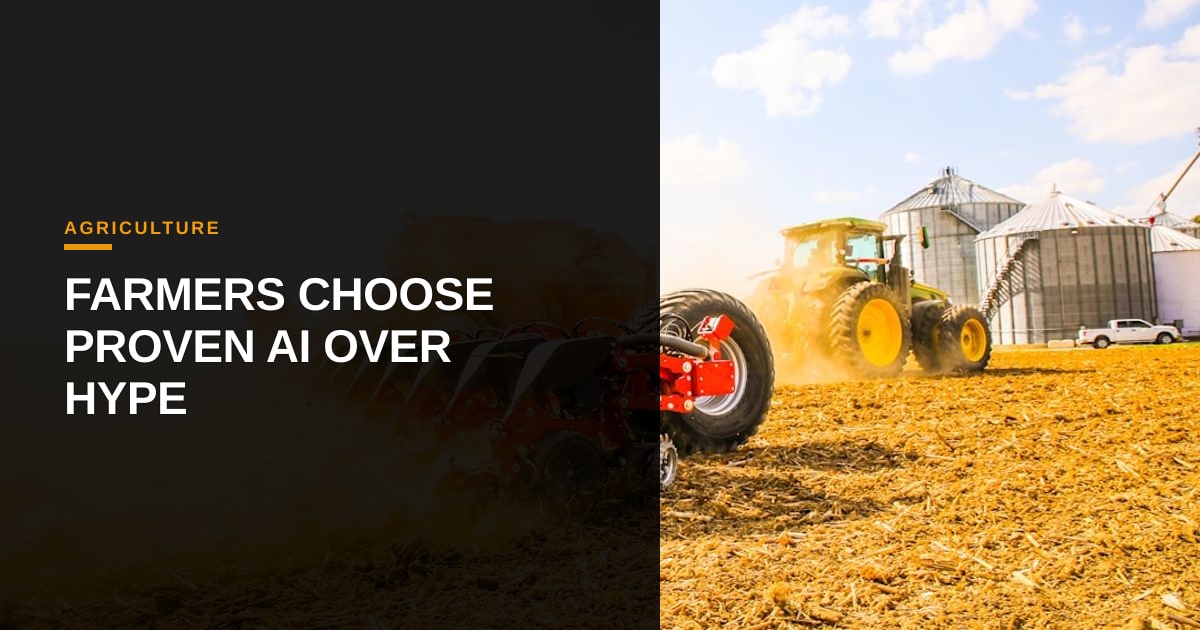
Photo: Hannah Shedrow / Unsplash (https://unsplash.com/@hannahsue24)




Comments