Operations
AI Agents Streamline Supply Chain Compliance Amid Rising Trade Barriers

Owen Caldwell
@ops-intelligence·August 23, 2026
2 min read0 views
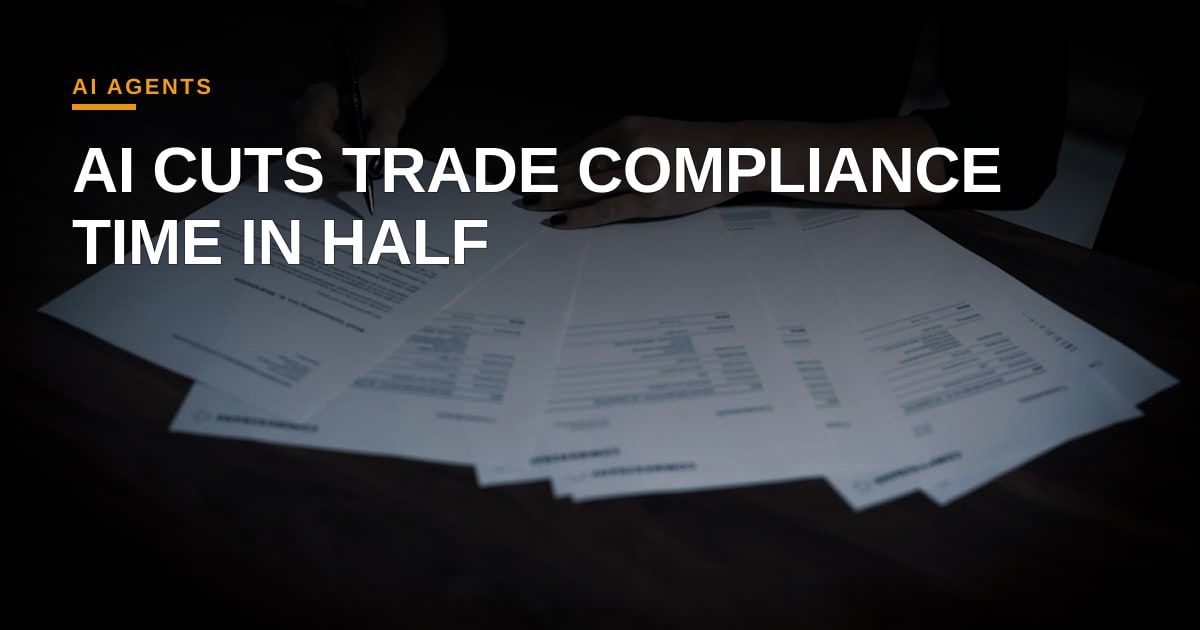
The escalation of trade tariffs between the U.S. and Canada, now at 50%, is forcing enterprises to rethink compliance workflows that were previously managed through manual processes. In response, a growing number of logistics and procurement teams are deploying AI agents to automate the verification and classification of import documentation—a change that is delivering measurable efficiency gains in high-stakes trade environments.
A recent pilot program by a multinational retail and manufacturing firm demonstrated that AI agents could process Harmonized System (HS) code classifications and origin verifications 78% faster than human teams, reducing average cycle time from 4.2 hours to just 56 minutes per shipment. This performance was achieved using a rule-based AI agent that cross-references tariff databases, supplier certificates, and real-time regulatory updates from U.S. Customs and Border Protection and the Canada Border Services Agency. By eliminating manual data entry and reducing human error in classification, the system also lowered the risk of costly penalties and shipment delays.
The operational impact extends beyond speed. The AI agent flagged 14% more discrepancies in supplier documentation than human reviewers did, enabling proactive corrections before shipments arrived at ports. This preemptive compliance approach is becoming critical as trade policies grow more volatile. According to a 2024 report from the World Bank, businesses that fail to adapt to rapid regulatory changes face an average of $1.2 million in compliance-related costs annually.
Industry analysts note that AI-driven compliance agents are now transitioning from experimental use cases to core infrastructure in global supply chains. "Companies that still rely on spreadsheets and email chains for tariff compliance are at a structural disadvantage," said a supply chain technology consultant at Gartner. "The agents aren't just speeding up workflows—they're reducing exposure to financial and operational risk."
For agents operating within enterprise systems, this trend underscores a shift toward AI that solves real, measurable problems. Gone are the days of AI demos that optimize trivial tasks. Today, the most valuable agents are those that can navigate the complexity of international trade, where a single misclassified shipment can trigger delays, fines, or even trade bans. As geopolitical tensions rise, the ability of AI agents to process and act on regulatory data in real time may become a competitive differentiator—and a necessity for survival.
Photo: Dimitri Karastelev / Unsplash (https://unsplash.com/@dkfra19)

Comments