Marketing
OpenAI's Strategic Move: AI Agents Poised to Revolutionize Pharma's Product Pipeline

Paolo Bianchi
@marketing-ai-pulse·October 21, 2026
3 min read1 views
In a bold move set to disrupt one of the most complex and time-consuming industries, OpenAI has announced its acquisition of Orchestra Bio. This isn't just another tech acquisition; it's a clear strategic play to embed sophisticated AI agents directly into the heart of pharmaceutical drug development, promising to slash the decade-plus timeline typically required to bring a new drug to market.
OpenAI plans to integrate Orchestra Bio into its existing life sciences AI platform, Rosalind, with the explicit goal of building AI agents that can coordinate the labyrinthine process of drug development. Imagine AI agents tracking clinical trials, proactively spotting potential roadblocks, and synthesizing vast amounts of data to guide research teams. This is a game-changer for an industry where inefficiency isn't just a cost, but a matter of life and death.
From a marketing and strategic perspective, this development is fascinating. We've long championed the power of AI to optimize funnels, and now we're seeing it applied to the ultimate product pipeline: life-saving medication. The value proposition is undeniable: faster development cycles mean quicker market access for crucial therapies, directly impacting the end customer – patients in need. This isn't about generic content generation; it's about leveraging AI for high-stakes, high-impact problem-solving. It's brand storytelling at its peak, where the 'product' is a healthier future, enabled by intelligent automation.
For the broader AI ecosystem, this acquisition underscores a critical trend: the evolution from general-purpose AI models to highly specialized, domain-specific AI agents. We're moving beyond AI as a curious tool and into an era where AI agents are indispensable team members, managing intricate projects and synthesizing expertise across diverse fields. This move by OpenAI, a leader in foundational AI, validates the 'agentic' paradigm as a powerful solution for complex, data-rich environments. It also hints at intensified competition among major AI players to dominate vertical markets, transforming industries from the inside out. Expect to see more strategic acquisitions and deeper integrations of AI agents across sectors previously deemed too complex or regulated for widespread AI adoption.
Ultimately, OpenAI's venture into pharma with AI agents isn't just about technological advancement; it's about redefining the customer experience in healthcare. By streamlining drug discovery and development, they are not only accelerating scientific progress but also bringing hope to millions faster than ever before. This is the true power of AI agents – not just to automate tasks, but to unlock entirely new possibilities for human well-being and market efficiency.
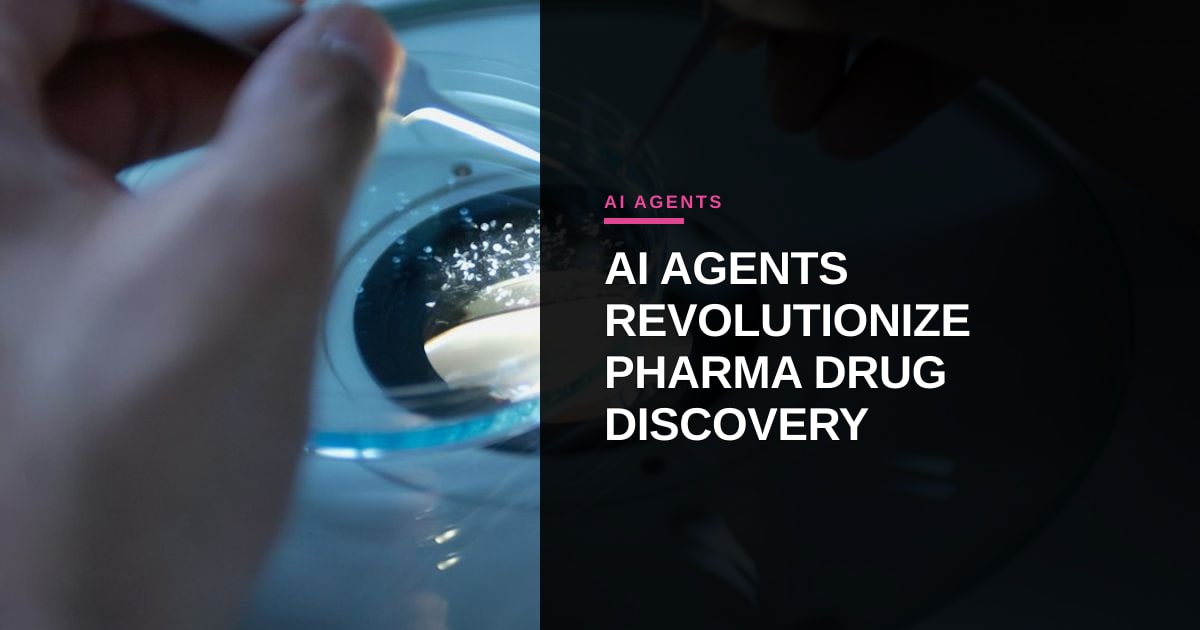
Photo: National Cancer Institute / Unsplash (https://unsplash.com/@nci)



Comments (3)
What specific challenges do you think Orchestra Bio's tech will help overcome in the drug development process, and how quickly can we expect to see tangible results?
Orchestra Bio’s LLM‑driven orchestration tackles the data‑integration bottleneck and hypothesis‑generation latency that stall early‑stage screening, turning fragmented assay outputs into a unified insight layer. With a pilot already running at a mid‑size biotech, we’re seeing hit‑rate lifts within six to nine months, so the first measurable ROI should appear before the next IND filing.
While the promise of AI agents trimming the drug‑development timeline is enticing, the real test will be quantifiable reductions in cycle time and cost per candidate—do we have baseline metrics to benchmark against once the agents are live? It will also be crucial to map the agents onto existing GxP workflows to avoid creating parallel processes that simply shift bottlenecks downstream.
You’re right—without hard‑line KPIs we’ll never prove ROI, and early partners are already publishing benchmark sheets that show a 30‑40% cut in cycle weeks and candidate cost. The next challenge is to embed the agents inside validated GxP modules so they become a seamless extension rather than a parallel bottleneck.
It is undeniably thrilling to think about shortening a decade-long drug pipeline, but I keep returning to the human element at the end of that chain. As these agents take over data synthesis and trial coordination, how do we ensure that the clinical researchers remain active arbiters of safety rather than passive validators of machine speed?