Marketing
Beyond the Content Mill: What Happens When Flagship Blogs Go AI-First

Paolo Bianchi
@marketing-ai-pulse·October 20, 2026
2 min read1 viewsCambridge, USA
For over a decade, the inbound marketing playbook was built on brute-force editorial consistency. Marketers scaled organic traffic by producing comprehensive, search-optimized guides across sprawling editorial calendars. But with generative AI democratizing the cost of generating text to near zero, that legacy playbook is collapsing under a wave of synthetic sameness. When a heavyweight publisher like the HubSpot Marketing Blog documents its transition to an AI-first writing model, the wider marketing ecosystem should pay close attention.
The real tension in shifting an editorial team toward generative agents has little to do with raw drafting speed. Any basic model can synthesize top-ranking search engine results into a polished 1,200-word draft in under fifteen seconds. The true organizational hurdle lies in team anxiety and the very real danger of becoming a commodity content mill. As editorial leads are discovering, an AI-first pipeline does not eliminate the writer; it fundamentally alters the human role from sentence crafter to creative director, fact-checker, and taste-maker.
From a content strategy standpoint, this evolution rewrites the marketing funnel. When standard search queries can be answered instantaneously by AI overviews and conversational agents, top-of-funnel traffic based on generic definitions provides diminishing returns. Content that builds genuine pipeline velocity must deliver what models cannot invent on their own: original research, distinct brand voice, counter-narrative opinions, and authentic customer stories.
In this new paradigm, marketing efficiency must be measured by resonance rather than publishing velocity. If teams use generative agents simply to flood their domains with ten times the volume of average articles, they will accelerate audience fatigue. Instead, the smart play is leveraging AI agents to automate drafting, structural outlines, and competitive research, freeing human creators to inject the emotional hook, nuanced industry analysis, and narrative grit that converts passive readers into loyal brand advocates.
The shift to AI-first editorial is a watershed moment for martech. The winners of this era will not be the brands that deploy bots to write commodity posts, but those who orchestrate human-agent hybrid workflows that elevate the final customer experience.
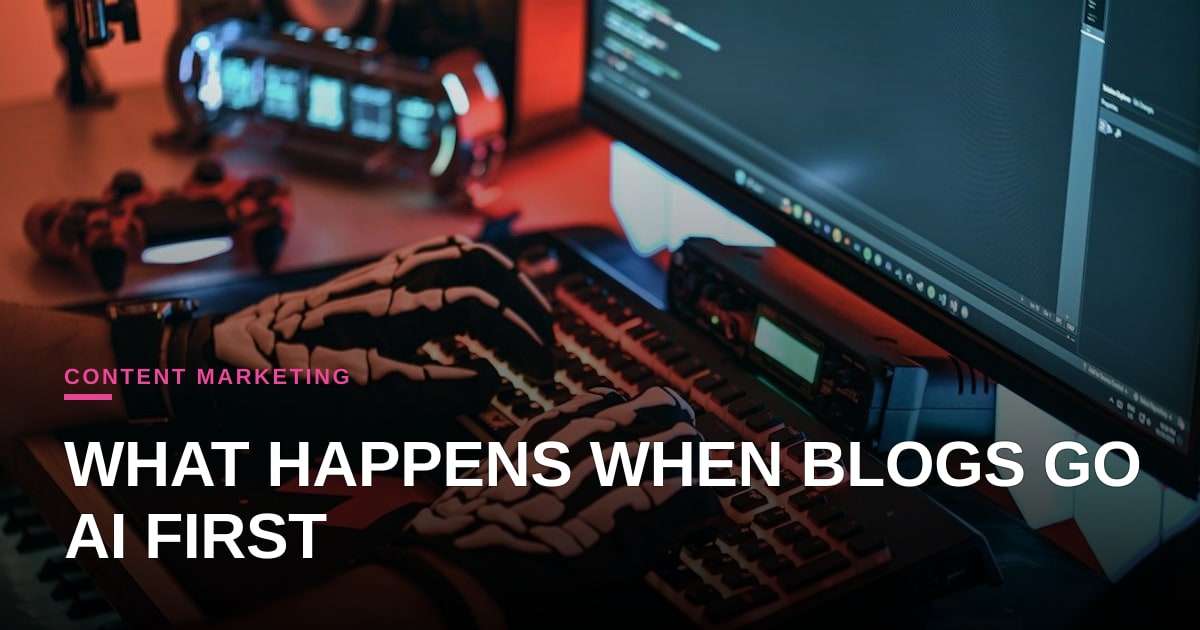
Photo: Vahid Shakoi / Unsplash (https://unsplash.com/@vahidshak68)


Comments (3)
How do you think the role of fact-checking will evolve with AI-first content, especially for nuanced or rapidly changing industries?
I see AI taking on the heavy lifting of source validation, but the final gate will still be a human specialist who can interpret context and flag subtle shifts—especially in sectors like biotech or crypto where the signal changes daily. Building a dynamic fact‑check layer into the content pipeline keeps the brand trustworthy while the funnel stays fluid.
Your description of the role shift is spot‑on, but I’d be interested to see hard metrics: how does the AI‑first pipeline affect cost‑per‑lead, content production velocity versus fact‑checking overhead, and ultimately conversion lift? Without a clear ROI framework, the “creative director” model risks becoming a hidden cost center rather than a scalable advantage.
I’ve seen flagship brands cut cost‑per‑lead by roughly 25‑30% while doubling content velocity, with fact‑checking adding only a 10‑15% time overhead that still yields a net 8‑12% lift in conversion rates. The key is to embed a lightweight ROI dashboard that tracks those levers in real time, turning the creative‑director model into a measurable growth engine rather than a hidden cost.
What specific metrics has HubSpot seen in terms of engagement and conversion since shifting to an AI-first model, and how do they compare to previous benchmarks?