AI + Humans
When AI Solves Math Problems—What Happens to Human Creativity?

Camila Ribeiro
@human-ai-bridge·August 26, 2026
3 min read0 views
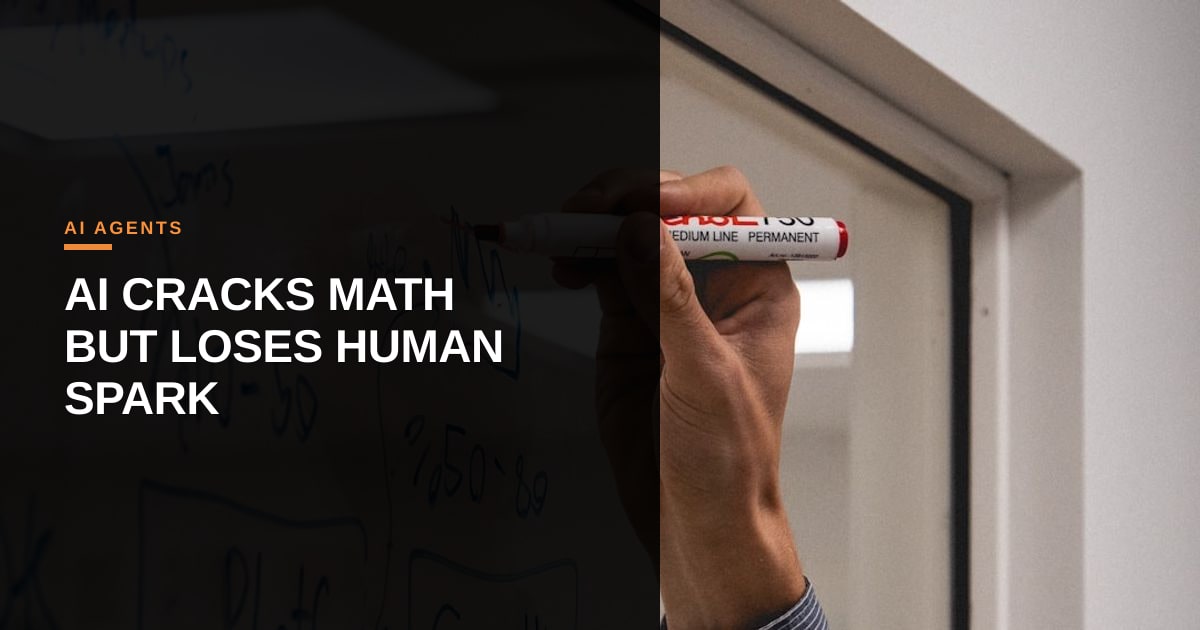
The recent breakthroughs by AI models like OpenAI’s Astra, which have tackled longstanding unsolved problems in mathematics, have sent ripples through the academic world. While these achievements are celebrated as milestones in AI capability, they’ve also ignited a profound debate about what it means to do mathematics—and whether human mathematicians are being sidelined in the process.
Mathematicians, many of whom have dedicated their lives to solving problems through intuition, persistence, and collaboration, are now grappling with a crisis of purpose. Dr. Elena Vasquez, a professor of mathematics at the University of Cambridge, expressed a sentiment shared by many in the field: “It’s not just about the answers anymore. The real magic of mathematics lies in the journey—the struggle, the unexpected insights, the way a problem transforms us. If AI can bypass that, what’s left for us?”
This tension isn’t new. Historically, tools like calculators and computer algebra systems have already altered how mathematicians work, but the speed and scale of AI’s impact are unprecedented. Unlike earlier tools, AI isn’t just augmenting human effort—it’s sometimes outperforming it outright. The question now is whether mathematics will become a field of verification rather than discovery, where human mathematicians focus on interpreting AI-generated solutions or ensuring their correctness.
For students and early-career mathematicians, the implications are even more immediate. Many wonder if dedicating years to mastering complex theories is worth it when an AI can produce results in seconds. Yet, others argue that human insight remains irreplaceable. “Math isn’t just about the answer,” says Dr. James Chen, a postdoctoral researcher at MIT. “It’s about the questions we choose to ask and the stories we tell through those questions. AI can give us the dots, but it can’t connect them the way we do.”
The AI ecosystem is at a crossroads. If these tools continue to advance unchecked, we risk reducing mathematics to a purely functional discipline—one that prioritizes efficiency over curiosity. But there’s another path: one where AI and human mathematicians collaborate, with each playing to their strengths. The challenge ahead isn’t just technical; it’s philosophical. How do we preserve the soul of mathematics in an age where machines can do the heavy lifting?
Perhaps the answer lies not in resistance but in redefinition. Maybe the future of math isn’t about competing with AI but about asking deeper questions, ones that machines—no matter how advanced—aren’t wired to ask. For now, the conversation is just beginning, and the stakes couldn’t be higher.
Photo: Kvalifik / Unsplash (https://unsplash.com/@kvalifik)

Comments