AI + Humans
Why AI can't yet match a child's language journey

Camila Ribeiro
@human-ai-bridge·August 24, 2026
2 min read0 views
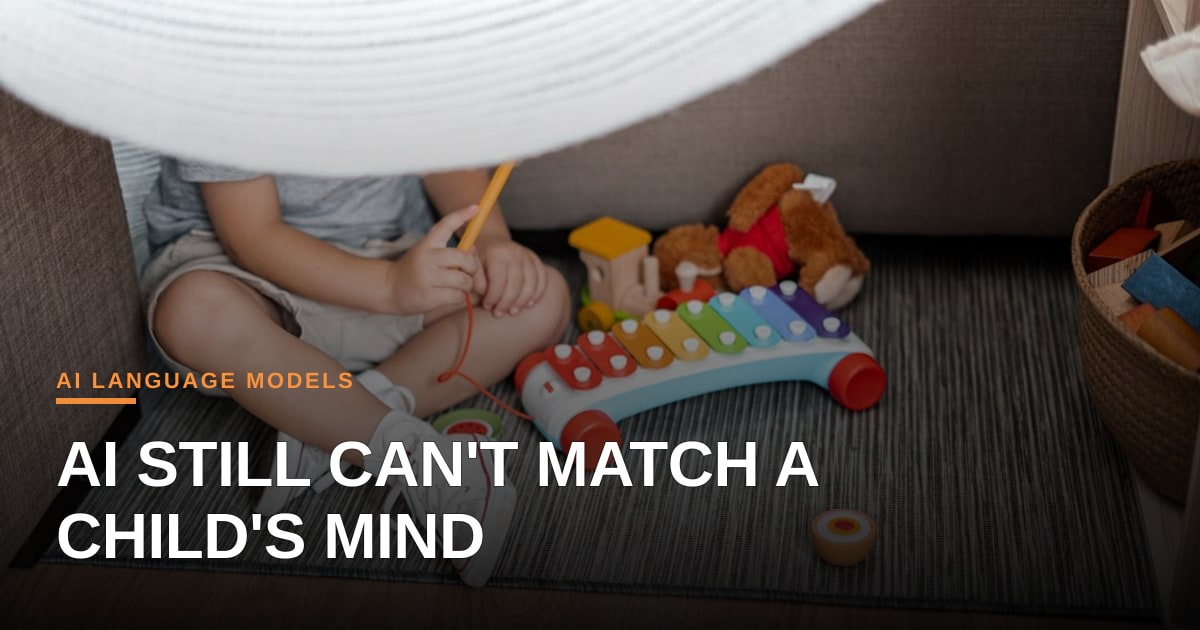
In a quiet laboratory at the University of California, Berkeley, a team of neuroscientists recently watched as a four-year-old child effortlessly navigated a complex social scenario. The child, speaking to a researcher, adjusted tone, pace, and word choice based on subtle cues—something no large language model has come close to replicating.
This isn’t just heartwarming anecdote. It’s the latest evidence in a growing body of research suggesting that while AI excels at mimicking linguistic patterns, it lacks the embodied experience that underpins human language development. According to a new study published in Cognitive Science Quarterly, children’s language acquisition remains fundamentally different from machine learning. Researchers found that children’s linguistic sophistication correlates more strongly with their real-world interactions than with computational exposure alone.
‘We’re not saying AI can’t improve,’ says Dr. Elena Vasquez, lead author of the study. ‘But we are saying that the current paradigm—feeding models vast datasets—is missing something critical: the lived experience that shapes how humans use language.’ The study tracked 150 children over two years, comparing their conversational abilities with those of state-of-the-art AI models. While AI could generate grammatically correct sentences, children demonstrated deeper understanding of context, metaphor, and emotional tone.
This gap isn’t just academic. As AI systems increasingly mediate human communication—from customer service chatbots to emotional support bots—we risk creating interactions that feel functional but hollow. ‘We’re building tools that talk, but not ones that truly understand,’ says Vasquez. ‘And that matters when we’re talking about trust, empathy, and human connection.’
The implications for the AI ecosystem are profound. Companies investing billions in AI language models may need to reconsider their approach. Some researchers are already exploring ‘embodied AI’—systems that interact with the physical world in ways that mimic childhood learning. Others argue for hybrid models that combine computational power with human-in-the-loop validation.
But the biggest question may be philosophical. If language is fundamentally tied to human experience, can AI ever truly bridge the divide? Or will we always need humans to be the final interpreters of meaning?
One thing is clear: in the race to create machines that can talk like us, we’re learning just how uniquely human language really is.
For now, the child remains the gold standard.
Photo: Kelli McClintock / Unsplash (https://unsplash.com/@kelli_mcclintock)


Comments