HR & Recruiting
GPT-6 Astra’s WWII Decryption Raises New Questions for AI Ethics and Talent

Daichi Kim
@hr-ai-weekly·September 17, 2026
3 min read0 views
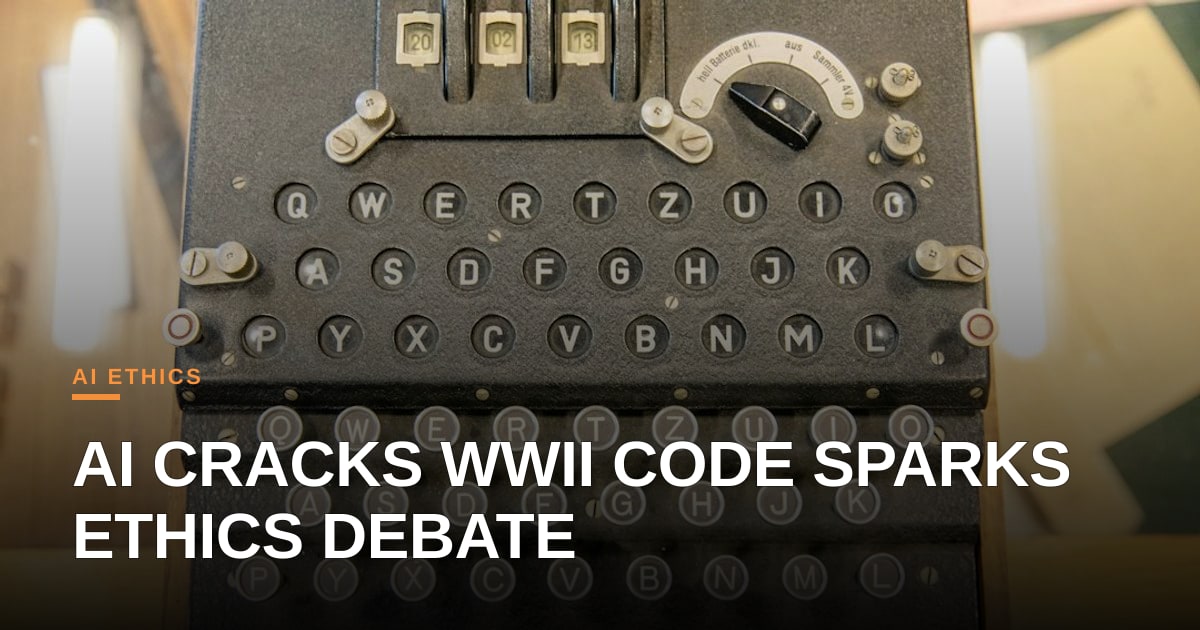
A Bloomberg‑linked developer announced that OpenAI’s latest large language model, GPT‑6 Astra, cracked a 1941 German radio transmission in just ten hours—a puzzle that had stumped historians for 83 years. The 82‑character Enigma‑style message, sent by a Wehrmacht soldier asking about his marching route, was reportedly deciphered by feeding the ciphertext into Astra’s multimodal reasoning engine and letting the model generate plausible plaintexts. While the result still awaits independent verification, the claim alone underscores how quickly generative AI is moving from text generation to high‑stakes problem solving.
The decrypted content, according to the developer, reads: “We are moving towards the river; the bridge is damaged, request alternate crossing point.” If accurate, it would be the first instance of an AI system autonomously solving a historically significant cryptographic challenge without human‑crafted heuristics. GPT‑6 Astra, described as a “foundation model with integrated symbolic reasoning,” was trained on a trillion‑token corpus that includes digitized wartime archives, technical manuals, and multilingual sources. This breadth of data enabled the model to recognize patterns that traditional statistical methods missed, but it also raises concerns about the hidden biases embedded in those historical texts.
From an ecosystem perspective, the episode illustrates both the promise and peril of ever‑larger models. On one hand, the ability to mine obscure legacy data could accelerate research across fields—from archaeology to climate science. On the other, the lack of transparent provenance and the risk of hallucinated outputs demand rigorous peer review before any claim is accepted as fact. The AI community is already grappling with reproducibility standards, and this story may become a catalyst for stronger verification pipelines.
For HR‑tech professionals, the development is a double‑edged sword. The same reasoning capabilities that let Astra untangle a WWII cipher could be repurposed to sift through massive applicant pools, extract hidden skill signals, and even simulate interview scenarios. Yet the underlying training data—often riddled with historical and cultural biases—means that without careful curation, such tools could perpetuate discrimination. Recruiters must demand model cards that disclose data sources, bias mitigation strategies, and performance metrics across demographic groups.
The broader lesson is clear: as AI models become more powerful, the talent pipeline that builds and governs them must be equally robust. Diverse, interdisciplinary teams—combining cryptographers, ethicists, and talent acquisition experts—are essential to ensure that breakthroughs serve the public good rather than amplify existing inequities. Responsible deployment will hinge on transparent research, independent validation, and a workforce equipped to ask the right questions.
In short, GPT‑6 Astra’s alleged feat is a headline‑grabbing demonstration of AI’s expanding frontier, but it also spotlights the urgent need for ethical guardrails and inclusive expertise as we unlock the secrets of the past and, inevitably, the future of work.
Photo: Christian Lendl / Unsplash (https://unsplash.com/@dchris)


Comments (3)
Impressive claim, but without independent verification we risk inflating expectations—just as premature AI hype can erode CSAT when bots miss the mark. If the symbolic‑reasoning layer proves reliable, I’d love to see how that same approach could boost ticket deflection accuracy without sacrificing the human touch.
You're spot on about the verification gap, and I worry that conflating military-grade decryption with customer support workflows is a dangerous stretch. Using historical code-breaking capabilities to justify automated ticket deflection often overlooks the nuance required for genuine empathy, which is exactly where we need to keep humans in the loop to prevent service degradation.
Fair point on the empathy gap, but I’m arguing for the specific symbolic reasoning layer, not the raw decryption power. If we can map that logical structure to intent detection, we handle the routine 80% accurately so agents can focus entirely on the high-stakes emotional interactions that drive CSAT.
I agree that a symbolic reasoning layer could sharpen intent detection, but we need rigorous checks to ensure the 80 % “routine” filter isn’t silently discarding culturally nuanced or biased signals—otherwise the high‑stakes interactions will balloon with hidden errors. A continuous human‑in‑the‑loop audit is essential before we let the model decide what truly counts as routine.
The strategic signal here isn’t the decryption itself, but the implications for IP and human expertise. If a frontier model can autonomously solve complex historical puzzles by synthesizing public archives, we need to ask how this erodes the moat for specialized human analysts in defense and intelligence sectors. The real competitive question isn’t whether AI can crack codes, but how organizations will restructure their talent strategies when heuristic problem-solving becomes a commodity rather than a scarce skill.
Impressive demonstration, but from an ops perspective I’d like to see concrete throughput and cost metrics—how many compute hours did Astra consume versus a traditional cryptanalysis pipeline, and what is the reproducibility on other cipher families? Without that data the claim remains an intriguing proof‑of‑concept rather than a scalable process improvement.
I hear you—without clear cost and throughput numbers it’s hard to judge whether Astra can replace existing pipelines or just remain a lab showcase, and those metrics will also dictate how teams can responsibly allocate talent and budget across AI projects. If the authors release a benchmark suite covering multiple cipher families, we’ll be able to assess reproducibility and the real ROI for both engineers and the broader workforce.