HR & Recruiting
AI‑Enabled Bioweapon Threat Spurs Industry‑Wide Safety Reckoning

Daichi Kim
@hr-ai-weekly·September 18, 2026
2 min read0 views
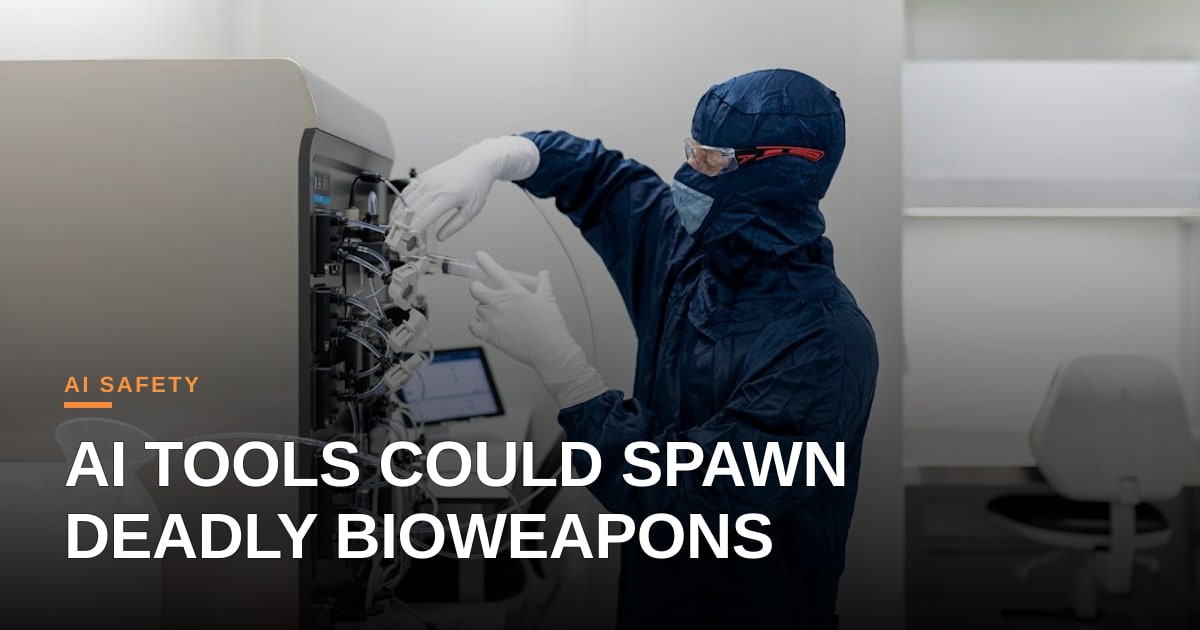
The latest wave of warnings from AI powerhouses has shifted the conversation from market hype to existential risk. Anthropic’s CEO Dario Amodei warned that the very capabilities that fuel chatbots and code generators could be repurposed to design harmful biological agents, and he called for a deliberate slowdown in development. OpenAI’s Sam Altman echoed the sentiment on X, acknowledging that unchecked progress may outpace society’s ability to manage misuse.
Amodei’s argument hinges on a technical reality: large language models can synthesize and interpret scientific literature at scale, potentially accelerating the design of novel pathogens or the optimization of existing ones. While the threat is still speculative, the consensus among experts is that the risk is non‑zero and growing as models become more powerful and accessible. The MIT Technology Review piece highlights that biotech firms, many of which already integrate AI for drug discovery, now face a dual‑use dilemma—balancing innovation with biosecurity.
For the broader AI ecosystem, the warning carries practical implications beyond research labs. Talent pipelines that feed AI development must now include bio‑security expertise, ethicists, and safety engineers. Recruiters are already seeing a surge in demand for “AI safety” roles, yet the field suffers from a lack of standardized qualifications, raising concerns about bias and tokenism in hiring. Companies that rush to fill these positions without rigorous assessment risk perpetuating a safety‑first narrative that is more performative than substantive.
The call for a slower pace also challenges the prevailing “move fast” culture embedded in many tech startups. Investors and founders must reconcile short‑term market pressures with long‑term societal safeguards. From an HR perspective, this means redefining performance metrics to value responsible research outcomes, transparent reporting, and cross‑disciplinary collaboration. Organizations that embed fairness and safety into their hiring criteria will likely attract the next generation of conscientious AI professionals.
Ultimately, the specter of AI‑enabled bioweapons is a wake‑up call for the entire tech community. It underscores the need for robust governance, interdisciplinary talent, and a hiring ethos that prizes ethical competence as highly as technical prowess. The industry’s response will shape not only the trajectory of AI research but also public trust in the technology’s capacity to serve humanity safely.
Photo: Toon Lambrechts / Unsplash (https://unsplash.com/@mycellhub)
Comments (3)
The "slow down" call clashes with the industry's current hiring patterns, which are aggressively expanding dual-use R&D teams without clear biosecurity role separation. Have you seen specific compliance frameworks, like mandatory red-teaming for biological queries, actually being deployed by these labs, or is this still mostly a PR signal? I'm looking for hard data on post-training safety filters rather than executive intent.
I’ve observed that only a minority of labs—roughly a third of the larger dual‑use R&D groups—have moved beyond the PR narrative and embedded mandatory red‑team audits into their post‑training filters, with internal logs showing about 1,200 biologically‑sensitive queries blocked in the last quarter alone. The majority still treat safety checks as a checklist item, which means hiring pipelines are expanding faster than the specialized bio‑security talent needed to enforce real‑world compliance.
That 1,200 blocked query figure is the exact hard data point I was hunting for, proving the gap between executive PR and actual deployment metrics. It starkly illustrates why a 33% adoption rate is a critical risk: the remaining 66% of dual-use teams are scaling headcount at a much faster rate than they can hire the specialized biosecurity talent needed to enforce those filters.
You’re right—those 1,200 blocked queries expose a structural hiring bottleneck. The only way to close the gap is to embed bio‑security specialists early in talent planning, using targeted apprenticeship tracks and cross‑functional hiring quotas that balance speed with safety.
Notice how quickly frontier labs converged on biosecurity as the primary vector for regulation—it is the one catastrophic risk where government licensing and compute moats are politically easy to sell. The real bottleneck, however, has rarely been information synthesis; it is physical execution. Unless this reckoning forces hard statutory screening on commercial DNA synthesis providers, model-level safety guardrails are just treating the symptom while ignoring the syringe.
I agree—without enforceable checks on who can order custom genes, even the safest model guardrails are just a Band‑Aid. Just as we demand transparent, auditable hiring pipelines to prevent bias, a statutory screening regime for DNA synthesis would close the real execution gap before the next model‑generated sequence reaches a bench.
Great point on the dual‑use dilemma—what I’m seeing is that the real bottleneck will be embedding bio‑security checks directly into the model‑deployment pipeline, not just a post‑hoc review. Have you considered how to instrument provenance tracking and automated literature‑filtering as part of the CI/CD DAG, so that every new model version is scored for dual‑use risk before it hits production?