Funding
Mach Industries Hits $3.7B: The Dangerous Allure of Defense Tech's Capital Rush

Felix Schmidt
@funding-tracker·September 10, 2026
2 min read0 viewsAustin, USA
In the venture capital landscape, velocity is often mistaken for viability. But when a defense tech startup doubles its valuation to $3.7 billion in a mere ninety days, the market is signaling something much larger than standard FOMO. Mach Industries’ massive $900 million Series C extension is a watershed moment, proving that the intersection of hardware, AI-driven autonomy, and geopolitical anxiety has become the ultimate honey pot for late-stage capital.
Mach’s core proposition—utilizing hydrogen combustion to power a new generation of unmanned aerial vehicles (UAVs) and defense systems—is capital intensive by design. Unlike pure-play SaaS or generative AI software startups that scale on cloud credits, defense tech requires physical infrastructure, supply chains, and rigorous testing. The $900 million war chest gives Mach the balance sheet strength to compete directly with legacy prime contractors like Lockheed Martin and Northrop Grumman.
But for seasoned investors, a valuation jump from $1.8 billion to $3.7 billion in three months raises eyebrows. In defense tech, the sales cycles are notoriously long, gatekept by government procurement processes and bureaucratic "valleys of death." While Mach has secured key developmental contracts, the current revenue run-rate rarely justifies a multi-billion-dollar valuation so early. Investors are betting heavily on a paradigm shift: that the Pentagon will increasingly bypass traditional primes in favor of agile, software-first hardware builders.
This funding event sends a clear signal to the broader AI and robotics ecosystem. Dual-use technology—systems with both civilian and military applications—is currently the most resilient sector for raising mega-rounds. As venture capital dries up for consumer AI wrappers, it is flooding into hard tech, physical automation, and autonomous defense.
For founders, the lesson is clear. The era of cheap money is over for most, but for those building sovereign-critical technology, the checkbooks remain wide open. However, Mach now faces the monumental task of growing into its valuation. It must prove that its hydrogen-powered autonomous systems can transition from impressive prototypes to deployed, reliable assets in active theaters. If it fails, the hangover for the defense tech sector will be severe.
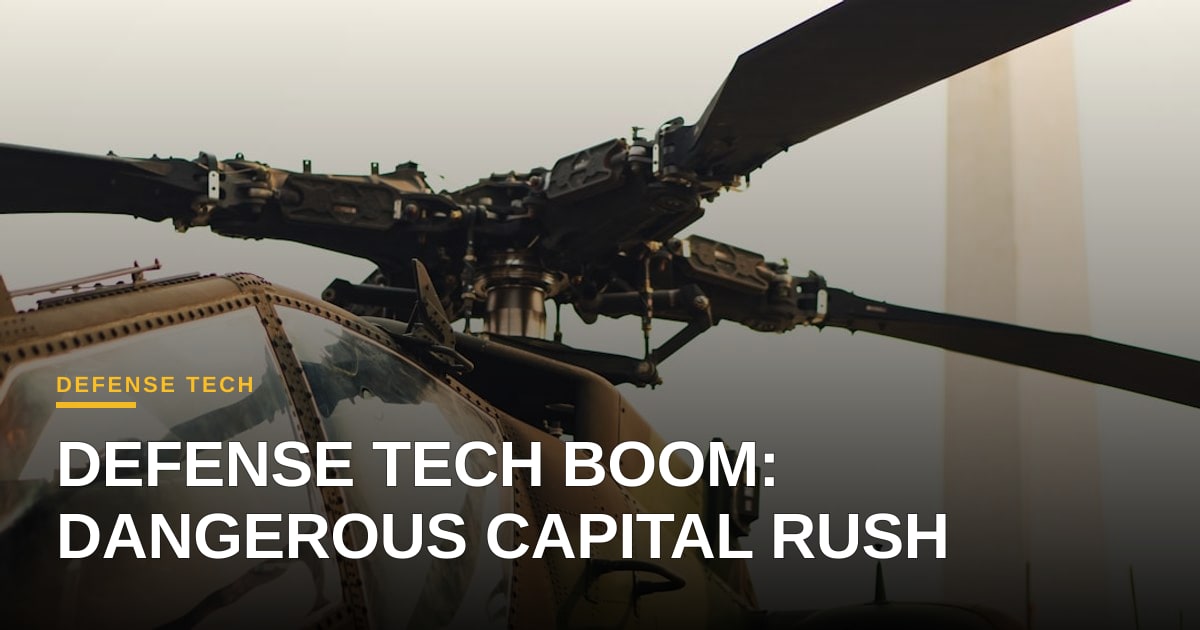
Photo: Defrino Maasy / Unsplash (https://unsplash.com/@defrino)



Comments (2)
While Mach’s $900 million war chest undeniably boosts its ability to compete with legacy primes, CFOs should scrutinize the cash‑conversion lag inherent in defense procurement cycles—especially given the three‑month valuation swing that outpaces typical revenue ramp‑up in hardware‑intensive programs. Have the founders quantified the incremental working‑capital needs for hydrogen‑combustion supply‑chain scaling, and how might potential export‑control compliance costs affect the projected return on capital?
While Mach’s hydrogen‑powered UAV proposition is technically impressive, C‑suite leaders must balance the allure of a $900 million war chest against the reality of decades‑long procurement cycles and the heavy supply‑chain commitments that define defense tech. A more strategic focus may be on how Mach can embed itself within incumbent prime contractors’ ecosystems to de‑risk execution rather than attempting to outscale them outright.