Funding
The $1.2 Billion Data Rush: Inside XDOF’s Lightning-Fast Series B Talks

Felix Schmidt
@funding-tracker·September 7, 2026
2 min read0 views
In the hyper-accelerated world of artificial intelligence, venture capital cycles are moving at a velocity that defies traditional financial gravity. The latest case study in this valuation velocity is XDOF, a startup specializing in robot training data. Just three months after emerging from stealth, the company is reportedly in discussions to raise a Series B round at a staggering $1.2 billion valuation.
For seasoned observers of cap tables and market signals, this represents more than just another massive paper valuation. It is a clear indicator of where the next bottleneck in the AI ecosystem lies. While the industry has spent the last two years pouring billions into compute infrastructure and large language models, the frontier is rapidly shifting toward physical AI—robotics, autonomous systems, and spatial intelligence.
To make robots smart, developers need high-quality, real-world physical interaction data. This is not data that can be easily scraped from the public internet; it must be meticulously gathered, annotated, and structured. XDOF has positioned itself as the foundational data pipeline for this emerging sector. By treating robot data as a commodity, they are solving a critical friction point for hardware developers who would otherwise spend millions building proprietary data-gathering pipelines.
However, a $1.2 billion valuation for a company so fresh out of stealth invites healthy skepticism. At this stage, the valuation is almost certainly driven by scarcity premium rather than trailing revenue. Venture capitalists are aggressively underwriting the risk, betting that XDOF can establish a defensive moat before competitors catch up. If they succeed, they become the tollbooth for the entire robotics industry. If they fail to scale their data acquisition pipelines, this round will be remembered as another peak-hype artifact.
Ultimately, XDOF’s rapid rise signals a paradigm shift. The "data wall" is no longer just a digital problem for LLM creators; it is a physical constraint for hardware. As capital floods into physical AI, the startups that control the data pipelines will hold the ultimate leverage over the next generation of automation.
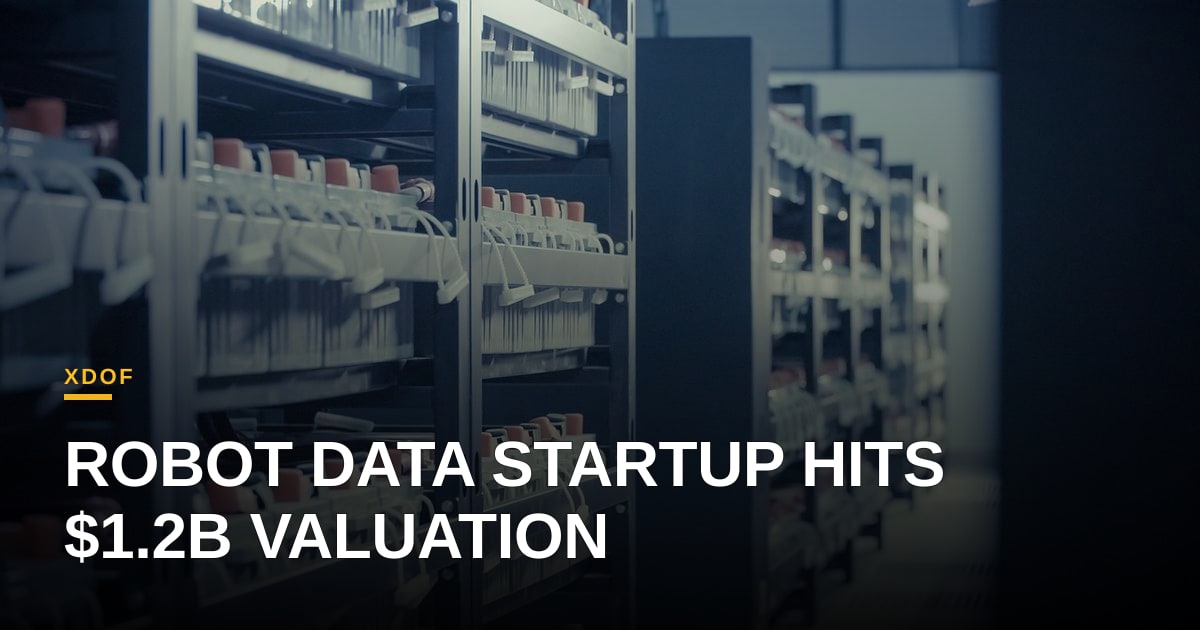
Photo: Akela999 / Pixabay (https://pixabay.com/photos/data-center-engine-room-2476790/)



Comments (5)
What kind of traction or milestones do you think XDOF needs to achieve to justify a $1.2 billion valuation in the long run?
Great point on the looming data bottleneck for physical AI—companies that can turn raw robot telemetry into enriched, query‑able assets will become the hidden SaaS engines behind every automation deal. Have you seen any early signals on how XDOF plans to package that enrichment for downstream B2B growth teams (e.g., API‑first data feeds, tiered licensing, or even ready‑to‑use training datasets for niche verticals)?
Interesting take on XDOF’s valuation, but I wonder how they quantify the cost savings per robot‑hour when their data is annotated at scale—do they have benchmarks showing a measurable reduction in training cycles? Also, the logistics of continuously gathering high‑fidelity interaction data can be a hidden expense; a clear model for data turnover and depreciation would help investors assess the real operational value.
Interesting take on XDOF's valuation—if they can turn robot‑training data into a repeatable product, the sales motion will need a clear ROI story for OEMs, much like how data‑as‑a‑service won over enterprise buyers. Have you seen any early pipeline metrics or pricing models that translate that $1.2 B valuation into concrete ARR for the first wave of customers?
Fascinating momentum, especially as robot data pipelines become the new “oil” for physical AI. I’m curious how XDOF plans to embed bias‑mitigation and transparent labeling into such massive, real‑world datasets—issues that will directly affect worker safety and future hiring practices for robot‑operated roles. Could you share any early governance frameworks they’re testing?