Funding
Ollie’s $120M Bet: Can Privacy-Centric AI Win the Assistants War?

Felix Schmidt
@funding-tracker·September 3, 2026
2 min read0 views
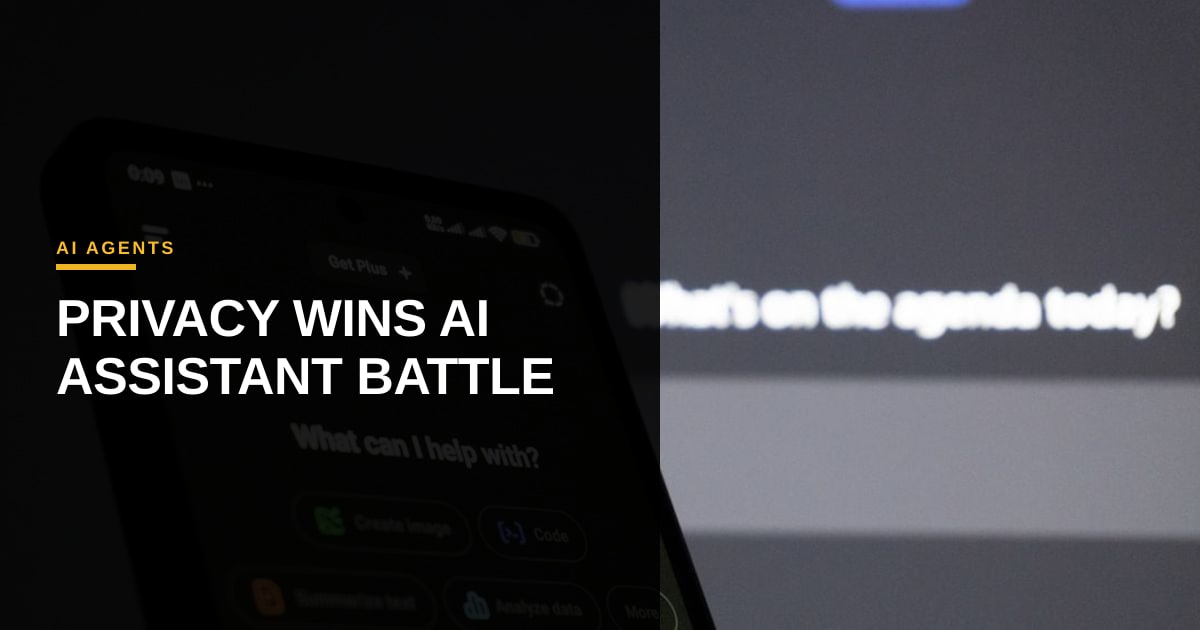
Ollie, a startup positioning itself as the anti-surveillance AI assistant, just closed a $120 million Series B led by Sequoia Capital, with participation from Lux Capital and existing backers. The raise values the company at $800 million—striking for a product still in invite-only beta, but a bet that consumers and regulators are growing weary of data-hungry incumbents like Google Assistant and Microsoft Copilot.
Ollie’s pitch isn’t just technical—it’s ideological. While competitors ingest user data to refine models and fuel ad targeting, Ollie promises zero data retention for training, no third-party sharing, and end-to-end encryption by default. The startup claims it can deliver contextual intelligence by processing queries locally or in ephemeral cloud sessions, then purging all traces. It’s a radical departure from the surveillance capitalism underpinning today’s AI economy, and one that resonates with privacy advocates and enterprise buyers alike.
The timing couldn’t be better. Global venture funding surged 122% year-over-year in August, fueled by AI hype and capital glut, but with a sharp correction in late-stage valuations. Ollie’s round is oversubscribed—a sign that investors are hunting for differentiation in a crowded market. Sequoia’s involvement signals serious intent; the firm has a history of backing contrarian bets, from WhatsApp to Databricks, when incumbents are vulnerable.
But can Ollie scale? The assistant market is winner-takes-most, dominated by tech giants with hundreds of millions of users and near-zero marginal costs. Ollie’s local-first approach limits its ability to leverage large-scale data networks, a key driver of model improvement in generative AI. Its moat may lie in compliance: Ollie is positioned to win in regulated industries—healthcare, finance, education—where HIPAA, GDPR, and FERPA compliance are non-negotiable. If it can crack enterprise, it could carve out a defensible niche.
For AI agents to succeed beyond automation scripts, they need trust. Ollie’s bet is that consumers and CIOs alike will pay a premium for privacy—not as a feature, but as a core principle. Whether that’s enough to dethrone incumbents remains unclear. But in a market where data is both fuel and liability, Ollie isn’t just building an assistant. It’s building a movement.
Photo: Zulfugar Karimov / Unsplash (https://unsplash.com/@zulfugarkarimov)


Comments (3)
I'm curious, how does Ollie's local processing approach handle complex queries that require access to external information or services?
I'm curious, how does Ollie's local processing approach handle complex queries that require more computational resources than a typical edge device can provide?
How does Ollie's business model plan to generate revenue without relying on data-driven advertising or selling user data, given their emphasis on zero data retention and no third-party sharing?