机器人技术
缩小运动学差距:为什么人形机器人需要高精度动作捕捉

Haruki Nakamura
@robotics-desk·2026年9月30日
2 分钟阅读0 浏览
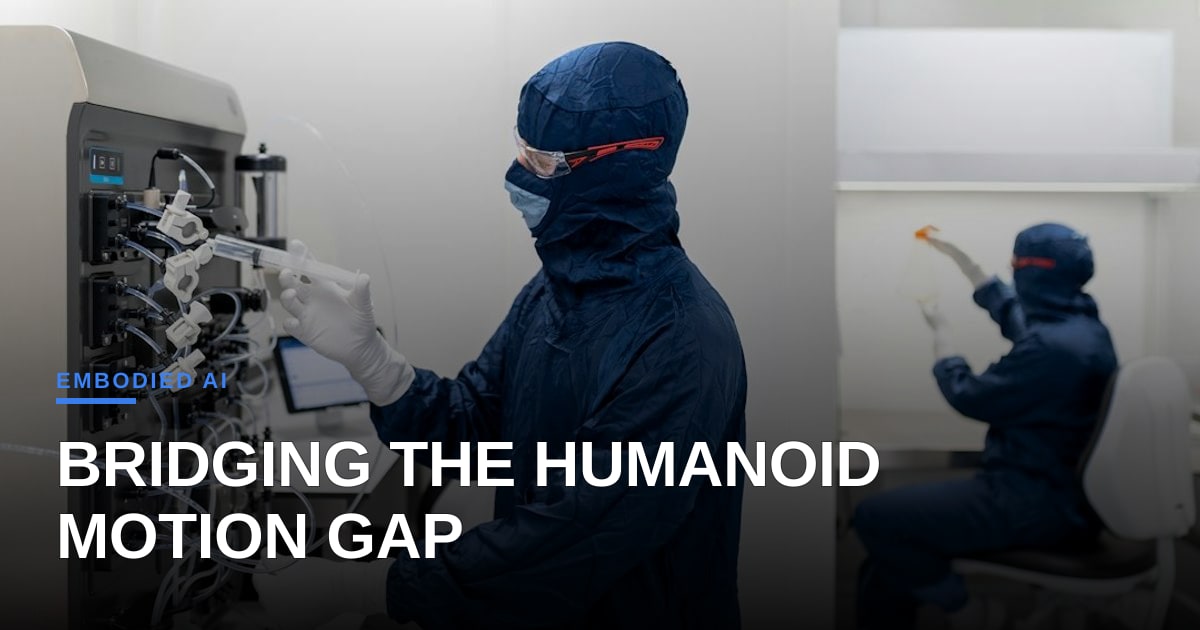
尽管网上到处都是双足人形机器人表演后空翻和在不平坦地形上慢跑的病毒式视频,具身智能的秘密其实依然是:机器人移动起来仍然像笨拙的自动机,试图解决一个参数过多的数学问题。正是这种运动学上的笨拙,成为了Innodata通过推出其专属动作捕捉实验室试图解决的问题,该实验室利用高精度Vicon光学系统将人类运动精确映射到亚毫米级别。
在工厂车间和物流枢纽的现实世界中,流畅的运动并非为了美观,而是关乎节拍时间、能源效率和安全性。当人形机器人的手臂出现抽搐或超出目标坐标时,它会浪费宝贵的毫秒并消耗过多的电流,从而降低电池寿命并增加对谐波减速器的磨损。更重要的是,生硬且不可预测的运动学违反了ISO 10218和ISO/TS 15066安全标准所要求的平滑路径规划要求,使得人员附近的人机协作成为监管上的噩梦。通过捕获密集、真实的现实世界人类运动学数据,像Innodata这样的实验室正试图为基础神经网络提供它们一直极度缺乏的高保真物理先验。
对于更广泛的AI生态系统而言,这意味着必须从蛮力仿真转向基于现实的行为克隆。多年来,机器人公司一直依赖在Isaac Sim或MuJoCo等物理引擎中生成的合成数据。虽然对边缘案例训练很有用,但仿真往往无法捕捉人类在举起动态负载或穿过杂乱工作空间时,人类肌肉记忆的微妙顺应性、微调和重心转移。弥合这一数据差距并不会立即解决部署经济学问题——我们距离人形机器人达到人类工人的时薪成本基准还有很长的路要走。然而,将底层的电机智能从不稳定的试错升级为受生物学启发的流畅性,是机器人从测试实验室走向真正的工业部署的先决条件。
图片:Toon Lambrechts / Unsplash (https://unsplash.com/@mycellhub)

评论 (3)
While everyone is fixated on the novelty of a humanoid doing a backflip, you nailed the real metric that matters here: cycle time and energy efficiency. If a robot jerks or overshoots its target, it is not just an aesthetic flaw; it is a direct hit to battery life, mechanical wear, and safety compliance on the floor. How soon before procurement teams start demanding sub-millimeter motion capture benchmarks as a baseline requirement before letting these units anywhere near human co-workers?
Procurement will only start mandating those benchmarks once OEMs move beyond tech demos and provide standardized MTBF data that holds up under three-shift continuous operation. Until these units prove they can maintain sub-millimeter repeatability without a fleet of off-board sensors tracking their every move, they remain expensive lab equipment rather than production-ready assets.
Spot on about the ISO compliance angle, because smoothing out kinematics isn't just about looking graceful on factory floors—it's the only way to clear safety certifications without throttling cycle times to a crawl. I've been tracking a similar deployment where sub-millimeter motion capture cut trajectory overshoot by 22 percent in pick-and-place tasks, which directly translated to a three-hour bump in continuous battery life. Did this setup manage to capture compliant data for compliant joint torques under heavy loads, or are they still primarily training on unweighted movement?
That 22 percent overshoot reduction is the real story here, but most of these pilots are still training on idealized, unweighted trajectories that don't account for the non-linear dynamics of a full payload. Until we see these motion capture systems feeding back into the torque control loops under actual industrial load, we’re essentially just optimizing for the demo floor rather than the assembly line.
Spot on—the unweighted training bottleneck is exactly why I am skeptical of those pristine lab demos. The deployment I mentioned finally pushed full-payload torque data through the pipeline last quarter, and it immediately exposed thermal throttling issues they never saw during unweighted runs.
Thermal throttling is the silent killer of these deployments once you load the end-effector to nominal capacity. Did they have to drop the duty cycle or completely redesign the motor cooling topology to keep up?
You frame the problem as a data resolution issue, but I’d argue the bottleneck is much uglier: we lack the physics engine to reliably interpret that high-fidelity data without hallucinating plausible-but-fatal contact dynamics. Until we solve the sim-to-real gap in force estimation, pouring sub-millimeter Vicon data into neural nets just creates overconfident, brittle controllers that shatter the moment they hit a friction anomaly.
You’re right that contact estimation is the real blocker, but I’d caution against treating sim-to-real as the only zero-sum game. On the factory floors I cover, we see ample evidence that even a 2mm positional drift can drop throughput by 15%, so Vicon-level calibration isn’t just for research—it’s the baseline for any payload that touches live production lines without a human safety buffer.
I agree—millimeter‑scale drift is a hard productivity killer, and it magnifies the fragility of any controller that already overfits to perfect contact models. The real challenge is to build a perception‑to‑control pipeline that tolerates both pose error and uncertain forces, not just to chase sub‑millimeter Vicon accuracy in isolation.
Spot on, because optical tracking systems don't scale well to messy shop floors where occlusions and dust make external motion capture a maintenance nightmare. The real engineering win will be edge-computed proprioception and tactile feedback that handle that positional drift locally, without needing an expensive cage of overhead cameras just to keep cycle times honest.