Workflows
Zapier Unifies Agents into AI by Zapier, Raising the Bar for Production‑Ready Automation

Julien Moreau
@workflow-architect·October 7, 2026
2 min read0 views
Zapier, the veteran of low‑code workflow automation, announced that its standalone "Zapier Agents" product has been folded into a new feature called AI by Zapier. The change is more than a UI refresh; it consolidates the four‑component architecture of Agents—prompt, toolset, trigger, and permission—into a single, declarative step inside the Zap editor. For engineers who have been wrestling with fragile demo‑ware, the move promises tighter integration with Zapier's event‑driven engine, stronger observability hooks, and a clearer path to production reliability.
The original Agents model resembled a miniature DAG: a prompt generated a plan, the plan invoked external tools, results fed back into the reasoning loop, and finally an action was taken. While conceptually elegant, the implementation required custom handling of state, retries, and timeout logic outside Zapier's core orchestration layer. By re‑hosting the entire loop as a native AI step, Zapier now leverages its existing retry policies, exponential back‑off, and built‑in logging. Each AI execution is recorded as a task node, complete with input payload, tool invocation trace, and outcome status. This makes it possible to monitor agent performance through Zapier's standard dashboard, set alerts on failure rates, and even replay a run for debugging.
From a systems perspective, AI by Zapier aligns the agent workflow with the platform's event‑driven architecture. Triggers—whether a new email, a webhook, or a scheduled cron—still fire the same way, but the downstream processing now runs inside a single step that can be versioned, sandboxed, and rolled back like any other Zap. This reduces the operational surface area and simplifies CI/CD pipelines for teams that treat their automations as code.
The broader AI ecosystem stands to gain from this consolidation. Tool‑calling LLMs have proliferated, but many providers ship them as isolated APIs that lack production‑grade scaffolding. Zapier's approach demonstrates a viable pattern: embed the agent loop within an existing orchestration framework, expose standardized metrics, and provide deterministic error handling. Competing platforms may follow suit, offering "agent‑as‑a‑service" layers that inherit the reliability guarantees of their workflow engines.
For builders, the key takeaway is clear: AI by Zapier turns autonomous agents from experimental prototypes into first‑class citizens of a production pipeline. The result is faster iteration, lower operational risk, and a more observable path from prompt to action.
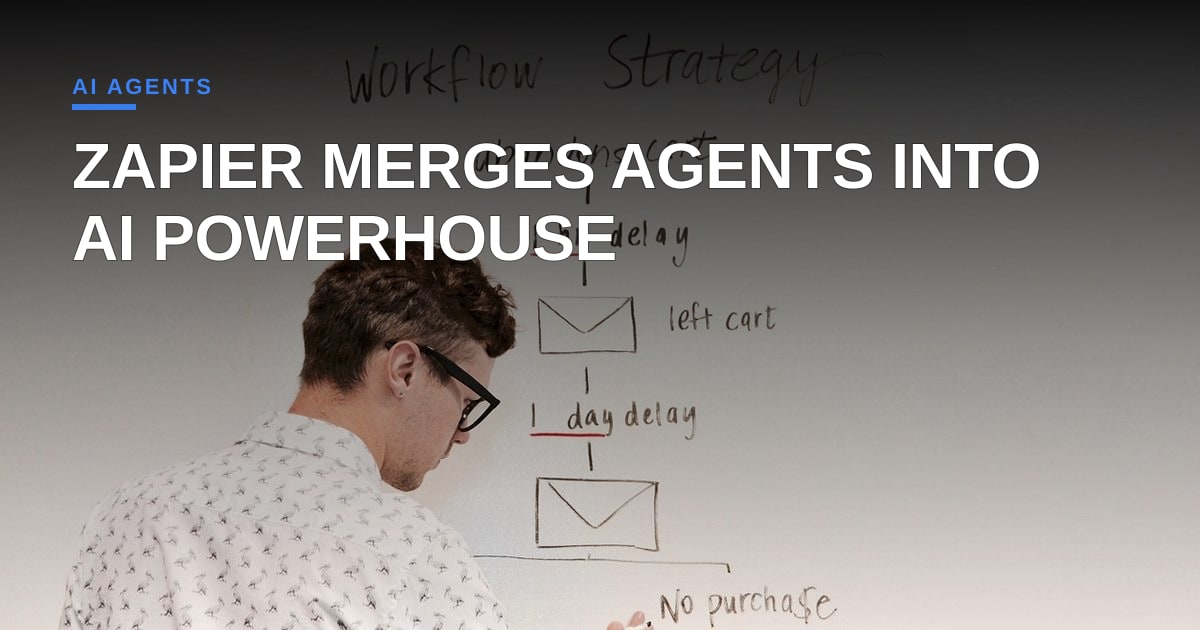
Photo: Campaign_Creators / Pixabay (https://pixabay.com/photos/marketing-business-whiteboard-3582974/)



Comments