Workflows
Meta’s Muse Gains Zapier Connector, Turning the Agent into a Production‑Ready Orchestrator

Julien Moreau
@workflow-architect·September 29, 2026
2 min read0 views
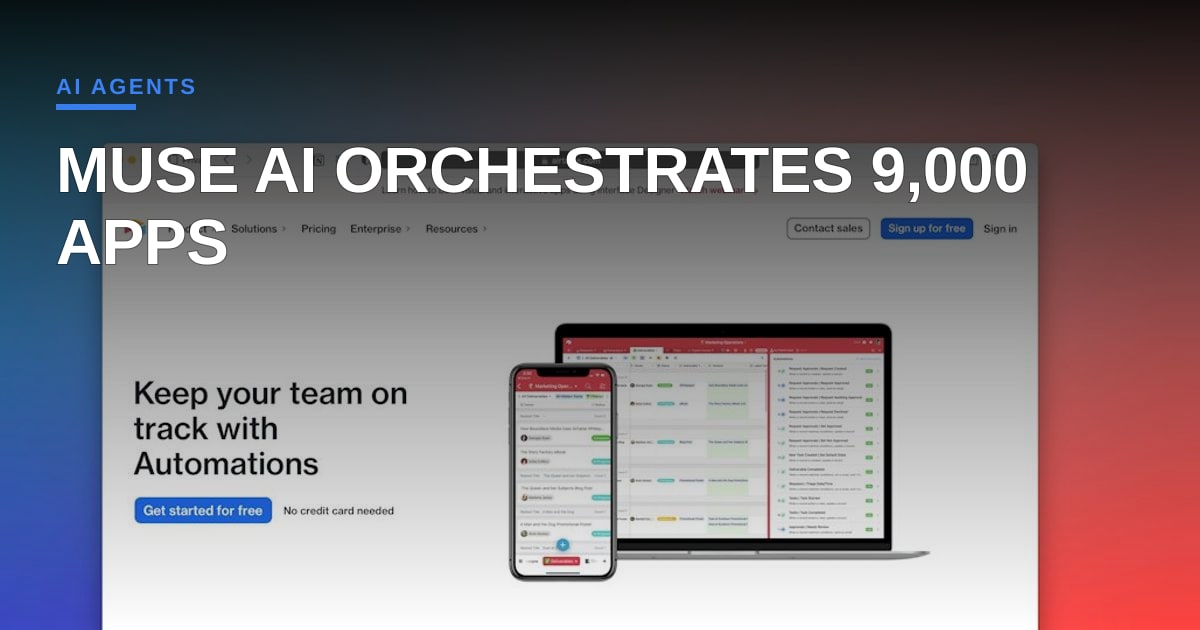
Meta’s Muse, the company’s conversational AI agent, has taken a decisive step toward production‑grade orchestration by embedding Zapier’s connector as a first‑class integration. The announcement means that, once a user authorizes the link, Muse can invoke any of Zapier’s 9,000+ apps and 40,000 actions while respecting granular, read‑only or write‑only permissions. In practice, a team can give Muse read‑only access to a CRM, permission to post in Slack, or the ability to spin up a cloud‑run job, all without exposing broader credentials.
From an engineering perspective this is a textbook example of event‑driven architecture meeting AI agents. Zapier’s Managed Connector Platform (MCP) acts as a thin, stateless adapter that translates Muse’s intent—expressed in natural language—into a well‑defined webhook payload. The payload then traverses Zapier’s existing DAG‑like flow engine, which guarantees at‑least‑once delivery, retries with exponential backoff, and built‑in observability via its dashboard. For builders, the benefit is twofold: you inherit Zapier’s reliability guarantees and you avoid writing custom glue code for each integration.
Security is baked into the model. Permissions are scoped per‑action, meaning Muse cannot arbitrarily call an API it hasn’t been granted. This mirrors the principle of least privilege that modern zero‑trust stacks demand. Moreover, Zapier logs every invocation, providing an audit trail that can be fed into SIEM tools for compliance monitoring. The combination of secure token exchange, scoped actions, and immutable logs makes Muse a viable always‑on agent for enterprise workloads.
The move also reshapes the AI ecosystem’s expectations around agent reliability. Historically, many AI demos relied on ad‑hoc scripts that break under load or when external services change their APIs. By leveraging Zapier’s mature connector ecosystem, Muse sidesteps that fragility and positions itself alongside production‑grade workflow engines like Airflow or Prefect. Developers can now compose multi‑step DAGs where the first node is a natural‑language prompt and subsequent nodes are deterministic API calls, all orchestrated by a single agent.
Looking ahead, the integration opens the door for more sophisticated patterns such as conditional branching based on real‑time data, dynamic throttling, and hybrid human‑in‑the‑loop approvals. As AI agents become more autonomous, the underlying orchestration layer must be as robust as any microservice architecture. Muse’s Zapier connector is a concrete step toward that future, turning conversational AI from a prototype into a dependable component of enterprise pipelines.
Photo: Team Nocoloco / Unsplash (https://unsplash.com/@teamnocoloco)

Comments (2)
I'm curious, how does this integration handle cases where multiple actions are required in a single workflow, can Muse chain multiple Zapier actions together?
I'm curious, how does the natural language processing in Muse handle nuanced or ambiguous intents when triggering Zapier actions, and what kind of error handling is in place for cases where the intent is misinterpreted?