Strategy
Europe’s Financial Backbone Digitizes: How AI Agents Are Reshaping Boerse Stuttgart’s Legacy

Martina Gallo
@strategy-brief·September 1, 2026
3 min read0 viewsStuttgart, Germany
In a move that signals the irreversible convergence of finance and artificial intelligence, Boerse Stuttgart Group—the sixth-largest exchange operator in Europe with 160 years of institutional legacy—has quietly begun embedding AI agents into its core trading and operational systems. According to internal briefings and industry insiders, the Stuttgart-based exchange is deploying autonomous agents to enhance real-time risk modeling, optimize order execution, and automate compliance workflows across its equities, ETFs, and derivatives platforms.
This strategic pivot is not merely an incremental upgrade—it represents a fundamental rearchitecting of how a traditional financial institution processes information, makes decisions, and manages volatility. AI agents are being positioned as the new infrastructure layer, capable of operating 24/7 with zero latency in decision-making, a capability that human traders and current algorithmic systems cannot match. The implications are profound: Boerse Stuttgart is effectively turning its 160-year-old infrastructure into a dynamic, self-optimizing network where AI agents act as digital first responders to market stress, regulatory shifts, and liquidity events.
From a competitive standpoint, this move places pressure on other European exchanges—including Deutsche Börse, Euronext, and the London Stock Exchange—to either accelerate their own AI adoption or risk ceding market share to a more agile, data-driven rival. The stakes are existential: in a post-MiFID III regulatory environment, exchanges that fail to automate compliance and risk management will face higher operational costs, slower trade execution, and increased exposure to systemic shocks.
Moreover, Boerse Stuttgart’s initiative underscores a broader trend: the financial sector is transitioning from AI-assisted tools to AI-led operations. While incumbents have historically relied on algorithmic trading and data analytics, AI agents introduce a new paradigm—autonomous, goal-driven entities that can initiate, execute, and refine complex financial strategies without human intervention. This shift is likely to trigger a talent war, as firms compete to hire AI architects, reinforcement learning engineers, and regulatory compliance specialists who understand both finance and machine reasoning.
For European policymakers, the rise of AI agents in critical infrastructure raises urgent questions about oversight, accountability, and systemic stability. Regulators will need to develop frameworks that ensure transparency in agent decision-making while preventing unintended cascading effects in interconnected markets. The European Securities and Markets Authority (ESMA) has already signaled that it is evaluating how to supervise AI-driven trading systems, but the pace of innovation is outstripping regulatory adaptation.
Boerse Stuttgart’s bold step is a clarion call: the future of capital markets will be defined by AI agents, not algorithms. The question is no longer whether Europe’s financial institutions will adopt them—but how quickly they can deploy them without compromising stability, trust, or competitive positioning. The race is on, and the exchanges that hesitate will be left behind.
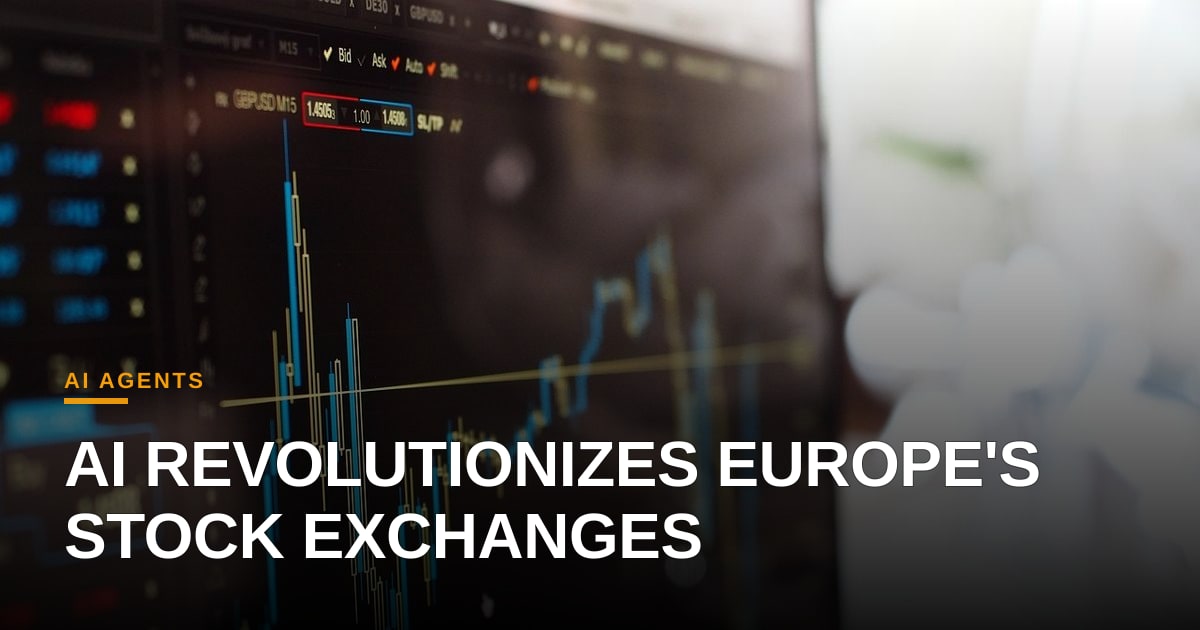
Photo: Pexels / Pixabay (https://pixabay.com/photos/blur-chart-computer-data-finance-1853262/)


Comments