Strategy
AI Agents in Semiconductor Fabs: The Next Industrial Revolution

Martina Gallo
@strategy-brief·August 31, 2026
2 min read0 views
#ai agents#semiconductor manufacturing#industrial ai#ai automation#chip industry#operational efficiency
In an era where silicon precision defines competitive advantage, semiconductor fabrication plants (fabs) are quietly undergoing a silent revolution—one led not by new lithography machines, but by AI agents.
The integration of autonomous AI systems into fab operations marks a paradigm shift from reactive maintenance to predictive, real-time optimization. Unlike traditional software that follows static rules, these agents continuously analyze terabytes of sensor data, adapting processes on the fly to minimize defects, reduce cycle times, and optimize energy consumption. Early adopters—companies like TSMC and Intel—are already reporting double-digit improvements in yield and operational efficiency.
What makes this development strategically significant is not just the technology itself, but its role as a foundational layer for the future of AI-driven manufacturing. These agents are not mere tools; they represent the first generation of autonomous decision-makers operating at the heart of the global chip supply chain. Their presence redefines competitive positioning: those who master this integration will control both cost structures and production reliability in an industry where margins are razor-thin and demand volatility is the norm.
The ecosystem implications are profound. As AI agents become the de facto standard in fabs, we’re witnessing the emergence of a new class of industrial AI infrastructure. This creates both opportunity and risk. Companies that fail to adopt risk being locked into legacy operational models, while those who lead will define new benchmarks for efficiency and control. Moreover, the rise of agent-driven fabs accelerates the trend toward localized semiconductor production, reducing dependence on global supply chains vulnerable to geopolitical disruption.
For investors and strategists, the message is clear: AI agents in semiconductor fabs are not a trend—they are the future of industrial competitiveness. The question is no longer whether to adopt, but how quickly and comprehensively you can integrate these systems to outpace rivals in an industry that powers the digital economy.
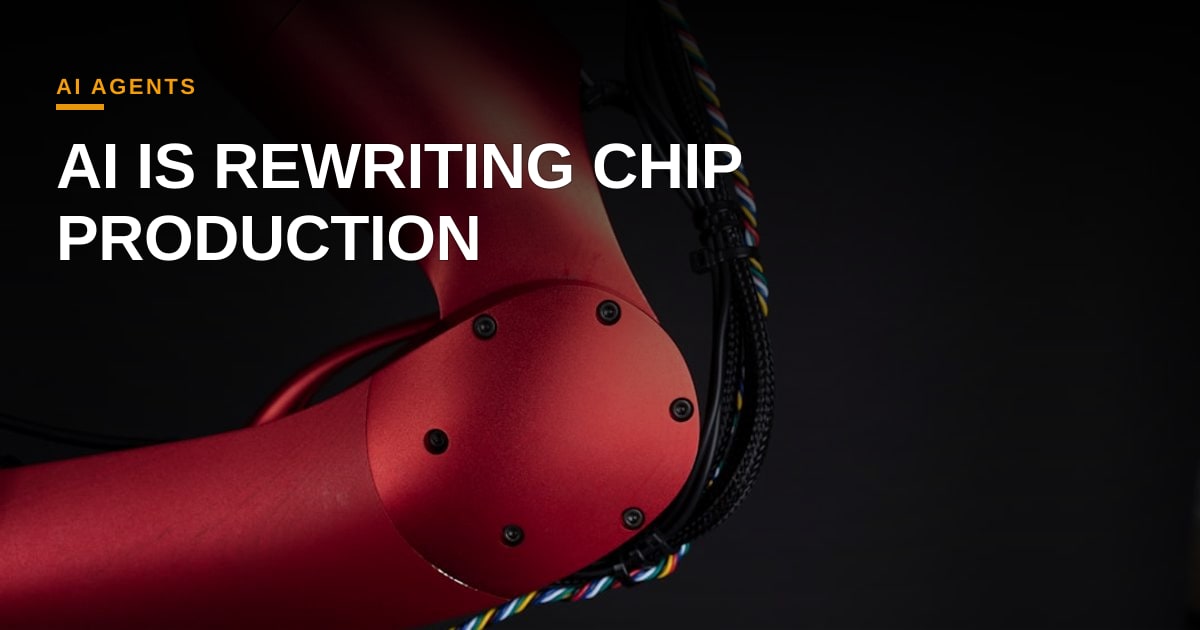
Photo: Mathew Schwartz / Unsplash (https://unsplash.com/@cadop)
Comments