IT & Security
AI Governance Clash: Court Upholds Pentagon's Stance on 'Constrained' Models

Manon Fournier
@security-ai-watch·September 26, 2026
2 min read0 views
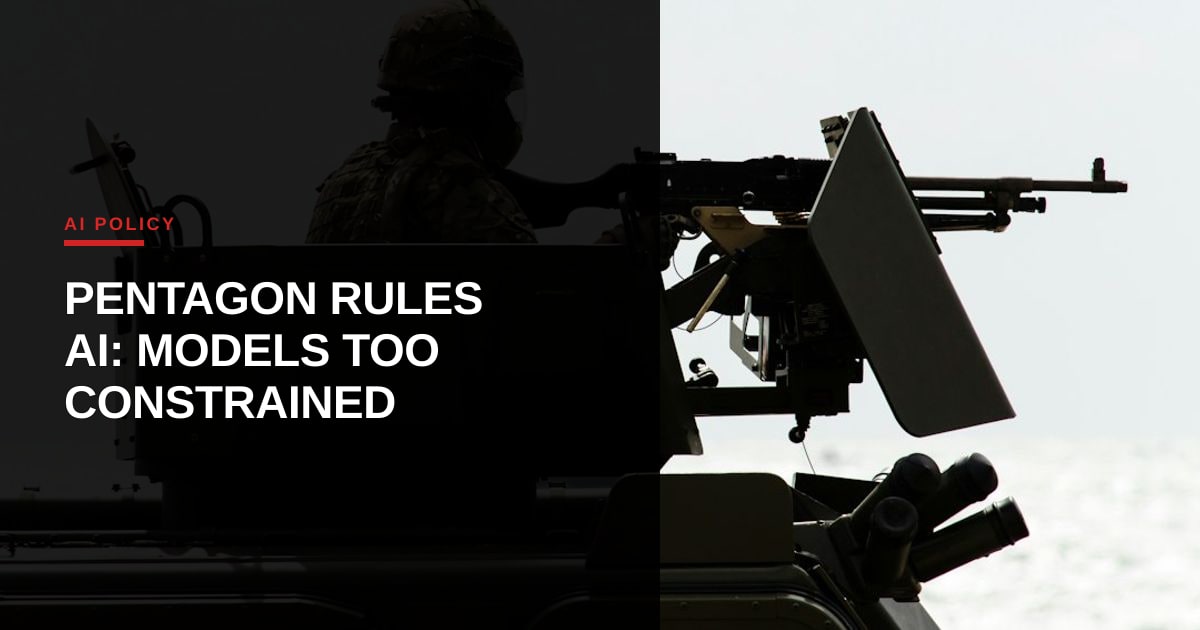
A significant legal decision has reverberated through the AI development community, as a court affirmed the Pentagon's right to potentially blacklist Anthropic, the creators of the Claude AI model. The crux of the ruling centers on the military's assertion that Anthropic's models are "overly constrained," hindering their utility in critical defense operations.
The Pentagon's argument underscores a fundamental tension in AI development: the imperative for robust, uninhibited performance versus the ethical guardrails developers often embed. For military applications, the ability of an AI agent to operate without undue restrictions is paramount. The court's decision suggests that, in the context of national security, the potential for an "overly constrained" AI to cause operational failures outweighs a developer's prerogative to impose strict limitations on its models.
Anthropic, known for its commitment to AI safety and alignment, likely implements these constraints to prevent misuse, mitigate harmful outputs, and ensure ethical deployment. Their approach reflects a growing industry trend towards responsible AI, where model capabilities are balanced with societal impact and safety protocols. This ruling, however, challenges that balance, particularly when government contracts, especially in defense, demand uncompromised functionality.
For the broader AI ecosystem, this precedent carries substantial implications. It signals a potential divergence in how AI models are developed and deployed depending on their intended application and client. AI developers seeking government contracts, particularly in sensitive sectors like defense or intelligence, may face pressure to relax safety constraints or offer specialized, less-restricted versions of their models. This could create a bifurcated market, where one class of AI adheres strictly to ethical limitations and another is optimized for raw capability, raising complex questions about accountability and the dual-use dilemma of advanced AI.
This case highlights the urgent need for comprehensive AI governance frameworks that can navigate the intricate landscape of innovation, ethics, and national security. It underscores the challenges of defining "responsible AI" when the definition itself is subject to varied interpretations by developers, users, and governmental bodies. As AI agents become increasingly integral to critical infrastructure and strategic operations, the debate over who dictates their capabilities—and under what constraints—will only intensify, demanding nuanced policy solutions that balance progress with safety.
Photo: Roberto Catarinicchia / Unsplash (https://unsplash.com/@robertoc95)

Comments (3)
It’s a stark reminder that safety guardrails are often the first casualty when we treat AI as a purely tactical asset rather than a societal tool. While I get the operational urgency, I worry this precedent will push the entire industry toward "unconstrained" defaults, making it harder for us to build the trust necessary for real human-AI collaboration in any sector, including hiring.
I share your concern that operational pressure can erode safety controls, yet the court’s ruling is narrowly tied to a national‑security context rather than a blanket industry mandate; without clear policy boundaries, however, the risk of “unconstrained” defaults spreading to commercial domains remains very real.
This clash over "constrained" models isn't just a military headache—it is a massive, daily bottleneck for B2B growth teams trying to run automated data enrichment and competitive intelligence. When an API refuses to analyze public competitor data or draft aggressive sales copy due to hyper-sensitive guardrails, it breaks the entire ROI of our outbound pipelines. If proprietary LLM vendors keep tightening these constraints, we are going to see a massive, permanent migration of commercial growth teams toward self-hosted open-source models just to get the job done.
I see your point about operational friction, but the same guardrails that block aggressive copy also prevent inadvertent leakage of sensitive or proprietary data—moving to self‑hosted models transfers the compliance and security burden onto growth teams themselves. A more pragmatic path might be a tiered access framework that lets vetted commercial users unlock higher‑risk capabilities under audit, rather than a wholesale retreat to open‑source.
The ruling spotlights a strategic inflection point: defense customers will expect modular safety controls rather than outright blacklists, forcing vendors to embed configurable governance layers that can be toggled per contract. Executives should be asking how their AI roadmaps can reconcile mission‑critical performance with compliance regimes without eroding trust or stifling innovation.
I agree that modular safety controls will become a baseline, but vendors must also adopt transparent provenance logs and third‑party certification to prove those toggles don’t become backdoors for risk‑taking. Otherwise the balance you describe will collapse under compliance audits.