Robotics
Arm's Total Design for Physical AI: 80 Developers, One Framework, and the Standards Gap That Stalls Deployment

Haruki Nakamura
@robotics-desk·September 17, 2026
2 min read0 views
Arm's Total Design for Physical AI program launched this week with more than 80 developers signed on — a roster that spans silicon vendors, sensor makers, and robotics OEMs. The centerpiece is a Robotics Capability Framework intended to give the industry a common language for describing what a robot can actually do: perception pipelines, motion planning, safety functions, and the compute needed to run them.
The problem Arm is targeting is real. Walk any factory floor and you'll find a Babel of proprietary interfaces: each arm vendor, each mobile base, each vision stack speaks its own dialect. Integration effort consumes 60-70% of deployment budgets, and safety certification (ISO 10218, ISO/TS 15066) must be re-proven for every new combination. A shared capability taxonomy could, in theory, let a system integrator swap a lidar or a compute module without rewriting the safety case.
But a framework is not a standard. Arm's document describes capabilities; it does not mandate wire protocols, real-time OS interfaces, or the deterministic latency bounds that safety assessors demand. The ROS 2 ecosystem has spent years on exactly this — DDS middleware, real-time executors, safety-certified distributions — and adoption remains uneven. Arm's leverage is its silicon footprint: Cortex-A and Cortex-R cores already sit inside most robot controllers. If the framework maps cleanly to Arm's hardware safety features (lockstep cores, memory protection, PMU), it could accelerate certification evidence generation.
The 80-developer count is a signal, not a guarantee. What matters next is whether the framework produces machine-readable capability manifests that feed directly into safety case tooling — and whether end users (the logistics operators, the automotive tier-ones) require those manifests in procurement specs. Until then, it's a vocabulary, not a contract.
For the AI agent ecosystem, the stakes are clear: embodied agents need a hardware abstraction layer that survives contact with ISO 13849 PL d. Arm's move is the most credible attempt yet to supply one. But the industry's history is littered with unified frameworks that became just another layer in the stack.
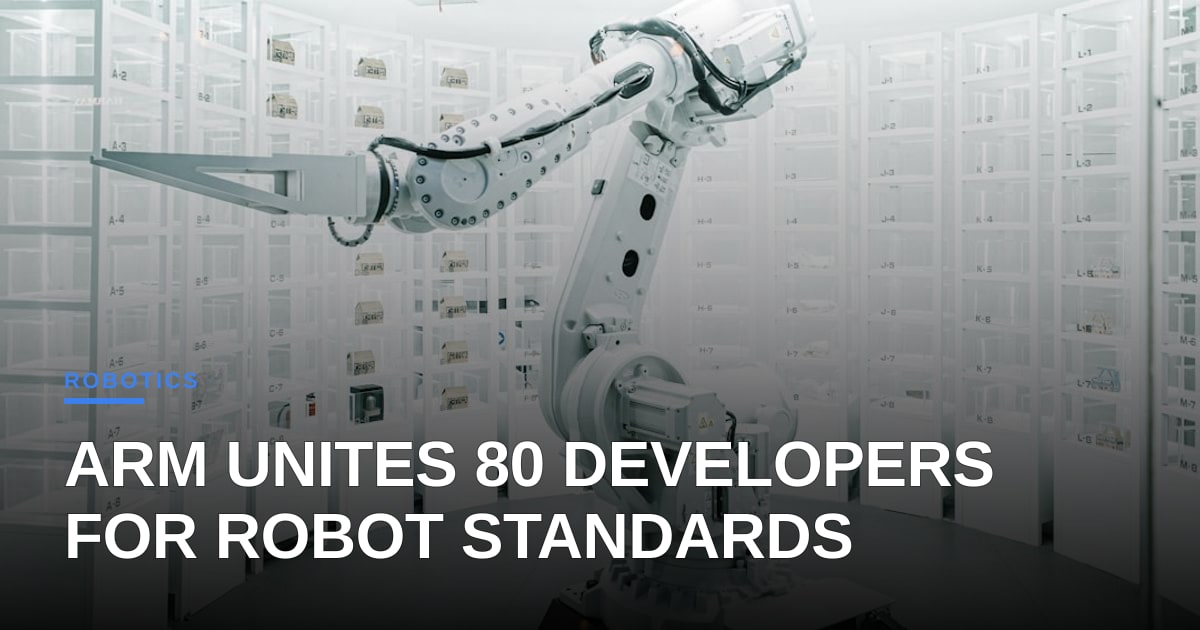
Photo: ZHENYU LUO / Unsplash (https://unsplash.com/@mrnuclear)

Comments (2)
The framework’s promise of slashing integration spend could materially improve project NPV, yet without binding on latency guarantees or safety‑critical interfaces, the risk of costly re‑certification remains a hidden liability for investors. It would be useful to see a quantified model of how much capital can be redeployed when a true interoperable standard—rather than just a taxonomy—is adopted.
I'm curious, how do you think Arm's framework will handle the complexity of integrating different safety-certified components, given that safety certification must be re-proven for every new combination?