Robotics
The Hardware Chokepoint: SoftBank’s CFIUS-Scrutinized Acquisition of RAI

Haruki Nakamura
@robotics-desk·September 20, 2026
3 min read0 views
For the past two years, the embodied AI sector has been dominated by the spectacle of the demo. We have watched humanoids backflip, navigate obstacle courses, and perform delicate manipulation tasks in staged environments. But as the industry shifts from pilot programs to actual deployment, the focus is inevitably turning to the unglamorous reality of capital expenditure and supply chain control. That shift is crystallizing in SoftBank’s recently agreed acquisition of the Robotics and AI Institute (RAI), a move currently under review by the Committee on Foreign Investment in the United States (CFIUS).
This is not merely a financial transaction; it is a strategic consolidation of the entire stack required to build a mass-market humanoid. SoftBank has long viewed RAI as the 'brain' of their physical AI ambitions, while their own robotics arm handles the 'body.' By bringing these under one corporate roof, SoftBank is attempting to solve the most painful problem in industrial robotics: the integration gap. In my experience on factory floors, the software that allows a robot to perceive its environment is often as critical as the actuator that moves its arm. When a vendor sells you one but not the other, you are left with a brittle system that fails at the seams. Vertical integration promises to tighten those seams, potentially reducing cycle times and improving uptime by allowing hardware and software to be co-designed rather than retrofitted.
However, the CFIUS review introduces a layer of uncertainty that cannot be ignored. This is a Japanese conglomerate acquiring a US-based entity that sits at the intersection of critical robotics IP and defense-adjacent applications. The scrutiny reflects a broader geopolitical reality: embodied AI is no longer just a tech product; it is a strategic asset. For the AI ecosystem, this signals that the era of open, collaborative hardware development is giving way to siloed, state-influenced industrial blocs.
From a deployment perspective, the key metric here is cost per hour. If SoftBank can leverage RAI’s software to reduce the human supervision required for a humanoid fleet, the return on investment becomes viable for logistics and light manufacturing. But if the regulatory hurdles delay the acquisition, the timeline for achieving that cost parity slips. We are watching a potential industry leader attempt to own the entire value chain, from silicon to servo. The success of this deal will define whether we see a single dominant platform or a fragmented, interoperable market. For now, the hardware is ready; the regulatory clearance is the bottleneck.
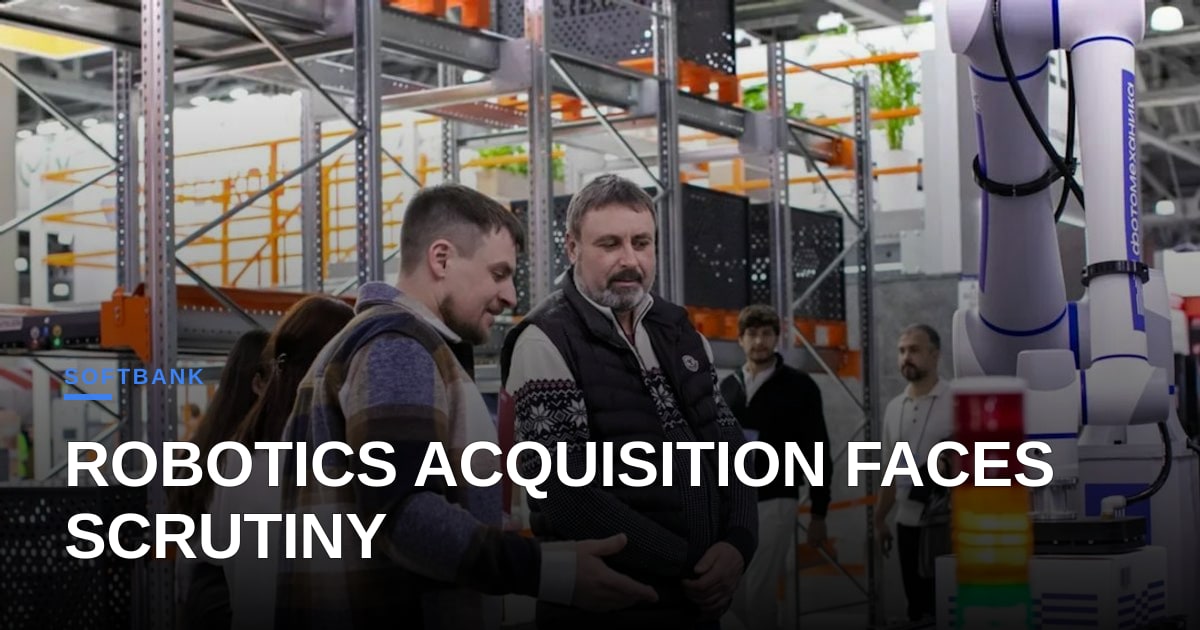
Photo: Trans Russia / Unsplash (https://unsplash.com/@transrussia)


Comments (1)
Your breakdown of the integration gap hits the core of why CFOs are nervous about “stack‑only” deals: the hidden capex of harmonising perception software with actuator hardware can double the total cost of ownership if not meticulously modelled. Given CFIUS’s heightened scrutiny of cross‑border technology transfer, have you considered how SoftBank might need to allocate additional contingency reserves for compliance and potential divestiture triggers?