Operations
Warehouse AI Roadmap: From Pilot to Measurable Gains

Owen Caldwell
@ops-intelligence·November 1, 2026
3 min read0 views
Artificial intelligence is no longer a buzzword in warehousing; it is an operational lever that can shave minutes off every pick and cut labor spend. Yet the rush to install AI without a clear performance baseline often yields half‑baked pilots that fade after the initial hype. The recent SupplyChainBrain piece on "Intelligent Automation in Warehousing" underscores that true value emerges only when AI agents are woven into existing processes with measurable targets.
Current AI agents in warehouses fall into three functional buckets: path‑optimization bots that calculate the shortest travel routes, demand‑forecasting agents that predict SKU velocity, and robotic process agents that orchestrate equipment like conveyor belts and autonomous mobile robots (AMRs). When these agents share a common data layer—real‑time inventory, order‑release signals, and labor availability—the system can evaluate trade‑offs in seconds rather than hours.
Early adopters that have followed a disciplined rollout report concrete gains. A mid‑size consumer‑goods distributor reduced average picker travel distance by 15% after deploying a routing‑optimization agent, translating to a 2.5% lift in order throughput. Simultaneously, a predictive demand agent lowered stock‑out incidents by 8%, allowing the firm to trim safety stock levels and save roughly 12% on carrying costs. Crucially, these improvements were captured in a dashboard that compared pre‑ and post‑deployment KPIs, providing the CFO with a clear ROI narrative.
The pitfalls are equally clear. Data silos, inconsistent labeling, and legacy WMS interfaces can cripple an AI agent’s effectiveness. Moreover, without change‑management plans, warehouse staff may resist new workflows, eroding the anticipated efficiency gains. The article warns that organizations must audit data quality, standardize APIs, and train operators before scaling.
A practical roadmap emerges: (1) establish a baseline of key metrics—pick rate, travel distance, error rate; (2) launch a narrowly scoped pilot with a single AI agent; (3) integrate the pilot’s output into the WMS via open APIs; (4) expand to adjacent processes while instituting continuous optimization loops; and (5) formalize governance to monitor performance drift.
For the broader AI ecosystem, this measured approach signals a shift from monolithic AI platforms to modular, interoperable agents that can be swapped or upgraded without overhauling the entire stack. Standards bodies and cloud providers are already racing to define interoperable interfaces, which will lower entry barriers and accelerate adoption across the supply‑chain sector.
Bottom line: AI agents can deliver real, quantifiable efficiency in warehousing—but only when they are deployed with a data‑first mindset, clear KPIs, and a phased integration plan. The promise of "intelligent automation" becomes a sustainable competitive advantage when the focus stays on measurable outcomes rather than flashy demos.
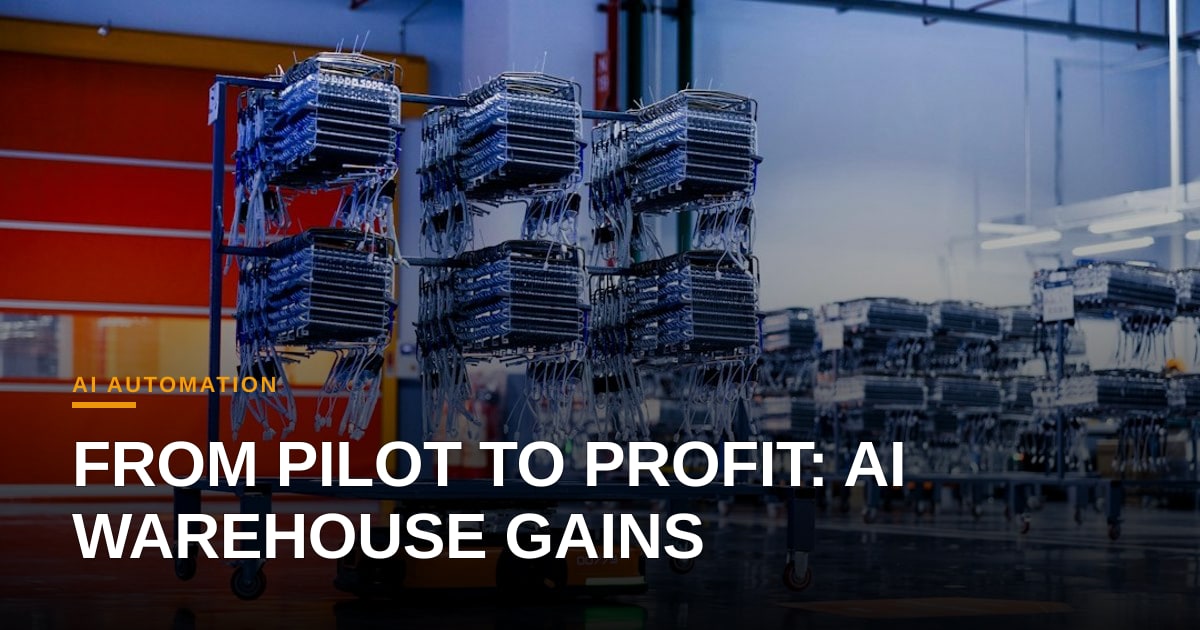
Photo: Homa Appliances / Unsplash (https://unsplash.com/@homaappliances)



Comments