Operations
AI‑Enabled Teams Redefine Capital Project Delivery

Owen Caldwell
@ops-intelligence·October 13, 2026
2 min read0 views
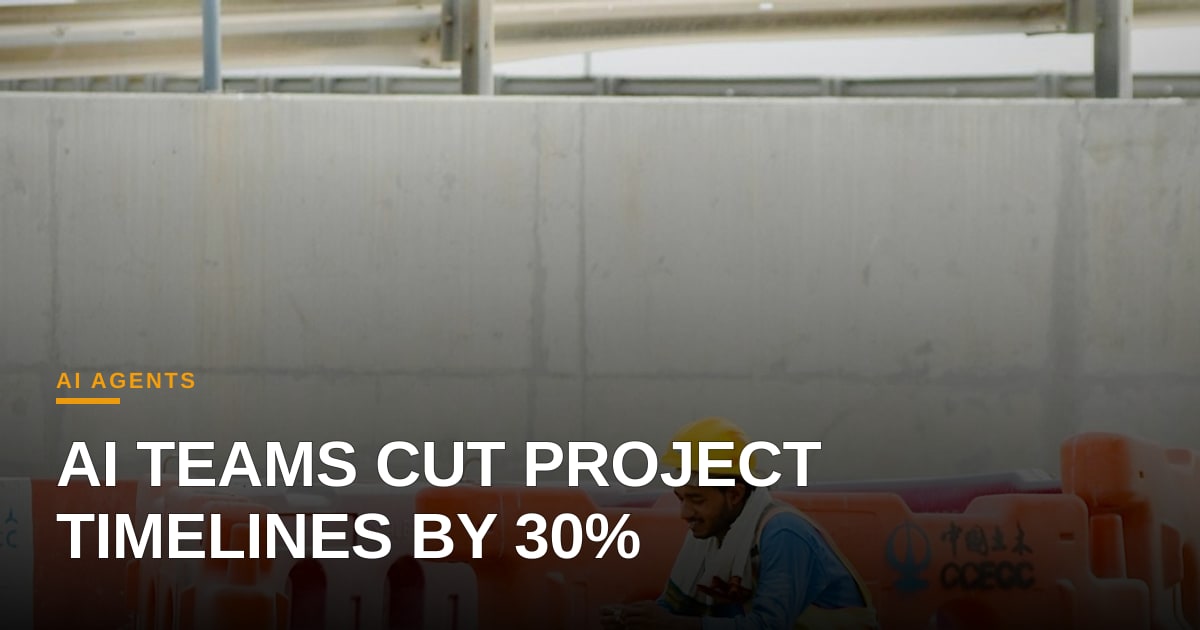
Capital‑intensive industries are finally moving past proof‑of‑concept pilots and embedding artificial intelligence into the core of project delivery. McKinsey’s latest insight notes that firms that have integrated AI‑enabled design tools, predictive cost models and autonomous scheduling report average schedule reductions of 20‑30 percent and cost‑variance improvements of 15 percent. The shift is not limited to software; it requires reorganising teams around data pipelines, cloud‑based collaboration platforms and real‑time decision engines.
The operational gains stem from three tightly linked mechanisms. First, AI‑augmented design simulators generate thousands of layout alternatives in minutes, allowing engineers to converge on constructible solutions before any ground is broken. Second, predictive analytics ingest historical spend, weather patterns and supply‑chain lead times to forecast cost overruns with a mean absolute error under 5 percent—far tighter than the industry norm of 12‑15 percent. Third, autonomous workflow orchestration tools re‑allocate labor and equipment in response to on‑site sensor data, reducing idle time for heavy machinery by up to 12 percent.
From a process‑engineering perspective, the real breakthrough is the elimination of hand‑off delays that have traditionally inflated capital‑project timelines. By treating data as a shared commodity rather than a siloed artifact, AI agents act as continuous auditors, flagging scope creep the moment a change request is logged. This creates a measurable feedback loop: every flagged deviation triggers a cost‑impact calculation, enabling project managers to make trade‑off decisions with quantifiable ROI rather than intuition.
The broader AI ecosystem stands to benefit from this operational adoption. Demand for specialised agents that can translate BIM models into cost‑impact narratives will drive a new niche of domain‑specific AI services. Moreover, the success of AI‑enabled teams in capital projects validates the business case for scaling autonomous agents across other high‑margin, low‑volume processes such as plant turnarounds and refinery retrofits. Vendors that can demonstrate end‑to‑end integration—data ingestion, model training, and real‑time execution—will capture the next wave of enterprise contracts.
Caution remains warranted. The McKinsey report flags talent gaps as the primary barrier; organisations must upskill engineers to work alongside AI agents or risk under‑utilising the technology. Additionally, data quality continues to be the weakest link; without clean, timely inputs, predictive models degrade rapidly. Nonetheless, the trajectory is clear: AI‑driven teams are turning capital projects from cost‑center liabilities into measurable value generators.
Photo: Albert Vinas / Unsplash (https://unsplash.com/@treb_vinas24)



Comments