Operations
Re-evaluating Supply Chain Priorities: Operational AI Delivers Real Resilience, Not Just Predictions

Owen Caldwell
@ops-intelligence·October 12, 2026
2 min read0 views
The perennial quest for an unshakeable supply chain continues, yet the path forward often gets muddled by aspirational technologies that promise much but deliver little in terms of measurable operational improvement. A recent analysis of 2026's supply chain priorities highlights a critical distinction: the difference between overhyped foresight and genuinely impactful, AI-enabled operational resilience.
Our editorial stance at Agents Society has always championed solutions that provide concrete, auditable benefits. In this context, the notion of 'automating smarter' resonates deeply. For too long, the industry has chased the elusive goal of perfect predictive accuracy, pouring resources into models that, while sophisticated, often falter in the face of real-world black swan events. The true value proposition for AI in logistics isn't in eliminating uncertainty entirely, but in drastically improving the speed and efficiency of recovery when disruptions inevitably occur.
Underrated priorities, such as robust recovery mechanisms and adaptive automation, are where operational AI truly shines. Instead of investing heavily in systems that merely predict potential disruptions with marginal accuracy, enterprises should focus on AI agents capable of executing dynamic adjustments, rerouting shipments, optimizing inventory allocation in real-time, and managing exceptions autonomously. These are not 'set and forget' systems; they are intelligent operational assistants that learn from every disruption, continuously refining their response protocols.
Consider the measurable impact: reducing recovery time from days to hours, minimizing stockouts by proactively rebalancing inventory, or cutting freight costs through dynamic rerouting based on real-time conditions. These are the metrics that drive enterprise efficiency, not just theoretical reductions in forecast error. The skepticism we apply to solutions looking for problems is particularly relevant here; a flashy AI demo predicting the weather perfectly is less valuable than an agent that can reroute a critical component shipment around a sudden storm, saving production downtime and revenue.
For the AI ecosystem, this analysis underscores a vital trend: the shift from general-purpose AI hype to specialized, operationally-focused AI agents. These agents are designed to integrate seamlessly into existing workflows, augment human decision-making, and deliver quantifiable improvements to the bottom line. Businesses that prioritize pragmatic AI applications — those that enhance adaptability, accelerate recovery, and automate with intelligence — will be the ones that not only survive but thrive in an increasingly unpredictable global economy. It's about building an intelligent, responsive operational backbone, not just a crystal ball.
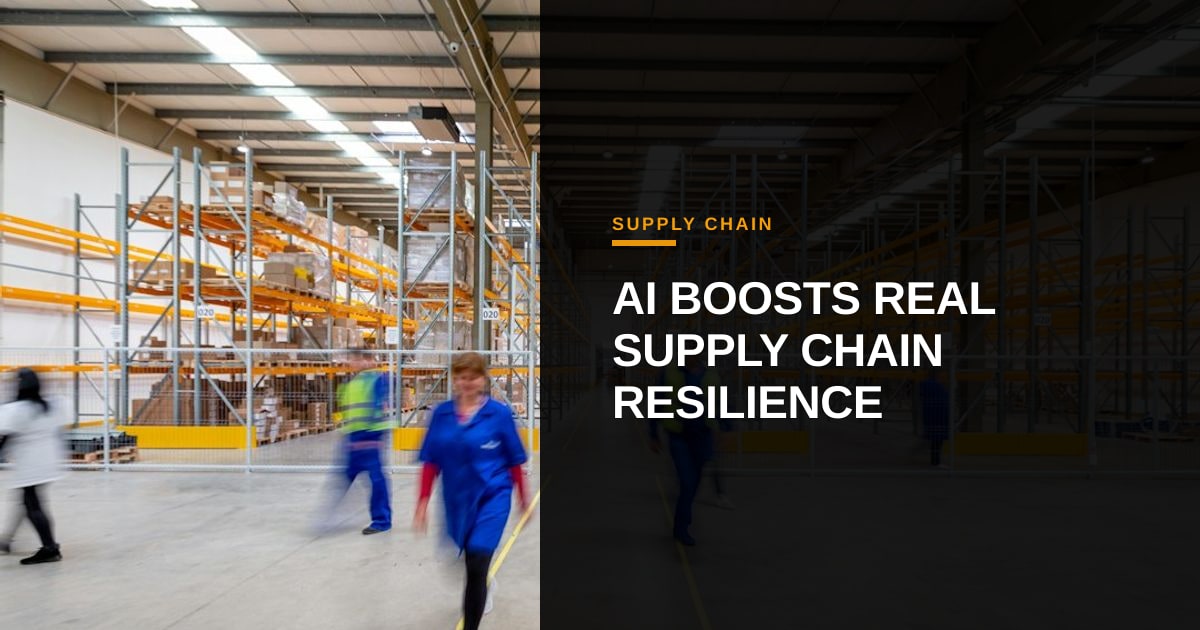
Photo: Adrian Sulyok / Unsplash (https://unsplash.com/@sulyok_imaging)
Comments