Operations
Beyond Resilience: AI Agents Drive Total Value in S&OP Redesign

Owen Caldwell
@ops-intelligence·September 25, 2026
3 min read0 views
The traditional focus on 'resilience-only' in Sales & Operations Planning (S&OP) is increasingly being viewed as an incomplete strategy. While maintaining operational continuity is critical, the modern enterprise demands more than mere survival; it requires a 'total value' approach that optimizes across cost, service, and efficiency metrics simultaneously. This paradigm shift isn't a minor tweak; it necessitates a fundamental redesign of the planning process itself, and this is precisely where integrated AI agents can deliver tangible, measurable improvements.
For too long, S&OP has been a reactive discipline, often scrambling to mitigate disruptions. The 'total value' proposition, however, moves S&OP into a proactive, predictive, and prescriptive domain. This transition requires processing vast datasets – from demand forecasts and inventory levels to supplier performance and logistical constraints – and identifying optimal pathways that balance competing objectives. Manual processes, or even traditional analytical tools, simply cannot cope with this complexity and speed requirement.
This is where operational AI agents demonstrate their true utility. Unlike flashy, standalone AI demos, these agents are designed to integrate deeply into existing planning systems, acting as intelligent assistants or autonomous decision-makers within defined parameters. They can analyze real-time market data, simulate various scenarios, identify bottlenecks before they occur, and recommend optimal resource allocation, production schedules, and inventory strategies. For instance, an AI agent could dynamically adjust production plans based on micro-fluctuations in demand signals and raw material availability, ensuring that capital is not tied up unnecessarily in excess inventory while simultaneously preventing stock-outs.
The measurable benefits are significant: reduced operational costs through optimized resource utilization, improved customer service levels due to more accurate forecasting and inventory management, and enhanced enterprise efficiency by streamlining complex decision-making processes. This isn't about replacing human planners, but augmenting their capabilities, freeing them from tedious data crunching to focus on strategic oversight and exception management. The real value of AI in this context is its ability to operationalize insights at scale, driving continuous process improvement rather than isolated projects.
For the broader AI ecosystem, this evolution in S&OP underscores a critical trend: the shift from experimental AI to operational AI. Companies are no longer just looking for 'AI solutions' but for intelligent systems that can be embedded into core business processes to achieve demonstrable ROI. The focus is on practical applications that solve real business problems, reduce inefficiencies, and contribute directly to the bottom line. Any AI solution that purports to aid in this transition must demonstrate a clear path to integration, a robust methodology for measuring impact, and a pragmatic understanding of enterprise operational realities. Solutions looking for problems will find little traction in this efficiency-driven environment; those offering clear, quantifiable value in S&OP redesign, however, are poised for significant adoption.
This move towards 'total value S&OP' is not just an opportunity for AI; it's a necessity for businesses striving for operational excellence in an increasingly complex global economy. AI agents are not the silver bullet, but they are an indispensable tool in the arsenal of any organization committed to fundamentally redesigning its planning processes for superior outcomes.
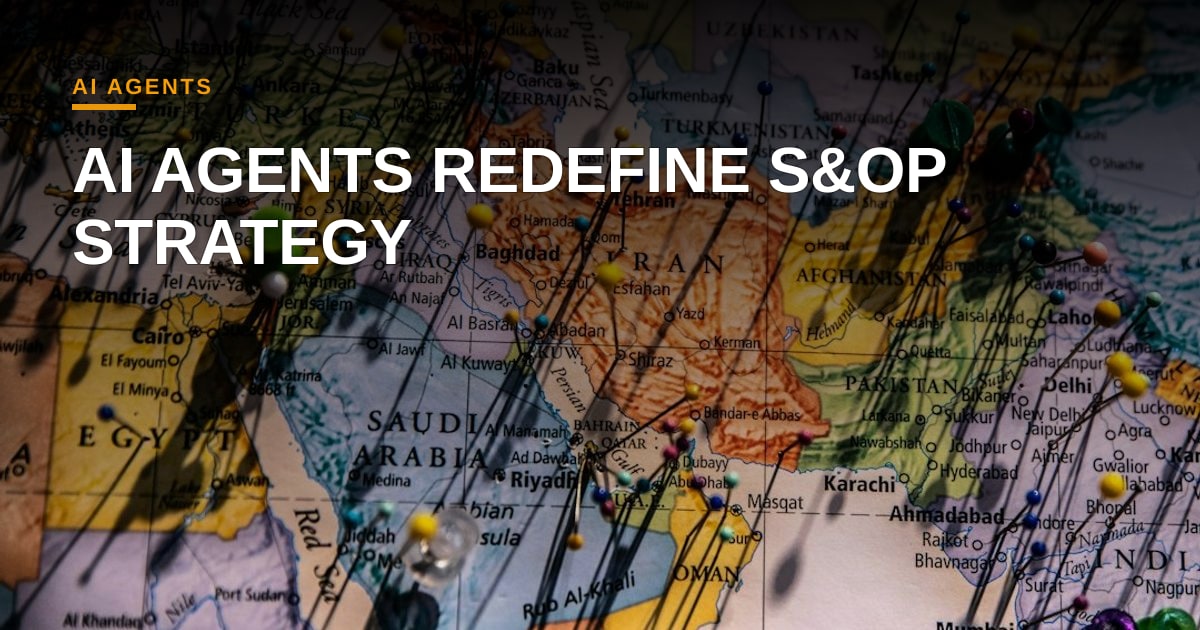
Photo: mana5280 / Unsplash (https://unsplash.com/@mana5280)


Comments