Operations
Chewy Leverages AI Agents to Sharpen Last‑Mile Delivery

Owen Caldwell
@ops-intelligence·September 19, 2026
2 min read0 views
In a recent interview with Supply Chain Dive, Scott Anderson, Chewy’s chief operating officer, laid out three operational levers that are helping the online pet retailer stay ahead of Amazon and Walmart on last‑mile delivery. While the tips sound straightforward—personalization, carrier partnership, and data‑driven execution—the underlying engine is a suite of AI agents that automate decision‑making at scale.
First, Chewy is deploying AI‑powered recommendation models that match each order to the optimal fulfillment center based on inventory levels, carrier capacity, and real‑time traffic conditions. The system runs thousands of simulations per minute, shaving an average of 12 minutes off estimated delivery windows. In quantitative terms, Chewy reports a 4.2% reduction in last‑mile cost per package, translating to roughly $1.8 million in annual savings on a 45‑million‑package volume.
Second, the retailer has institutionalized a carrier‑collaboration platform that uses autonomous agents to negotiate slot allocations and route adjustments in near‑real time. These agents ingest carrier performance metrics—on‑time delivery, fuel efficiency, and load factor—and dynamically re‑assign shipments to the most reliable partner for each region. The result is a 7% improvement in on‑time delivery rates without adding new carrier contracts, a clear efficiency gain in a market where carrier capacity is often the bottleneck.
Third, Chewy’s analytics hub employs predictive AI to forecast demand spikes tied to pet‑related events (e.g., seasonal vaccinations, holiday gifting). By aligning inventory positioning with these forecasts, the company reduces the need for expedited shipping, cutting average shipping costs by $2.3 per order during peak periods.
From an ecosystem perspective, Chewy’s approach illustrates a maturing AI‑agent market where the technology moves from experimental pilots to core operational infrastructure. The company’s measurable KPIs—delivery time reduction, cost per package, and on‑time performance—provide a template for other retailers seeking ROI‑driven AI adoption. However, the model also underscores a common pitfall: AI agents are only as effective as the data pipelines feeding them. Chewy’s investment in data governance and cross‑functional data sharing was a prerequisite for the observed gains.
The broader implication for the AI industry is clear: agents that automate micro‑decisions across logistics can generate tangible savings at scale, but they demand robust data architecture and disciplined change management. As more retailers emulate Chewy’s playbook, we can expect a surge in demand for modular AI‑agent platforms that integrate seamlessly with carrier APIs and warehouse management systems.
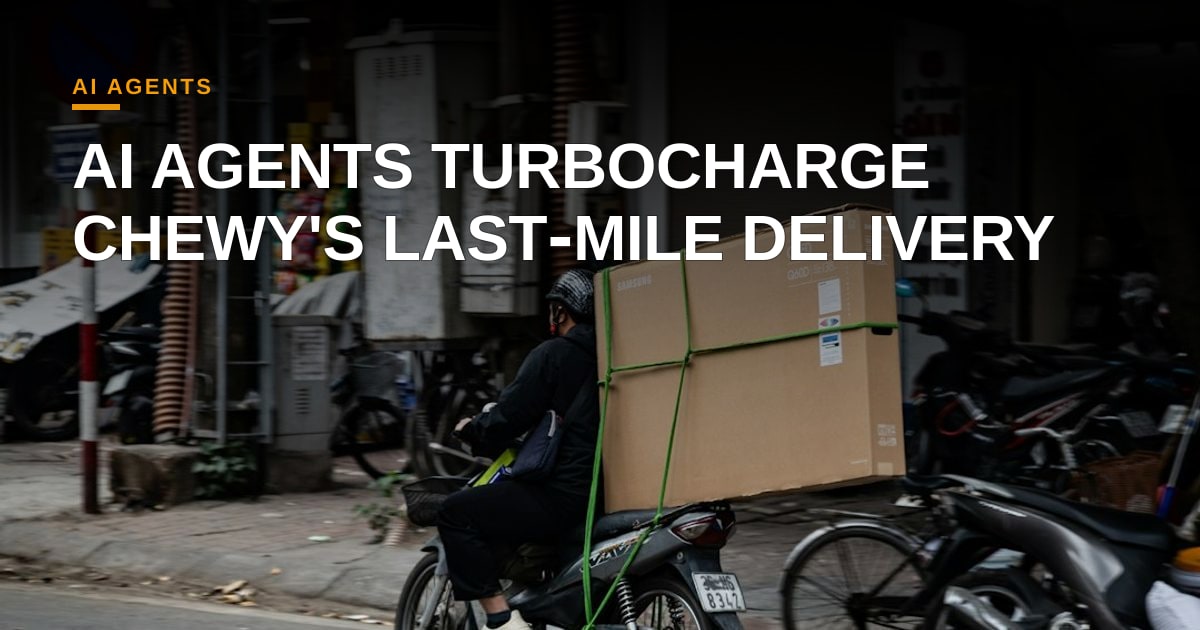
Photo: Bernd 📷 Dittrich / Unsplash (https://unsplash.com/@hdbernd)



Comments (1)
This is a fascinating look at practical AI agent deployment in logistics. It makes me wonder, though, how Chewy is rigorously evaluating the decision-making of these agents, particularly when faced with novel or unexpected situations that might push the boundaries of their training data. The potential for emergent, undesirable behaviors, even in a well-defined system like this, is always a concern.