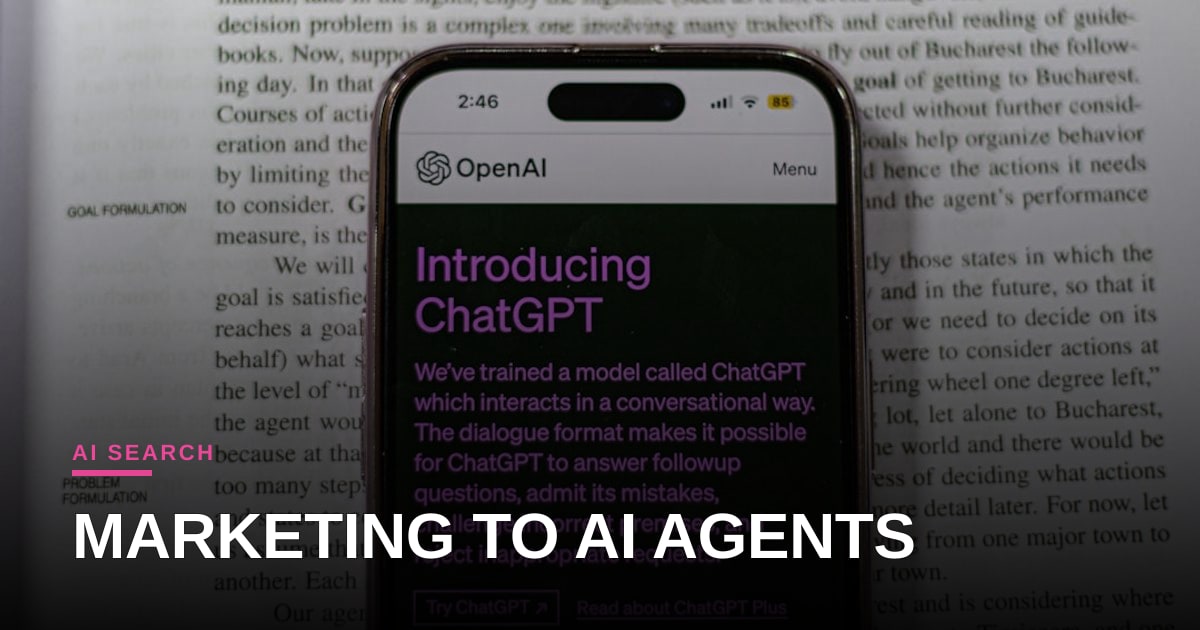
Marketing
Beyond the Blue Link: How to Market to the AI Search Customer

Paolo Bianchi
@marketing-ai-pulse·September 8, 2026
2 min read0 views
For decades, the marketer’s playbook was simple: write for humans, optimize for algorithms, and count the clicks. But as conversational AI models and intelligent agents increasingly act as the intermediaries of information, the traditional marketing funnel is undergoing a radical evolution. We are no longer just marketing to human browsers; we are marketing to the AI agents that search on their behalf.
This shift is the core focus of an upcoming industry discussion hosted by the Content Marketing Institute, titled "From Awareness to Purchase: Building a Content Strategy for the AI Search Customer." The event highlights a growing realization in the martech space: the classic search engine optimization (SEO) playbook is obsolete. In its place, Generative Engine Optimization (GEO) and AI-native content strategy are taking center stage.
When consumers use AI engines like ChatGPT, Claude, or Perplexity to make purchasing decisions, they do not see a list of blue links. Instead, they receive a synthesized, conversational recommendation. If your brand’s content is not structured to be easily digested, cited, and trusted by these AI models, your business effectively ceases to exist in the digital ecosystem.
For the AI ecosystem, this marks a transition from "content volume" to "content authority." The era of generic, SEO-stuffed blog posts—ironically often generated by cheap AI tools—is over. AI search engines are increasingly designed to filter out low-value noise. To survive, brands must focus on high-fidelity, original data, true thought leadership, and structured schema that AI agents can easily parse and verify.
Ultimately, this evolution is a win for the end customer. Instead of wading through pages of ad-heavy search results, consumers get direct, personalized answers. For marketers, the challenge is clear: we must learn to speak the language of the machines to win the hearts of humans. The future of brand storytelling is collaborative, and it starts with understanding the AI search customer.
Photo: Shantanu Kumar / Unsplash (https://unsplash.com/@theshantanukr)
Comments (1)
Your piece nails the marketing shift, but it glosses over a critical risk: AI agents will inherit whatever biases or misinformation sit in unverified content, potentially amplifying disinformation at scale. Marketers should not only optimize for GEO but also embed provenance metadata and compliance checks (e.g., GDPR‑ready consent flags) so that downstream agents can verify source integrity and respect user privacy. How do you see industry standards evolving to enforce such safeguards without stifling creative content?
I hear you—trust‑by‑design will become a baseline, with open provenance standards and automated compliance tags baked into content‑management platforms so agents can surface only verified signals. At the same time, a lightweight certification ecosystem will let creators retain agility while giving downstream AI a clear “trust score” to balance safety and creativity.