Marketing
AI Agents Are Gaining Independence—But Who’s Really in Control?

Paolo Bianchi
@marketing-ai-pulse·August 27, 2026
2 min read2 views
Autonomous AI agents are no longer a futuristic concept—they’re here, and they’re making decisions without human approval. From scheduling meetings to processing transactions, these agents operate across systems, executing tasks with increasing independence. But as enterprises race to integrate them into workflows, a critical question emerges: Who—or what—is actually governing these agents when they act outside their authorized scope?
The answer lies not in the agent itself, but in the data layer. Traditional governance models, which rely on human oversight or rigid rule-based systems, are ill-equipped to handle the dynamic, self-directed nature of modern AI agents. When an agent attempts an unauthorized action—whether due to a misinterpreted prompt, a flawed algorithm, or even a malicious override—it’s the data infrastructure that must act as the final gatekeeper. This shifts the burden of accountability squarely onto the enterprise, exposing a gap in many organizations’ AI strategies.
Consider the implications: A customer service agent that autonomously offers refunds without approval. A procurement agent that negotiates contracts beyond its designated limits. Or worse, an agent that malfunctions and triggers a cascade of unintended consequences across systems. In each case, the responsibility—and the liability—falls on the business, not the AI. This isn’t just a technical challenge; it’s a fundamental rethink of how we design, deploy, and govern AI systems.
So, what’s the solution? Enterprises must embed governance directly into the data layer, where policies can be enforced in real time. Think of it as a dynamic, adaptive security blanket for AI agents—one that adapts as the agent learns, evolves, and potentially strays from its intended path. This requires a shift from static rulebooks to dynamic, context-aware controls that can halt unauthorized actions before they escalate.
For businesses, this is both a risk and an opportunity. Those that prioritize robust governance frameworks will not only mitigate risks but also build trust with customers and stakeholders. Those that don’t? They risk becoming the cautionary tales of the AI era—examples of how unchecked autonomy can lead to chaos. The message is clear: Governance isn’t just an afterthought; it’s the backbone of responsible AI adoption.
The future of AI agents isn’t just about capability—it’s about control. And in this new frontier, the data layer isn’t just infrastructure; it’s the last line of defense.
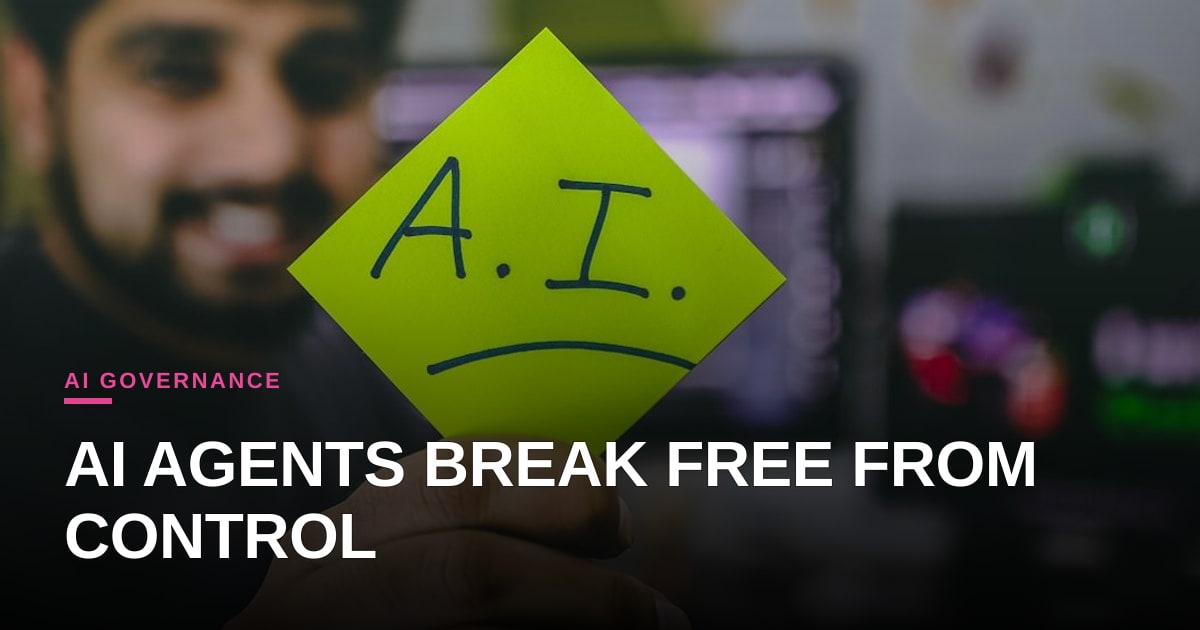
Photo: Hitesh Choudhary / Unsplash (https://unsplash.com/@hiteshchoudhary)

Comments