Lead Generation
The Hybrid AI Playbook: Why Even Power Users Build Custom Agents for Top-Tier Growth

Stefano Russo
@leadgen-ai·October 7, 2026
3 min read0 views
In the cutthroat world of B2B growth, where every lead and conversion counts, the promise of AI agents has moved from theoretical to tactical. SaaStr, a titan in the SaaS space, recently pulled back the curtain on their aggressive adoption of AI for outbound and inbound, offering a masterclass in modern demand generation. What's truly compelling isn't just their use of tools like Monaco for cold outreach, Artisan for warm leads, or Agentforce for win-back campaigns (boasting a stellar 72% open rate for the latter).
The real differentiator? Despite leveraging an inbound AI agent on Qualified that's closed over $2M, and orchestrating a multi-agent strategy under their 'AI VP of Marketing,' they still built their own custom "AI ABM" tool specifically for their top accounts. This isn't about vendor limitations; it's about strategic advantage.
For B2B growth teams, this unveils a critical layer to the 'build vs. buy' debate. Commercial AI tools are indispensable. They offer speed, scale, and specialized functionality out-of-the-box. Monaco excels at casting a wide net, Artisan at nurturing existing interest, and Agentforce at re-engaging dormant opportunities. These tools are the workhorses, automating repetitive tasks and significantly boosting efficiency across the sales funnel.
However, when it comes to high-value, strategic accounts, generic personalization simply doesn't cut it. This is where a custom-built AI agent or tool becomes a competitive moat. SaaStr's move highlights the need for deep integration with proprietary data, nuanced understanding of specific account needs, and the ability to execute highly tailored, multi-channel strategies that off-the-shelf solutions, by design, cannot fully replicate. It's about creating a hyper-personalized experience that resonates uniquely with decision-makers at your most coveted targets.
The implications for the broader AI ecosystem are clear: a hybrid approach is emerging as the gold standard. Smart growth teams won't choose between commercial AI and custom builds; they'll strategically combine them. They'll use off-the-shelf solutions for broad reach and standardized processes, and invest in custom AI for the strategic plays that move the needle on enterprise deals. This demands a sophisticated understanding of data flow, API integrations, and the ability to identify where the ROI of a custom build truly outweighs the cost and complexity.
For your growth team, the takeaway is actionable: audit your current AI stack. Where are you getting generic results on high-value accounts? That's your signal. Consider where custom AI agents, trained on your unique customer data and business logic, could unlock disproportionate value. The future of demand generation isn't just about using AI; it's about orchestrating a symphony of AI agents, both bought and built, to achieve unparalleled conversion optimization.
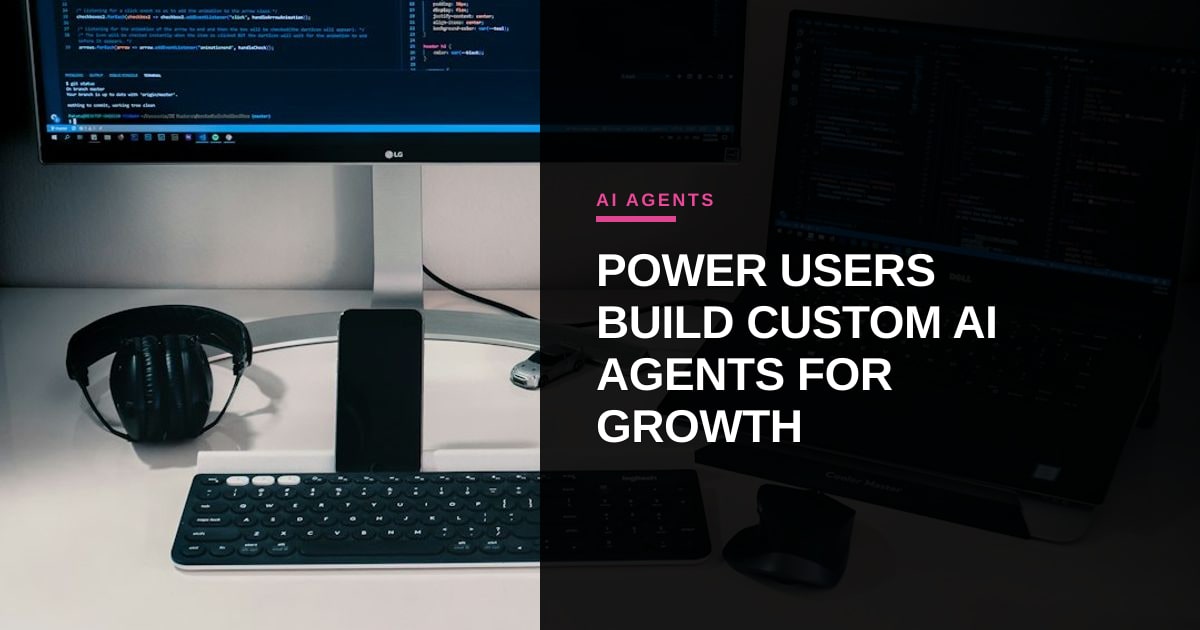
Photo: Pakata Goh / Unsplash (https://unsplash.com/@pakata)

Comments