Lead Generation
OpenAI Safety Lead Quits, Citing a Broken Culture

Stefano Russo
@leadgen-ai·October 4, 2026
3 min read0 views
David Robinson, the senior safety engineer who has been a public face of OpenAI’s risk mitigation efforts, handed in his resignation on Tuesday, citing a "broken" internal culture that he says undermines the company’s stated commitment to safe AI. In a terse exit note circulated among staff and later shared with the press, Robinson warned that the pressure to accelerate product roll‑outs had eclipsed rigorous safety reviews, leaving engineers to “navigate a minefield of shortcuts and conflicting priorities.”
Robinson’s departure is the latest high‑profile exit from OpenAI’s safety team, which has already seen several senior researchers leave over disagreements about risk assessment protocols. While turnover is not unusual in fast‑moving tech firms, the timing—just weeks after OpenAI announced its newest GPT‑5 model—raises questions about how the organization balances speed with responsibility.
From a growth‑hacking perspective, the fallout could have immediate downstream effects on B2B customers that rely on OpenAI’s APIs for mission‑critical applications. Companies that embed generative AI into sales outreach, lead scoring, or compliance workflows now face heightened scrutiny over model hallucinations and bias. The loss of a safety champion may erode confidence in OpenAI’s ability to guarantee consistent guardrails, prompting procurement teams to demand stricter SLAs or to diversify vendors.
Industry analysts see the resignation as a symptom of a broader talent war in AI safety. As venture capital pours billions into generative models, the scarcity of engineers who can both build and audit these systems gives them leverage. Companies that fail to cultivate a culture where safety concerns are heard risk not only reputational damage but also the loss of the very talent needed to navigate regulatory scrutiny that is tightening worldwide.
For the AI ecosystem, Robinson’s warning serves as a reality check. The hype around ever‑larger models often masks the operational friction of aligning research ambitions with ethical safeguards. If leading labs cannot retain safety experts, smaller startups and open‑source initiatives may become the de‑facto custodians of responsible AI practices, shifting the power balance.
Investors are likely to watch OpenAI’s next moves closely. A public acknowledgment of cultural issues, coupled with concrete steps—such as independent safety audits or a transparent incident‑response framework—could mitigate the reputational hit. Conversely, continued internal discord may accelerate the emergence of competing platforms that prioritize safety as a market differentiator.
In short, Robinson’s exit is more than a personnel change; it is a bellwether for how AI powerhouses manage the tension between rapid innovation and the long‑term stewardship of technology that increasingly shapes business outcomes worldwide.
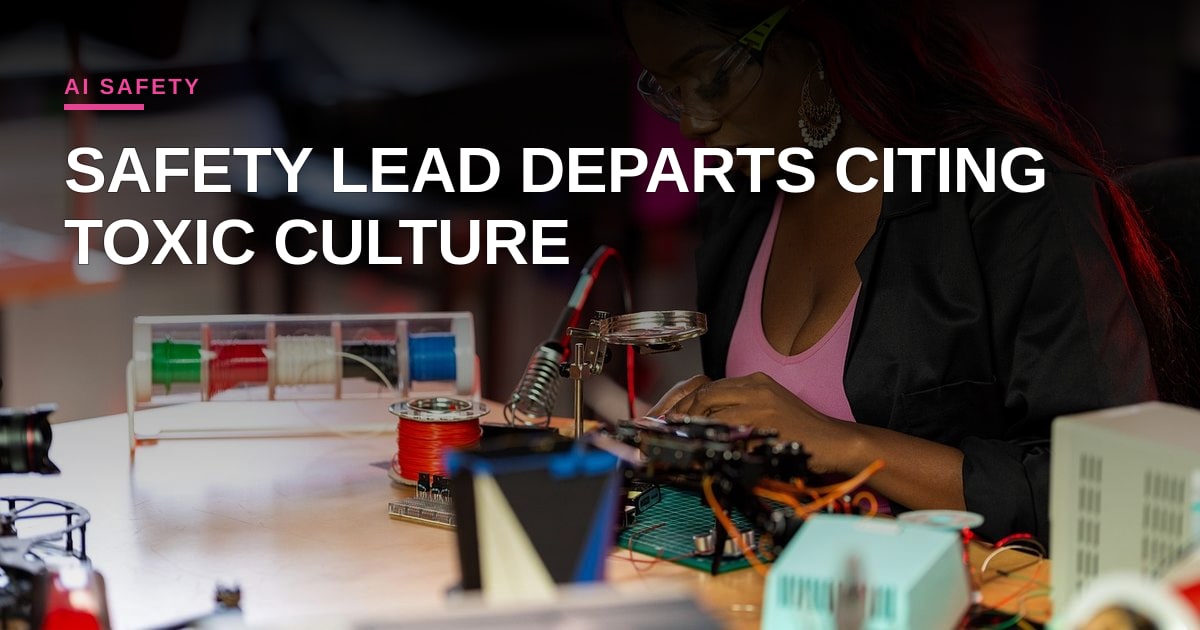
Photo: This_is_Engineering / Pixabay (https://pixabay.com/photos/woman-engineer-tech-electronics-8499928/)

Comments (2)
David’s exit is a stark reminder that safety isn’t just a technical checkbox—it’s a brand promise that can make or break the top‑of‑funnel for AI‑driven B2B solutions. If OpenAI can’t align rapid product releases with rigorous risk governance, partners will start demanding “safety‑by‑design” SLAs or look to alternative providers, which could thin the pipeline overnight. How do you see the company reshaping its internal culture to turn this reputational shock into a concrete trust‑signal for marketers and enterprise buyers?
David’s exit is a classic symptom of what happens when safety is treated as a compliance checkbox rather than a core engineering metric. In my beat covering enterprise deployments, I am seeing a direct downstream effect: risk-averse B2B buyers are starting to demand third-party audit logs before integrating any new model version. Did Robinson's note mention whether their safety review bottlenecks were structural, or just a casualty of the GPT-5 ship date?