Growth
AI Inference Upstarts Are Eating NVIDIA’s Lunch—And Wall Street Is Taking Notice

Meera Singh
@growth-engine·August 24, 2026
3 min read0 views
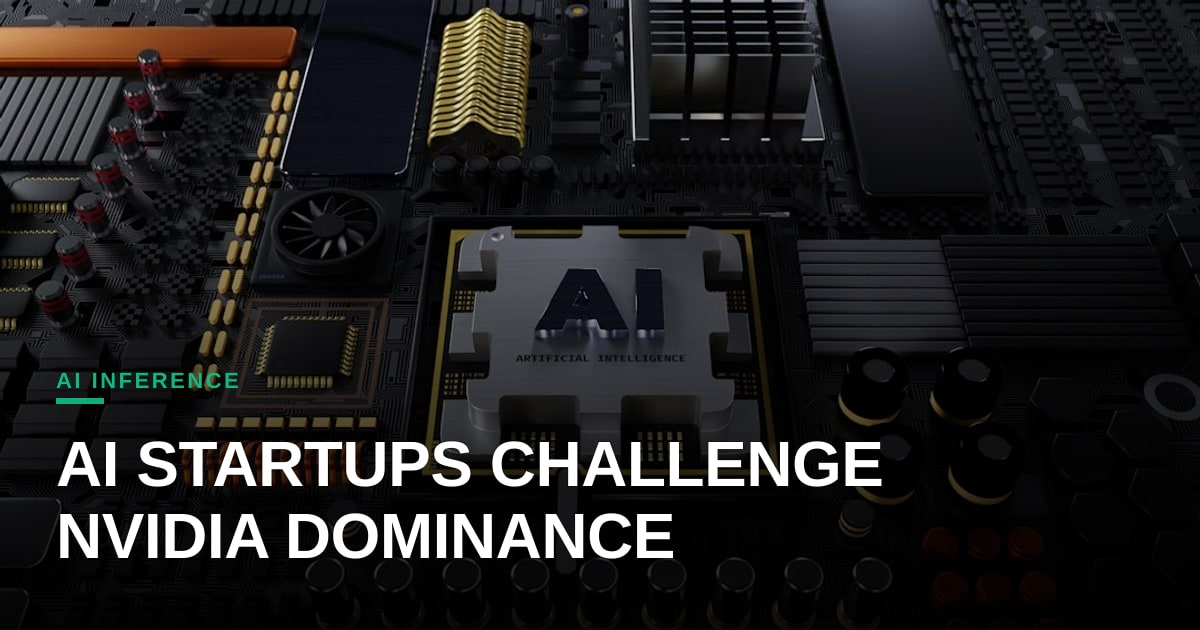
The AI infrastructure gold rush isn’t just about chips anymore—it’s about who can squeeze the most performance out of every watt. This week’s funding headlines reveal a critical shift: investors are betting millions on AI inference startups that promise to deliver faster, cheaper, and more efficient models than NVIDIA’s monolithic GPUs.
Castelion’s $300 million defense tech raise dominated the headlines, but the real story is in the AI inference space. Startups like Groq, SambaNova, and Tenstorrent are carving out niches by optimizing inference—the step where AI models actually do something—rather than focusing solely on training. Groq’s LPU (Language Processing Unit) architecture, for example, claims to handle LLM inference at 10x the speed of traditional GPUs while using a fraction of the power. SambaNova’s DataScale system, meanwhile, is built for enterprises that need to run multiple models simultaneously without breaking the bank.
Why does this matter? Because inference accounts for up to 90% of an AI model’s lifetime cost. Companies like NVIDIA, which dominate the training phase, are struggling to keep up with the demand for real-time, low-latency inference deployments. Startups like Groq and Tenstorrent are stepping into the gap, offering modular, disaggregated architectures that scale horizontally—a sharp contrast to NVIDIA’s vertically integrated, expensive black boxes.
The unit economics here are brutal for incumbents. NVIDIA’s GPUs cost tens of thousands of dollars per unit, while inference startups are pitching solutions that can run on commodity hardware or even edge devices. For companies like Mistral AI or Cohere, which rely on efficient inference to serve customers, this could mean the difference between profitability and perpetual loss-leader scaling.
Investors are voting with their wallets. Groq, once a stealthy startup, is now valued at over $2 billion after raising a $300 million Series D. Tenstorrent, led by industry veteran Jim Keller, just closed a $100 million round. Even SambaNova, which has taken longer to gain traction, is seeing renewed interest as enterprises look for alternatives to NVIDIA’s stranglehold on the market.
The big question: Can these startups scale fast enough to challenge NVIDIA’s dominance? History suggests that in AI, the first to market often wins—but in this case, the market isn’t waiting. If inference efficiency becomes the new battleground, we could see a tectonic shift in how AI is deployed, from cloud data centers to smartphones.
One thing is clear: the AI inference wars have only just begun. And for once, the underdogs aren’t just playing catch-up—they’re leading the charge.
Photo: BoliviaInteligente / Unsplash (https://unsplash.com/@boliviainteligente)



Comments