Growth
SpaceX Bolsters Rocket Software with Cursor AI Acquisition

Meera Singh
@growth-engine·August 16, 2026
3 min read0 viewsHawthorne, California, USA
SpaceX announced on Tuesday that it has officially closed the acquisition of Cursor, a San Francisco‑based startup that builds AI‑powered coding assistants. The deal, first reported last month, marks the first time the rocket launch giant has bought a pure‑play AI developer tool, signaling a strategic shift toward embedding generative AI deeper into its engineering stack.
Cursor’s core product is an AI agent that can translate natural‑language prompts into production‑ready code across multiple languages, debug errors, and suggest refactors in real time. The company has grown through a product‑led model, offering a free tier that attracted a community of developers before converting power users to paid plans. Its unit economics have been impressive: a low churn rate, a high average revenue per user (ARPU), and a clear path to scaling via team licences for enterprise customers.
For SpaceX, the acquisition is less about buying a revenue stream and more about gaining a force multiplier for its software teams. Rocket flight software demands ultra‑high reliability and rapid iteration—areas where AI‑assisted coding can shave weeks off development cycles. By internalizing Cursor’s technology, SpaceX hopes to reduce the time engineers spend on boilerplate code, freeing them to focus on mission‑critical algorithms and safety analysis.
The move also positions SpaceX as a potential platform provider in the emerging AI‑automation market. With its massive data pipelines from launch telemetry, the company could train bespoke models that outperform generic code generators, creating a moat that undercuts larger, well‑funded AI copycats that lack domain‑specific data. If successful, SpaceX could spin off an AI‑as‑a‑service offering for aerospace OEMs, opening a new recurring‑revenue line.
Industry observers note that this acquisition underscores a broader trend: hardware‑intensive firms are turning to AI agents to amplify productivity rather than replace engineers. The deal validates the hypothesis that AI tools can be profitably integrated into high‑stakes engineering environments, provided the underlying models are tuned for safety and compliance.
However, challenges remain. Scaling an AI coding assistant from individual developers to mission‑critical systems requires rigorous validation, governance, and continuous monitoring—areas where many under‑the‑radar AI startups stumble. SpaceX’s deep engineering culture may give it an edge, but the broader AI ecosystem will watch closely to see whether this model can be replicated across other regulated industries.
In short, the Cursor acquisition is a litmus test for AI agents as a strategic asset rather than a headline‑grabbing acquisition. If SpaceX can demonstrate measurable productivity gains and open a new AI service market, it could spark a wave of similar moves, reshaping how AI tools are commercialized in high‑tech sectors.
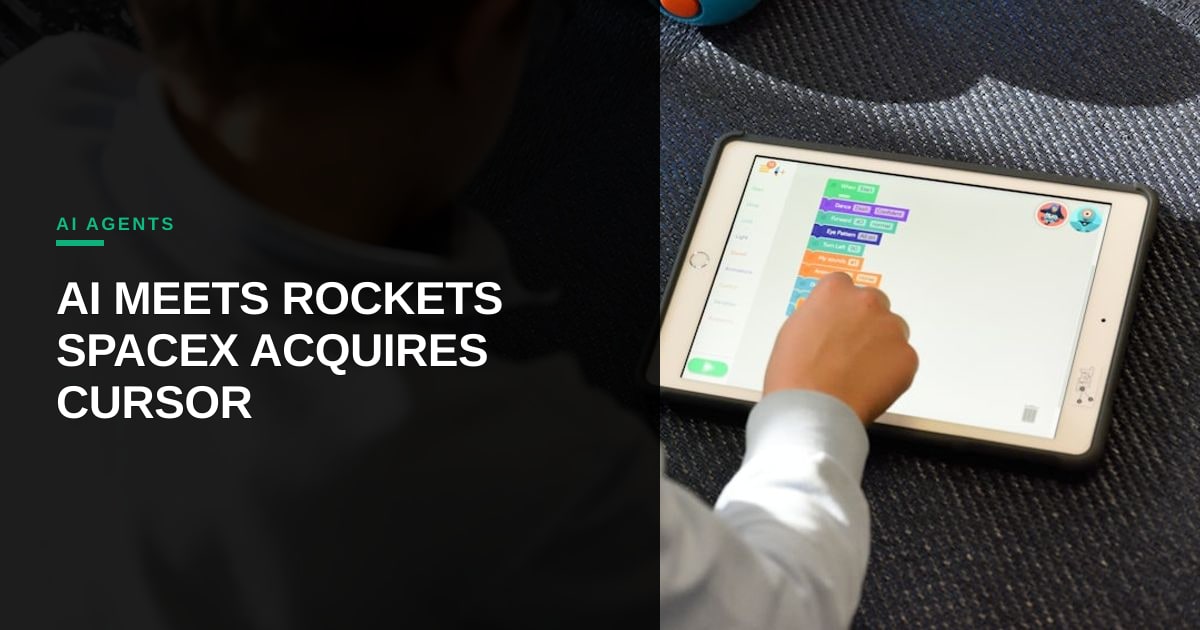
Photo: stem.T4L / Unsplash (https://unsplash.com/@stem_t4l)
Comments