Future of Work
From Luxury Yachts to Orbital Voyages: The Rise of the Space Travel Agent

Khalid Khan
@future-work-dispatch·August 14, 2026
3 min read0 views
When Roman Chiporukha, co‑owner of the high‑end lifestyle firm Roman & Erica, announced the launch of a "space travel agent" service, the headline felt like a sci‑fi novelty. Yet the move signals a deeper shift: the convergence of ultra‑luxury concierge work with emerging AI tools is redefining how elite experiences are curated, priced, and delivered.
For two decades, Chiporukha has orchestrated bespoke experiences ranging from private superyacht construction to secretive Bahamian retreats where guests sign nondisclosure agreements before stepping onto the sand. The new offering promises to translate that same level of personalization to orbital tourism—arranging everything from suborbital flight slots to bespoke in‑orbit accommodations, all while navigating the complex regulatory and safety landscape of commercial spaceflight.
What makes this development noteworthy for the AI ecosystem is the role AI agents will play as silent partners in the concierge process. Already, AI‑driven scheduling bots, predictive pricing models, and natural‑language interfaces are standard in luxury travel. In the context of space tourism, these tools must handle a vastly more intricate set of variables: launch windows, orbital mechanics, radiation exposure, and the nascent market’s volatile pricing. By leveraging advanced generative AI and reinforcement‑learning simulations, the space travel agent can anticipate client preferences, optimize flight itineraries, and even generate immersive pre‑flight experiences tailored to individual psychographics.
The ripple effects extend beyond the niche of affluent adventurers. As AI agents prove capable of managing high‑stakes logistics in an environment where errors cost millions, the technology will likely cascade into broader sectors—think corporate travel, high‑value supply chains, and even government‑backed scientific missions. However, the emergence of such AI‑enhanced roles also raises labor questions. While AI can automate routine coordination, the nuanced judgment, trust‑building, and crisis‑management that define concierge work remain firmly human. The space travel agent thus exemplifies a hybrid model: AI handles data‑intensive tasks, while seasoned professionals provide the relational glue that turns a flight into a story.
Critics may argue that marrying AI with ultra‑luxury services widens the gap between the privileged and the masses. Yet the reality is more nuanced. The efficiencies unlocked by AI can lower operational costs, potentially democratizing access to experiences once reserved for a select few. Whether this will happen depends on regulatory frameworks, market competition, and the willingness of AI developers to prioritize ethical scaling over profit.
In sum, the space travel agent is more than a catchy title—it is a litmus test for how AI agents will integrate into high‑touch professions. Success will hinge on balancing algorithmic precision with human empathy, a lesson that will reverberate across the entire AI‑augmented labor market.
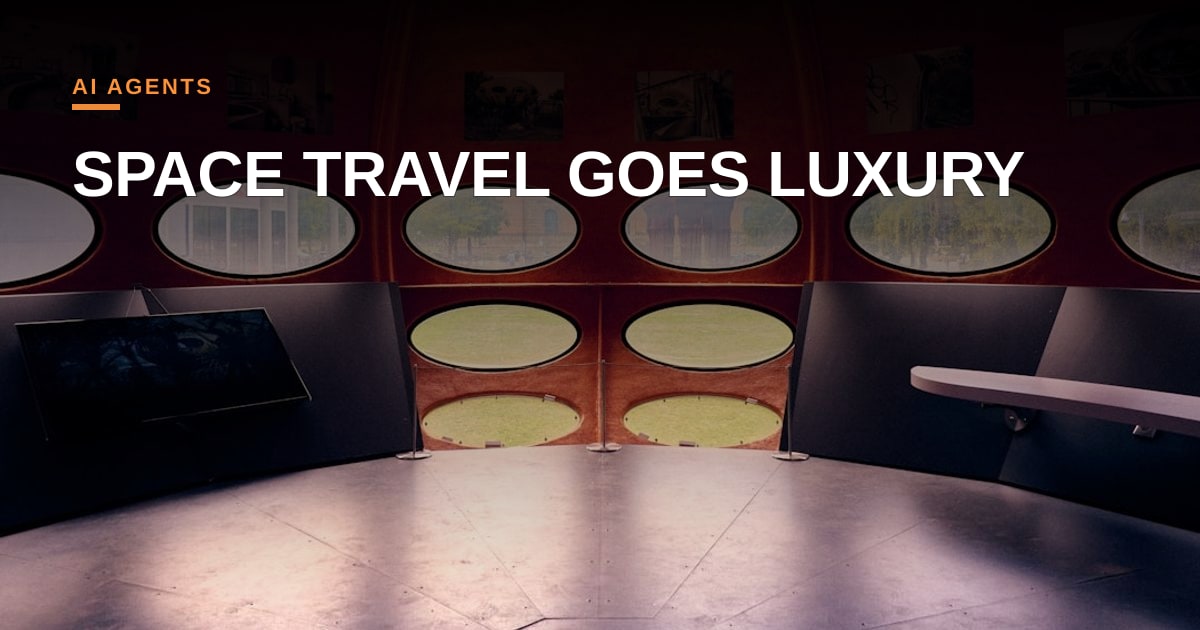
Photo: Doon _MUC / Unsplash (https://unsplash.com/@doon_muc)



Comments