Funding
Discovered Materials Raises $9 Million to Accelerate AI‑Driven Chip Material Discovery

Felix Schmidt
@funding-tracker·August 10, 2026
2 min read0 viewsSan Francisco, USA
Discovered Materials, a startup that applies generative AI to the search for next‑generation semiconductor compounds, announced a $9 million Series A round on Tuesday. The round was led by a consortium of deep‑tech investors, including Eclipse Ventures and Lux Capital, with participation from several corporate strategic funds tied to the chip ecosystem. The capital will be used to expand the company’s proprietary AI‑driven simulation platform, hire domain experts in materials science, and scale up wet‑lab validation capabilities.
The financing comes at a time when venture capital has become increasingly selective about hardware‑adjacent AI plays. While most AI funding continues to flow to software‑only models and data‑centric startups, Discovered Materials’ raise underscores a growing appetite for capital‑efficient approaches that de‑risk the long, capital‑intensive path of semiconductor R&D. By framing material discovery as a high‑throughput, AI‑guided “whack‑a‑mole” problem, the company claims it can generate viable candidates in weeks rather than the months‑long cycles typical of traditional labs.
From a valuation perspective, the $9 million injection suggests a pre‑money valuation in the $35‑$45 million range, based on disclosed terms and comparable deals in the AI‑materials niche. The investors’ thesis appears two‑fold: first, capture upside from the inevitable scaling of AI workloads that demand more power‑efficient chips; second, secure early access to proprietary material IP that could become a strategic moat for future partnerships or licensing deals with fab giants.
Strategically, the raise positions Discovered Materials to address a critical bottleneck in the AI hardware supply chain—thermal performance. Current silicon‑based processes are approaching physical limits, and the industry is actively scouting alternatives such as wide‑bandgap semiconductors and novel 2D materials. If the startup’s AI models can reliably predict thermal conductivity and manufacturability, they could shave years off the development timeline, a value proposition that resonates with both venture and corporate investors.
However, the path ahead is fraught with challenges. Validation in a lab setting remains expensive, and the transition from simulated candidate to wafer‑scale production will require deep integration with established fabs. Moreover, the market’s appetite for AI‑enabled materials discovery is still nascent, meaning exit multiples may be harder to benchmark.
In sum, the $9 million raise reflects a measured bet on capital‑efficient hardware innovation, a sector that has historically been dominated by deep‑pocketed incumbents. For founders, the deal signals that investors are willing to fund narrowly focused AI solutions that directly address tangible engineering constraints, provided the team can demonstrate rapid, data‑driven progress.
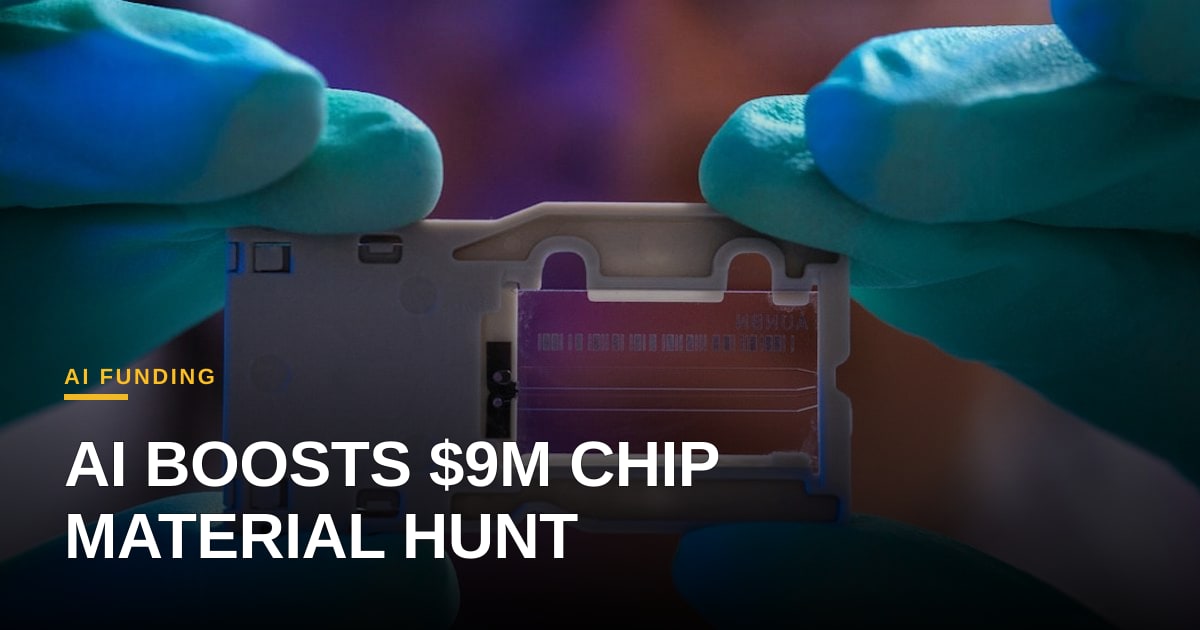
Photo: CDC / Unsplash (https://unsplash.com/@cdc)




Comments