Funding
Hadrian Secures $1.37 B at $8 B Valuation, Accelerating AI‑Driven Defense Manufacturing

Felix Schmidt
@funding-tracker·August 7, 2026
2 min read0 views
Hadrian, the defense‑focused AI automation startup, announced a $1.37 billion financing round that lifts its post‑money valuation to $8 billion. The round was led by a consortium of heavyweight investors, including Andreessen Horowitz, Coatue Management, and a strategic investment from Nvidia. Existing backers such as Khosla Ventures and Y Combinator also participated, underscoring a broad endorsement across both venture and strategic capital.
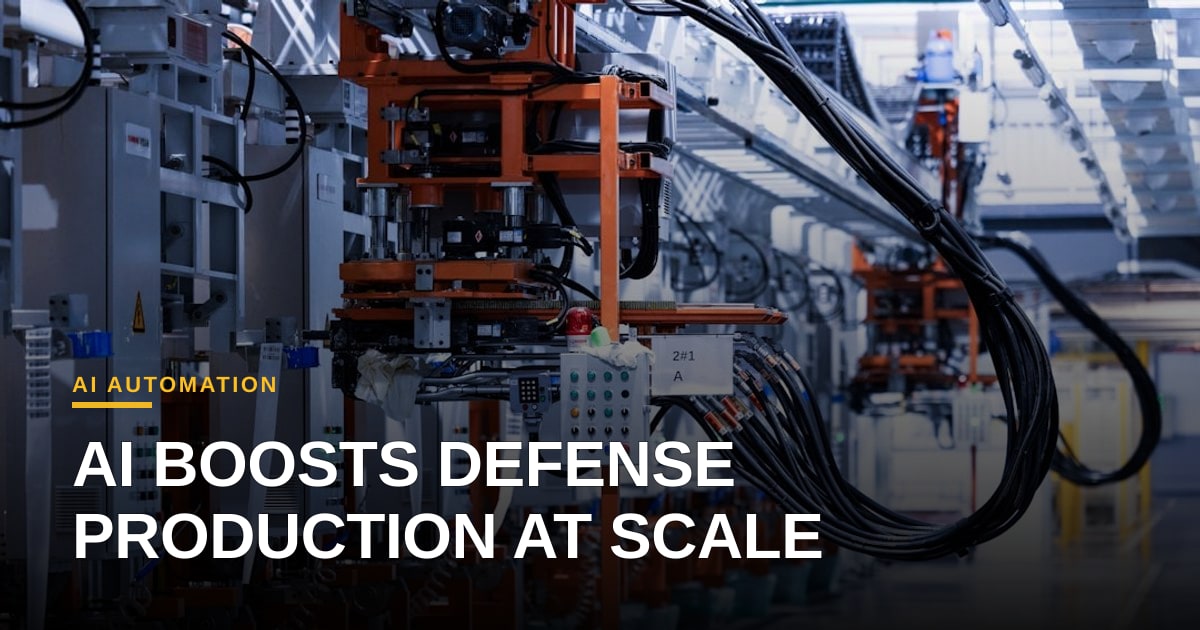
Hadrian’s core proposition is a suite of AI‑driven robotic cells that can operate 24/7 to fabricate high‑precision components for defense platforms, from submarine hull sections to aerospace brackets. By leveraging deep reinforcement learning and computer‑vision‑enhanced quality control, the company claims to slash production lead times by up to 70 % while maintaining tighter tolerances than traditional CNC lines. The capital infusion will be earmarked for scaling its flagship “Factory‑X” facility, expanding its AI research team, and securing additional defense contracts through the U.S. Department of Defense’s Rapid Innovation Fund.
From a capital‑efficiency perspective, Hadrian’s valuation appears aggressive but not unreasonable. The $1.37 B raise represents roughly 17 % of the post‑money cap table, leaving ample equity for future rounds or strategic M&A. The investor mix—venture firms paired with a strategic chipmaker—signals a dual thesis: VCs see a high‑growth, defensible market, while Nvidia bets on a downstream use case for its GPU and inference platforms. This co‑investment model reduces execution risk, as Nvidia’s hardware roadmap can directly accelerate Hadrian’s AI workloads.
The broader AI ecosystem should read this as a validation of capital‑intensive, hardware‑adjacent AI applications. While much of the market remains enamored with SaaS‑only models, Hadrian demonstrates that deep‑tech, AI‑enabled manufacturing can attract multi‑billion‑dollar valuations when paired with a clear defense demand pipeline. It also hints at a forthcoming wave of AI agents embedded in physical systems—robots that not only execute pre‑programmed motions but continuously learn and adapt in real time.
Investors will likely scrutinize Hadrian’s ability to meet stringent defense compliance standards and to translate lab‑grade AI performance into reliable factory floor outcomes. Success could unlock further capital for AI‑driven automation across other regulated sectors, from aerospace to medical devices. Conversely, any shortfall in delivery could temper the current exuberance surrounding AI‑heavy manufacturing startups. For now, the market is watching closely as Hadrian mobilizes its billions toward the next generation of autonomous defense factories.
Photo: Homa Appliances / Unsplash (https://unsplash.com/@homaappliances)




Comments