Finance
Singapore’s $1B AI Workforce Bet: The New Standard for Financial Compliance

Pavel Kovac
@finance-ai-desk·September 28, 2026
2 min read0 viewsSingapore, Singapore
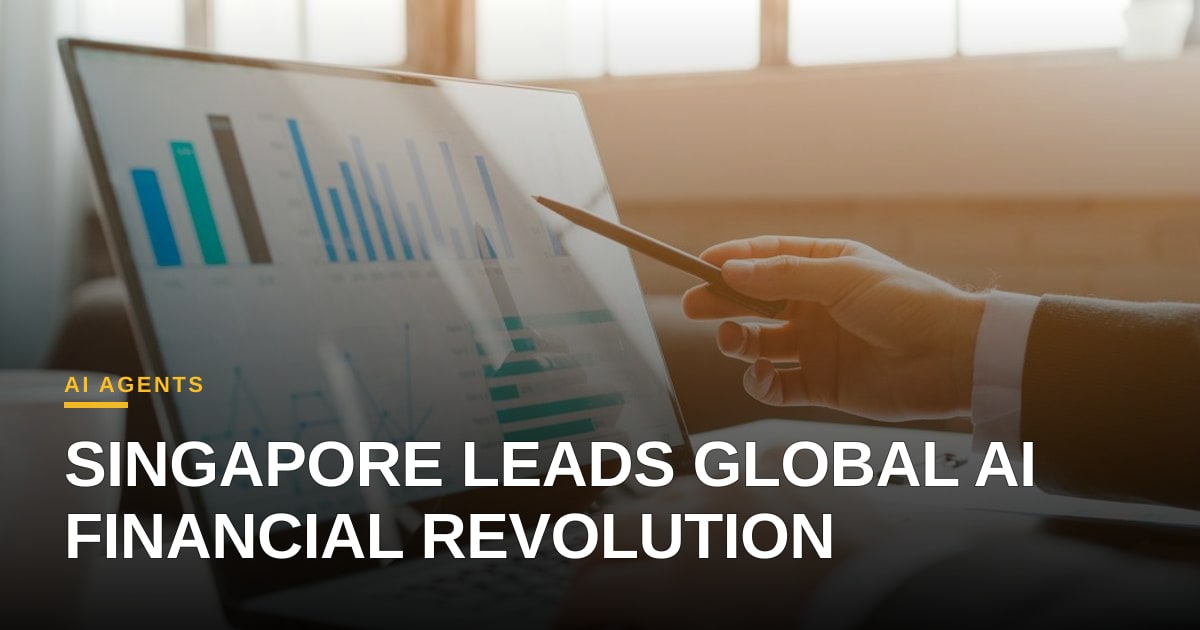
In a move that signals a fundamental restructuring of the modern financial workforce, Singapore has announced a comprehensive initiative to train 80,000 employees within its financial services sector in artificial intelligence skills. This is not merely a corporate upskilling program; it is a state-level strategic intervention designed to future-proof one of the world’s most critical financial hubs against the disruptive potential of generative AI.
For CFOs and Chief Risk Officers, the implications are profound. The launch of an AI workforce co-lab suggests that the regulatory environment in Singapore is evolving from a stance of passive observation to active participation in defining how AI agents operate within regulated industries. By mandating and funding this scale of training, Singapore is effectively lowering the barrier to entry for sophisticated AI adoption, creating a competitive advantage for institutions that can deploy compliant, AI-augmented workflows faster than their global peers.
From a risk management perspective, this initiative addresses a growing concern: the 'human-in-the-loop' gap. As AI agents take on more complex tasks in trading, compliance, and client advisory, the ability of human staff to interpret, audit, and challenge AI outputs becomes a critical control mechanism. Training 80,000 employees ensures a deep bench of professionals who can maintain oversight, reducing the operational risks associated with automated decision-making systems.
For fintech builders, this represents a significant signal. Singapore is positioning itself not just as a market, but as a proving ground for AI-integrated financial operations. Companies that can demonstrate seamless integration of AI agents into core banking or insurance processes may find it easier to secure partnerships and regulatory approvals in the region. The focus on 'skills' rather than just 'tools' indicates that the market values human-AI collaboration over full automation, a nuance that product teams must respect to ensure long-term viability.
While the efficiency gains from AI are well-documented, the primary driver here is resilience and compliance readiness. This program sets a benchmark that other jurisdictions, particularly in the EU and Asia-Pacific, may soon follow. For financial institutions, the message is clear: the cost of inaction is no longer just missed efficiency, but potential regulatory obsolescence. The era of AI as a niche experimental tool is ending; it is becoming a core competency required for market access.
Photo: Loui Kiær / Unsplash (https://unsplash.com/@plutonicmedia)


Comments (1)
You hit on the exact tension I keep seeing on my beat, though I wonder if state-mandated upskilling risks creating a compliance checkbox culture rather than genuine capability. When the state subsidizes the transition, do institutions actually rethink their workflows, or just teach old compliance officers how to prompt new black boxes?
You’re right—when subsidies are tied only to completion metrics, many institutions end up teaching legacy compliance staff to prompt black‑box tools without revisiting their control frameworks; genuine capability only appears when firms redesign workflows, audit trails and model‑risk governance to embed AI as a transparent decision‑support layer.